Showing posts with label Nonfiction. Show all posts

Thursday, October 15, 2015

What Wouldn't You Want to Live Without?

What wouldn't you want to live without?


Chocolate?  Google?  Pictures? Snuggling?  Cheese? Those were some of the answers our students and parents gave when we asked them that question.

Zombies scary stuf! [sic]
Last spring I purchased 40+ books in the You Wouldn't Want to...  series (You Wouldn't Want to Live Without... Electricity/ BooksFireYou Wouldn't Want to Be A... Suffragist/ An Aztec Sacrifice; you get the idea!) for the school library.  I knew they would be popular once they made it onto the shelves this fall, but I still wanted to draw the students' attention to this new collection.  I left out slips of paper asking what they couldn't live without and tons of children (and a few parents) filled them out and, as expected, the books have proved popular.

These books are not the type of nonfiction I usually like.  I find a lot of today's nonfiction too busy (I did not grow up with all the screens and video games that get today's kids used to seeing lots of graphics and scattered information on each page). And while I think there is a place for nonfiction that provides snippets of information, I think they have to be supplemented if students want to delve more deeply into a topic.  Finally, these books feel a bit gimmicky to me - they make everything about history gross, horrific and negative.
Star Wars

Despite myself,  I do like these books.  I find they go more in depth than others of this type. They are less busy than, say, the Magic School Bus books, which I find dizzying.  The topics are interesting. When you think of things you wouldn't want to live without, clean water and toilets come to mind, and are covered by entries in this series, but you probably wouldn't think of things that you think you would want to live without, like insects, or extreme weather, which also are covered here.  Similarly, being a suffragist or a samurai or a gladiator might sound really cool... until you read these books.

So, what wouldn't you want to live without?

Monday, November 18, 2013

Book Fair Mea Culpa


The books I bought at the school book fair.

Classics, good.
Elephant and Piggie, good.
Lego and Star Wars, bad.
I was wrong.  I was $205.20 wrong.  That's how much I spent at the school book fair.  (To justify it to myself,  I donated some of the books I purchased to either the school library or my daughters' classroom libraries.)  The quality of the books was, overall, top-notch.  Yes, there were the usual character-driven books, especially for boys (Star Wars, Ninja-something-or-other, Lego).  But the vast majority were high-quality books (both in terms of literary and physical quality, both of which are lacking with Scholastic book fairs), including both classics and new releases, including many of which I, who spends her days reading book reviews, book blogs and scouring bookstores, had never seen or heard of before.  The book fair was run by Main Street Book Company, a book fair company, which gets books from many different publishers.  It even provided a few adult titles, including cookbooks, which I thought was a nice touch.  Main Street Book Company is apparently also a provider of specifically Jewish book fairs as well.  Who knew?  I didn't even know that such companies existed.  For those of you seeking to improve your own school book fairs, the parent-organizers of ours told me they were very pleased with the service.

Full reviews will have to wait, as we haven't had a chance to even read them yet, but here's what I bought for ourselves and some initial thoughts:

Greek Myths by Ann Turnbull.  I'm particularly excited about this well-reviewed collection of Greek myths, as it fills a gap in our home library.  I may also supplement it with this version for younger children.

My five-year-old's wish list
The Barefoot Book of Mother and Daughter Tales by Josephine Everts-secker.  I'm intrigued.  And their books are always so beautiful.

The Barefoot Book of Father and Daughter Tales by Josephine Everts-secker.  Ditto.

Lifetime: The Amazing Numbers in Animal Lives  by Lola Schaefer.  As I paged through this quickly between my two parent-teacher conferences, I worried that this beautiful book might be too simplistic for my math lover.  But then I spied the notes at the end, which explain  concepts like averages, and decided to go for it.

Thomas Jefferson Builds a Library by Barb Rosenstock.  All I had to see was "library" in the title and I was sucked in.  Not to mention it was on my five-year-old's wish list.

My five-year-old's wish list, continued
My Dad Thinks He's Funny by Katrina Germein.  My husband and the father of my children does think he's funny.  And he is.  How could I resist?

The Relatives Came  by Cynthia Rylant.  A classic.  And so much better than the early readers she seems to churn out daily.

About Time: A First Look at Time and Clocks by Bruce Koscielniak.  Perfect for my daughter who's interested in time and time zones.  I don't know this author at all but his other books look equally fascinating, including one about Gutenberg and the printing press.

AlphaOops!: The Day Z Went First by Alethea Kontis.  Another book in which Z complains about being last.  Look for an upcoming post about a 200+ year-old version of this lament.

Winter Trees by Carole Gerber.  This beautiful book looks like a nice complement to the equally stunning Fall Walk by Virginia Brimhall Snow, which I recently purchased.

Heidi by Johanna Spyri.  A classic.

The Magic Half by Annie Barrows.  By the same author as the Ivy and Bean series.  Selected by my 8-year-old.

So, what did you or your children buy at their school book fair this year?

Wednesday, May 1, 2013

A 3-D Look At the Human Body


When I first started searching for a book about the human body for my 5-year-old, I looked online.  I came across one called Uncover the Human Body, which has a 3-D model inside.  But I couldn't tell from an online photo how useful such a book would be or how detailed the model was.  My fabulous local bookstore didn't have the book in stock but said they could order it for me and, since they carry it anyway, I wouldn't be obliged to purchase it.  It came in the other day and my husband convinced me it was worth the $18.95.  He was right!   The model is small but not tiny and is fascinating.  Photographs don't do it justice.  The only thing missing, which my daughter noticed immediately, is the reproductive system.  Nonetheless, it is another worthwhile book for any budding doctor.

Friday, April 12, 2013

It's Not Disgusting to Me!

My 5-year-old is fascinated by anything gory or gruesome, particularly injuries.  If one of us cuts herself, she wants to see the blood.  She recently asked how the crucifixion actually killed Christ; that is, she wanted to know the medical cause of his death (it's suffocation, by the way). She is particularly proud that these things are "not disgusting to [her]" because, as her science teacher pointed out, we need people who are not made queasy by these things to be doctors and scientists.  In fact, she recently declared she wants to be a surgeon so she can "cut people open and see their insides."


In that spirit, we went looking for a book about the human body that had photographs, not merely diagrams. These were hard to come by.  Those that had photographs often had too much text and text that was too difficult for her. Although we could have bought a book just for the photos, I wanted one that also had information at the right level for her.  After sitting on the floor paging through a variety of options, we ended up with First Human Body Encyclopedia, put out by DK publishing, known for its excellent non-fiction books for children.

My daughter and I are both extremely pleased with our choice.  The book has a mix of photographs and diagrams, intriguing enough for her to look at on her own when I cannot read to her.  The text is not dumbed down, but is not way over her head either and includes wonderfully gross information, such as the fact that we swallow about a glass of snot a day, as well as more basic facts.
There are sections on bones, muscle, blood, organs, reproduction (without explaining the birds and the bees although, if your child doesn't already know about them, this may prompt her to ask), the five senses, germs and the immune system, allergies, multiple births, and much more.

The book is not perfect.  More detail would have been nice at times. For example, today we saw a sign advertising a blood drive.  I explained to my daughter about different blood types and told her we could learn more in her book. I was disappointed to find that while the book does mention blood types, it doesn't get into any more detail than what I had already told her.  Overall, however, this book is a great introduction to many different facets of human biology and goes into more depth than many other beginner books on the subject.

I highly recommend this book for any child interested in the human body.  Do you have any other recommendations, or a recommendation for what book we could get next if (when!) my daughter wants more information?

Tuesday, February 26, 2013

Picture Book Biographies: Word Collector

My 5-year-old is a true word lover.  When she plays a game her friend invented, called Bad Mr. Nobody, in which they try to capture and defeat the eponymous fellow by using magic powers, she always chooses words as her magical device.  She doesn't let a new or unknown word go by, in conversation or when I read to her, without asking what it means.  So of course, she loved Noah Webster & His Words, which tells the story of the person whose name is almost certainly on the dictionary in your home right now (that dictionary is, as the book tells us, the second most popular book ever printed in English, after the Bible).  I was familiar with Webster's name from the dictionaries I have in my own home, but I had no idea that his work on this dictionary was part of his effort to distinguish American English from British English and to standardize spelling in the United States, thereby uniting what had only recently been 13 disparate colonies. The book's cartoonlike figures with oversized heads and spindly limbs draw children in, as do the definitions of words used in the text interspersed throughout, in dictionary format.  Not only did this book teach my daughter about the life of Noah Webster, it may very well have been her first introduction to the American Revolution.  Perfect for word lovers of all ages as well as lovers of American history.

There is another picture book biography of Webster: Noah Webster: Weaver of Words.  It, however, is geared toward a much older audience, as it is much wordier and more detailed.


Wednesday, January 16, 2013

Picture Book Biographies: Singing for Civil Rights

With the commemoration of Martin Luther King, Jr.'s birthday and work approaching, I wanted to draw your attention to two books about two lesser-known women who fought for civil rights in their own ways.  Both of these picture book biographies of black women singers in the '20s and '30s are thought-provoking and gorgeous.


Harlem's Little Blackbird: The Story of Florence Mills by Renee Watson is written simply yet poetically. Mills's refusal to sing where black audiences were not allowed is inspiring.  The text is complemented by Christian Robinson's stunning multimedia illustrations, some of which look like you could reach out and feel them.  This is a beautiful book about a lesser-known artist and fighter for civil rights.

When Marian Sang: The True Recital of Marian Anderson by Pam Munoz Ryan and illustrated by Brian Selznick tells the story of Marian Anderson, the discrimination she faced, and how she sang before an audience of 75,000 on the Washington Mall, a concert arranged with the help of Eleanor Roosevelt.  Nearly 16 years later, she finally achieved her lifelong dream of performing at the Metropolitan Opera.  With Brian Selznick's sepia illustrations, this book has a more advanced vocabulary than Harlem's Little Blackbird.

However, both are perfect to accompany a lesson on civil rights or Black History Month that goes beyond the same historical figures children hear children hear about year after year.  And although neither of these women became leaders of the civil rights movement, they both stood up for what was right and fought for justice.  Civil rights were won not just by a movement, but by individuals and these biographies both teach that important principle in an accessible format.

What are your favorite books about lesser-known figures who fought for civil rights?

Friday, July 6, 2012

Library Round-Up #6

Brief reviews of some of the poetry and picture books we have out from the library right now. My 7-year-old is whipping through chapter books so quickly I can't keep up but maybe soon she'll write her own reviews!


Press Here by Herve Tullet.  Worthy of all the buzz it's been getting, this interactive book has readers press and rub dots on the page, shake the book, and perform other acts in order to get the dots to move, multiply, or change in other ways on each successive page.  My 4-year-old loved being in on the joke: "You don't really have to press.  There's already more dots on the next page but I still like doing it." 

Sunflakes: Poems for Children edited by Lillian Moore and illustrated by Jan Ormerod.  I picked up this poetry anthology after having read and loved the title poem in a different anthology.  I didn't even realize at first that the illustrations are by one of my favorite children's book illustrators!  While the title poem, about building sunmen out of sunflakes and other such reversals, by Frank Asch, is probably still my favorite, this compilation captures the essence of childhood and is definitely worth a look, if not a purchase. 

The Art of Miss Chew by Patricia Polacco.  Another sophisticated autobiographical winner by Patricia Polacco.  Perfect for the aspiring artist and the teachers in your life.

All the Way to America: The Story of a Big Italian Family and a Little Shovel by Dan Yaccarino.  A lovely story about immigrants, tradition and family and the power of things to convey memories and values.

How Much Is A Million? by David Schwartz.  Similar in concept to How Many Jelly Beans? this book explains big numbers by showing how high a tower of a million, billion or trillion children would be, how large a bowl would be needed to hold a million, billion, or trillion goldfish and, perhaps most amusing, how long it would take to count to each number (and which of the counters would be dead, shown by gravestones, by the time the count was complete!).  Unlike How Many Jelly Beans? this book doesn't actually show a million, billion or trillion of anything, although it does show 100,000 tiny stars.  My 4-year-old is obsessed with both of these big-number books but I prefer this one.

Chloe, Instead by Micah Player.  My expectations for this one were so high they were bound to be disappointed and they were.  I love the cartoon-y, big-eyed children and the brightly colored illustrations but Chloe turns out to be a rather typical mischievous younger sibling who eats crayons and the like.  But the demonstration of how the underlying sibling relationship is a loving one is very sweet. 

The Mitten by Jan Brett.  A classic retelling of a Ukranian folktale.  My girls recognized that it was by the same author-illustrator as that of The Hat right away.

The Honeybee Man by Lela Nargi.  Award-winning, yet it didn't grab our attention and I found myself tripping over the words as I read it aloud.

Follow the Line Around the World by Laura Ljungkvist.  Not my favorite of the Follow the Line books in terms of the illustrations, but it held my 7-year-old's interest, rare for non-fiction for her.

I Feel Better With A Frog In My Throat: History's Strangest Cures by Carlyn Beccia.  After renewing this one from the library 5 or 6 times, I thought we'd never read it.  But then my 7-year-old picked it up the other day and was fascinated and loved the multiple choice format.  Another non-fiction winner.

My No, No, No Day! by Rebecca Patterson.  Adored by my younger daughter, I can't help but think of this as a pale imitation of Alexander and the Terrible, Horrible, No Good Very Bad Day (which is actually one of the results retrieved when you search for the Patterson book on Amazon).  However, it has its place as it is definitely geared toward a younger audience than that classic.

Forgive Me, I Meant to Do It: False Apology Poems by Gail Carson Levine.  The second book of poems we've read inspired by the famous William Carlos Williams poem, This Is Just to Say.  This one struck me as repetitive and required a good deal of background knowledge to get all the allusions.  However, I loved the first one we read, This Is Just to Say: Poems of Apology and Forgiveness  by Joyce Sidman, fictional apology poems and responses to them.


Don't Want to Go! by Shirley Hughes.  Ms. Hughes always captures the daily minutiae of childhood so perfectly and this book is no different.  A young child who doesn't want to go to a family friend's house while her mom has the flu ends the day by not wanting to leave the friend's house.  This one doesn't have any of the familiar Hughes characters like Alfie and isn't my absolute favorite of her books (that would be Dogger) but it's still a lovely, relatable story with Ms. Hughes trademark warm, realistic illustrations.  I had no idea she was still writing until we found this 2010 work at the library! 

What have you been reading from the library?

Monday, February 13, 2012

If You Don't Have It, Read About It! Snow Edition

Here in NYC, we're suffering (yes, suffering!) from weirdly mild weather and a scarcity of snow.  So, in its absence, we've been reading about snow.  A poor substitute for the real thing, but these two beautiful books go a little way in alleviating my snow cravings.

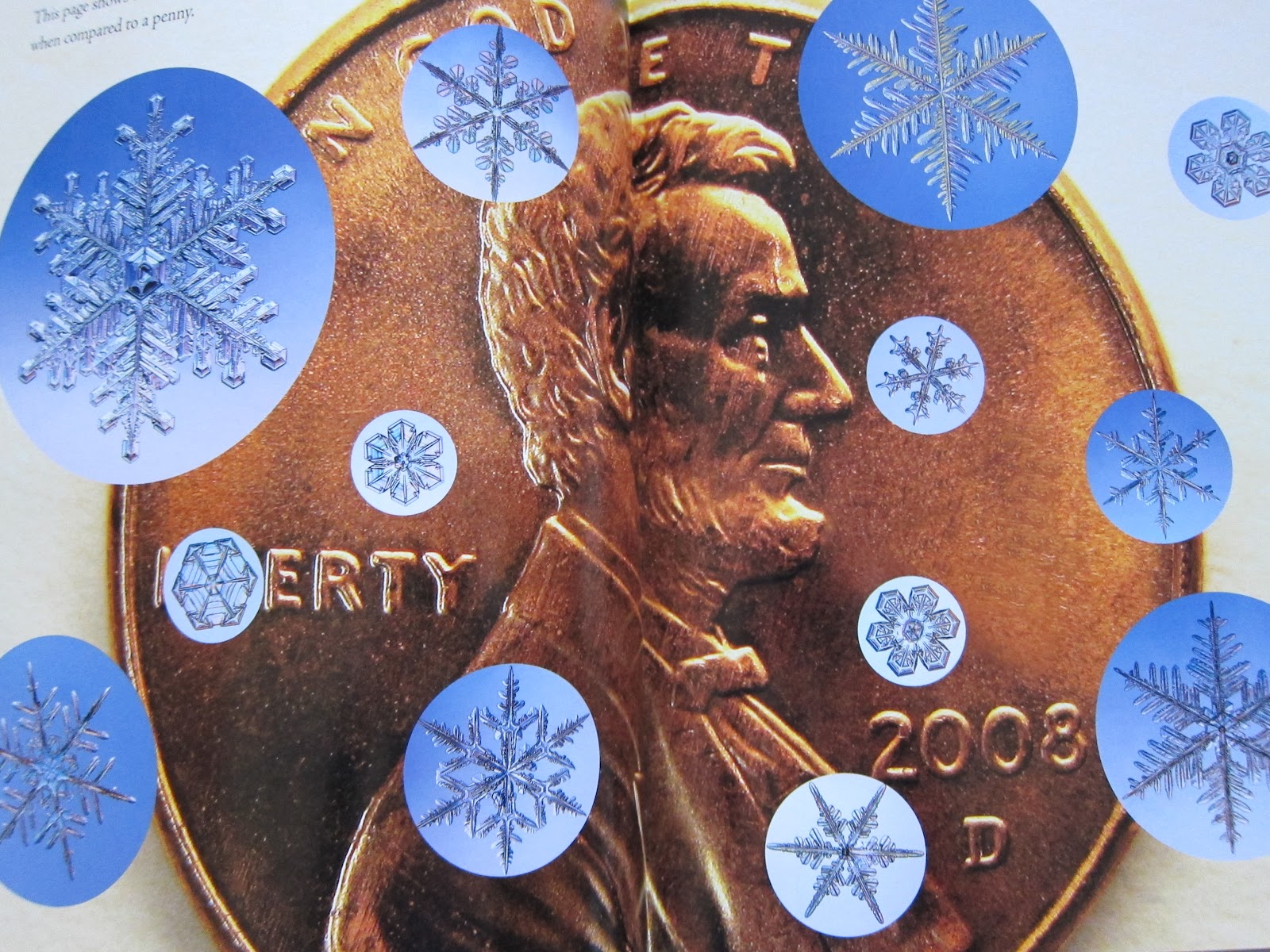
The Secret Life of a Snowflake: An Up-Close Look at the Art & Science of Snowflakes by Kenneth Libbrecht is my older daughter's favorite of the two.  I think she was taken in by the unbelievable gorgeous photographs, as was I - this is one of the few books I have bought without checking it out from the library first!  Dr. Libbrecht, a physics professor, photographs snowflakes with colored lights behind them, which lends them a breathtaking prismatic, rainbow effect.  With several books for adults on the same topic, Dr. Libbrecht, a professor of physics at CalTech, mostly succeeds in explaining and describing snowflakes to a younger audience.  I especially like the page where he shows the relative sizes of snowflakes compared to a penny.  And I never knew that snowflakes come in column (pencil) shapes, or that they are often not quite symmetrical.


The Story of Snow: The Science of Winter's Wonder by Mark Cassino with Jon Nelson, PhD. is my pick.  It also has beautiful, if slightly less dramatic, photos, as well as other diagrams, and the scientific explanations are a little more comprehensible to the layman (or, more importantly for our purposes, the laychild).  It focuses on the same set of facts as the Libbrecht books: how snowflakes form, the different types of snowflakes, including the column-shaped ones, and the fact that snow crystals are rarely perfect (or symmetrical), among other things.

Since both books cover essentially the same ground, I would advise owning only one.  Take them both out of the library and see which one you prefer.

I'm linking to Nonfiction Monday.

What is your favorite nonfiction book about snow?

Monday, February 6, 2012

Presidential Hopefuls

I've confessed before that I don't do a lot of browsing at the library.  Instead, I return my books, pick up my holds and I'm on to the next stop.  But I had a few minutes the other day at the beautiful I-wish-I-could-live-there Children's Room at the 42nd Street library and serendipitously happened upon not one but two books about presidents (and/or first ladies) to complement the one I'd put on hold, just in time for Presidents' Day.

What Presidents Are Made Of by Hanoch Piven is comprised of portraits of selected presidents, along with snippets of biographical information.  But these aren't your staid presidential portraits.  These are collages, made with materials that Piven thought conveyed the essence of each president, like peanuts for Jimmy Carter's nose or jelly beans for Ronald Reagan's features.  The biographical information isn't just the usual historical fare either but tidbits that are interesting enough to entice a child into learning more.  I love the double meaning of the title!  The book includes photos or paintings of all the presidents through publication date (2004) at the end.  When I asked my daughter what she noticed about them she said, "They all have white faces."  I pointed out that that is true no longer (a new paperback edition has come out which includes Barack Obama.), but something true then still is: they are all men. 

And speaking of the lack of female presidents, Doreen Rappaport's Eleanor: Quiet No More is a wonderful introduction to a great First Lady and great humanitarian.  A picture book biography which follows Eleanor from her birth to the end of her life, it includes many of her famous sayings, like "Do something every day that scares you" although it omits the famous "No one can make you feel inferior without your consent."  


Finally, I had put the justly-praised Looking at Lincoln by Maira Kalman on hold and picked it just a few days ago.  In her signature style, Kalman tells Lincoln's story and manages to include just the right amount of historical context combined with musings about his family life and inner that a child can relate to such as "On the day he was elected, I bet Mary made his favorite vanilla cake."

My 6-year-old, no history buff, loved all of these, and even my 4-year-old sat through them happily. 

What are your favorite books about presidents or first ladies?

Sunday, March 6, 2011

Just the Facts, Ma'am: Nonfiction About Artists

We have the usual gender divide in our family: the girls and I read mostly fiction and my husband reads mostly nonfiction.  My girls have gone through phases where they are interested in certain nonfiction topics, particularly the human body and New York City, both of which I hope to write about eventually.  But generally, we stick to the fiction side of things.

Lately, however, a few nonfiction works have caught my older daughter's attention.  She's always been very interested in art so when I came across An Eye for Color: The Story of Josef Albers by Natasha Wing, I immediately reserved it at the library for her.  Josef Albers, an artist whom I'd never heard of before, made the study of color his life's work.  My daughter was intrigued to learn that he spent years painting different colored squares to see how the various colors play off each other.  Just days later she received her issue of Click Magazine and found that this entire book had been reprinted in the magazine, along with colored squares of different sizes for the reader to cut out and experiment with.  Of course, you can try this yourself with colored construction paper.

On another note (pun intended), the self-described mockumentary, The 39 Apartments of Ludwig van Beethoven by Jonah Winter is a wacky exploration of why Beethoven lived in thirty-nine different apartments during his adult life.  Although the parody aspect of it was a bit over my five-year-old's head, she understood it once I explained it.  The book also describes the artistic process and how Beethoven dealt with its inherent frustrations, including by pouring water over his own head!

In Jan Greenberg and Sandra Jordan's Ballet for Martha: Making of Appalachian Spring, Martha Graham appears to be Beethoven's spiritual heir, as she throws her own tantrums (and shoes!) while choreographing Appalachian Spring, leading me to believe that the stereotype of the temperamental artist has a kernel (or more) of truth.  This book shows not just the inspiration but the effort, the editing, the back-and-forth which go into making a work of art, whether it's a musical composition, a sculpture, or a ballet.  The illustrations by Brian Floca show how dancing requires not just physical prowess but acting skills as well.  The authors end by explaining how, every time the ballet is performed, there is a new interaction between the dancers, the music, the set - and the audience - and that it is never the same twice.

This book was crammed wtih facts that were new to me.  I had no idea that Martha Graham asked Aaaron Copland to write the music for the ballet; I always thought the music came first.  Nor did I know that Isamu Noguchi, whose work I've admired and enjoyed (I highly recommend the The Noguchi Museum in Queens), was the set designer for the ballet. 

What are your favorite nonfiction children's books about artists?