Showing posts with label Rebecca Stead. Show all posts

Tuesday, September 29, 2015

My Apartment Complex

Do you remember those TV ads for the Publishers Clearinghouse sweepstakes?  You know, the ones where they knock on someone's door and tell them they've won $25,000?  Well, every time my sister and I saw one of those, we had the same reaction: Why doesn't anyone who lives in an apartment ever win?

I have the same question about children's books.  Where are the apartment buildings? Perhaps, as a lifelong apartment-dweller myself, I am oversensitive and thus exaggerating their scarcity.  Sure, there are some books - some pretty famous ones, at that - featuring apartment dwellers: When You Reach Me, Liar and Spy, and Goodbye Stranger, all by Rebecca Stead, the Riverside Kids books (these really get at the heart of apartment living, with unpleasant interactions in the elevator, a building-wide party, and Nora's imagining all 200 residents brushing their teeth at the same time!), the Clementine series, and the Fudge books (except for the year the Hatcher family decamps for New Jersey).  The characters in Mark Goldblatt's Twerp and its sequel, Finding the Worm, live in apartment buildings in Queens.  Harriet the Spy is a city dweller, but her wealthy family lives in a house, as do the Primms of Lyle the Crocodile books.  Ditto for the Melendy Quartet.  Some older books, especially those that feature immigrants, are set in (small) apartment buildings such as All-of-a-Kind Family series and In the Year of the Boar and Jackie Robinson.  But modern, apartment dwelling kids?  They seem to be few and far between.

As for picture books, such depictions seem even more rare. Amy Schwartz's A Glorious Day portrays the daily activities of the residents of a low-scale Brooklyn apartment building. What Happens on Wednesdays, Nana in the City (where a boy becomes reconciled to his grandma living in the city, but still doesn't want to live there himself!), the books of Ezra Jack Keats, Gina, a little known out-of-print gem by Bernard Waber about a tomboy who lives in Queens also come to mind.  (Speaking of which, the latter, Mark Goldblatt's books, and How Pizza Came to Queens are the only children's books I have found set in Queens.)  Some others, like Tar Beach, feature apartment dwellers, but that fact plays little to no role in the story.  


Even non-fiction books that take as their subject matter homes seem to equate homes with houses, not apartments.  In Carson Ellis's otherwise lovely Home, apartments get barely a glancing mention.  In If You Lived Here (which admittedly does have the subtitle Houses of the World), there is nary an apartment to be found, although there are other types of multiple dwellings mentioned, such as the tulou of China.  And in Cynthia Rylant's Let's Go Home: The Wonderful Things About a House (emphasis added), of course only addresses the components of houses (including a ridiculously big bathroom).  A search did uncover Apartment Book, but I can't think of any other books about apartments and/or apartment buildings.  Not (only) how they are built, not their architecture or engineering, but how they function as homes.

What children's fiction can you think of where the protagonist lives in an apartment?  Is there non-fiction about apartment buildings that I've missed?

Is it me, or do way more children's book protagonists live in houses than apartments?

Sunday, February 3, 2013

Why Middle-Grade Fiction?


This weekend I attended a panel discussion at the NYPL entitled Middle Grade: Surviving the YA Onslaught about how middle-grade novels are being rebranded as Young Adult (YA).  The panelists were authors Jeanne Birdsall (The Penderwicks series), N.D. Wilson (The Dragon's Tooth), Adam Gidwitz (In a Glass Grimmly) and Rebecca Stead (When You Reach MeLiar and Spy).  I was especially fascinated by how these authors considered their readers and the age of their readers as they wrote.  They didn't just write a children's book that turned out to be middle-grade fiction; they purposely chose their audience and tailored their writing to it.  That might be obvious to the writers among you but it wasn't to me.

I appreciated the comment that they write for middle-graders because "they have all the intelligence and none of the hormones" as well as Jeanne Birdsall's idea that the author assures the middle-grade reader of "safe passage" through the book.  I love middle-grade fiction for its story-telling, its exploration of identity, friendship, and family.  I'd say middle-grade readers are ages 8-12, although the upper end of that spectrum overlaps with YA.  (I wish there were a different name for this audience, though; middle-grade has unfortunate connotations of mediocrity.)

The blog From the Mixed-Up Files, written by a group of middle-grade authors, has some great quotes about middle-grade fiction and its intended audience.

Being in middle grade is like being in limbo. You're not a little kid anymore, yet you're not a full-fledged teen. I love writing middle grade novels. It's an exciting and scary age, and the gateway to becoming who we are meant to be.  Lisa Yee

Middle grade readers are intrepid explorers: excited, unafraid, seeking the clues that will show them the way to the larger world.  Stephanie Greene

Middle grade fiction is for the young (or young at heart) person with one foot on the playground and the other foot on the path to growing up. It is for readers who are still filled with wonder but who have also begun to feel the weight of their internal and external world.  Ingrid Law

Middle grade is that age when you believe you're old enough, but often need confirmation from your parents that you really are.  Jody Feldman

Middle-grade is what Natalie Babbitt once called 'the last best years of childhood.' I have never felt anything more intensely or deeply in the rest of my life, as what I felt then, and it's those extremes of joy and sorrow, caused by events that can seem so small and insignificant to others, that I try to capture and honor in my books. Claudia Mills

To me, middle grade means that wonderful place sandwiched between easy readers for the very young and the mature, issue-centered books for young adults. Middle grade readers are still happily hunkered down in childhood, eager to move on from the more 'babyish' fare of their beginner reading days but not ready for (or even wanting) the more mature topics of teen reads. 
Barbara O'Connor

I believe the books we read at this age have a certain power. The characters can live on inside us and help us figure out who we want to be, and what we want to do with our lives. I wanted to write for this age to give something back to the next generation of readers the types of books that meant so much to me.
Wendy Mass

It's a fabulous age to write for. The kids are old enough to know that magic isn’t real, but young enough to wish that it might be. These readers are curious, creative, incredibly loyal, and just beginning to taste their own independence. And they crave characters that reflect their experiences.  Bruce Hale

Middle grade is a magical time when you're no longer a baby and not quite a teenager. The only thing that could be better than being a middle-grader is writing for them.  Laurie Friedman

Which of these quotes do you like?  What do you think is special and important about middle-grade fiction?


Thursday, January 17, 2013

One-Hit Wonder No More: Kate Feiffer

You know how, when you find a book you really love, you immediately go out and try to find all the other books that author's written.  Well, that's what I do anyway.  And it is so disappointing when none of the author's other works live up to the promise of the first one you read (which may not be the first one the author wrote).


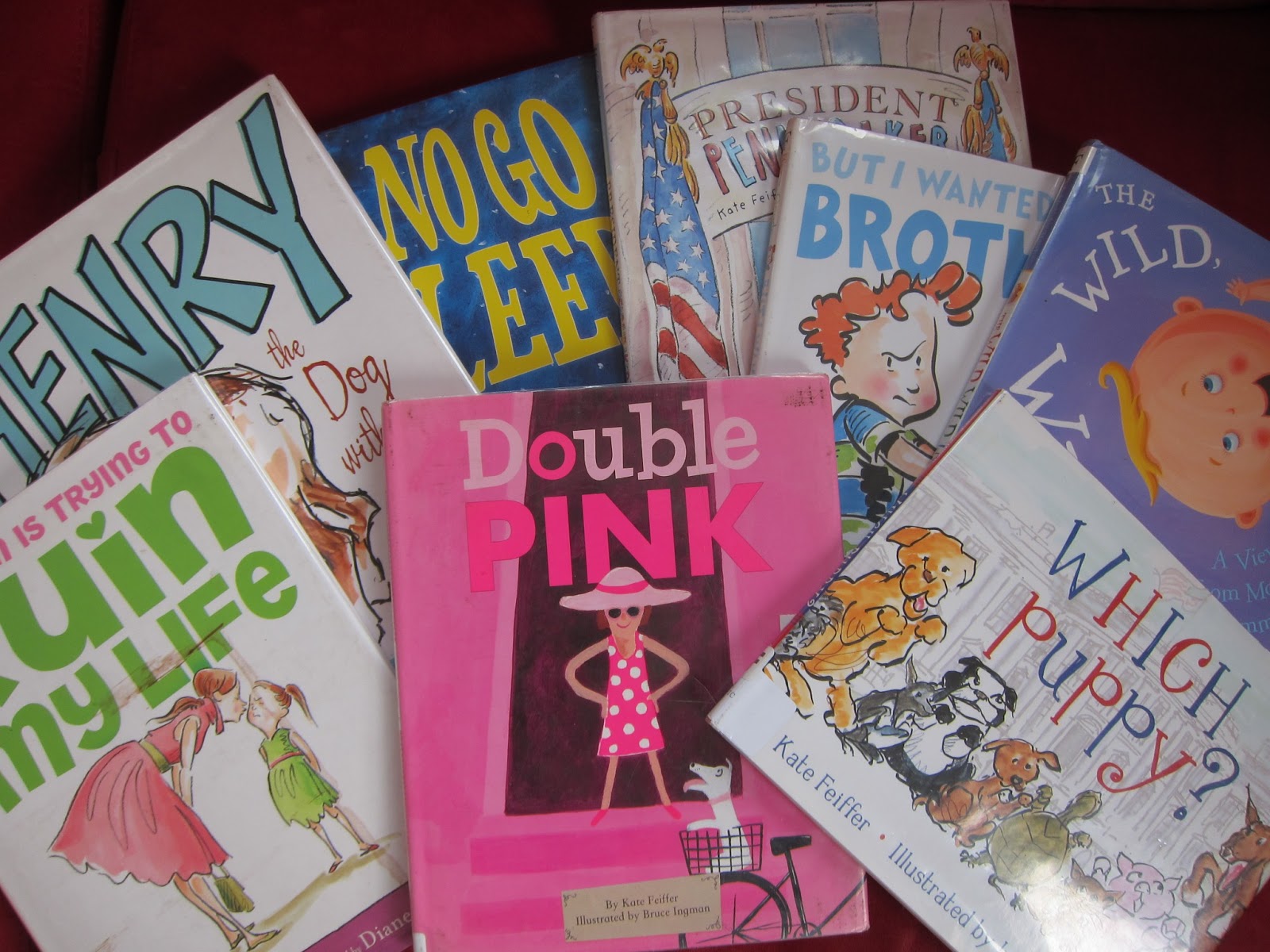
That's what happened to me and Kate Feiffer, at least with regard to her picture books.  I loved, loved, LOVED My Side of the Car, published in April 2011 and illustrated by her famous father, Jules Feiffer.  I had no idea that it wasn't her first book or even that she'd written other books.  But then I saw that she'd just come out with No Go Sleep! (2012), also illustrated by her father and when I reserved that at the library, I discovered a number of other books by her.  In order of publication they are: Henry the Dog With No Tail (2007) (illustrated by Jules Feiffer), My Mom Is Trying to Ruin My Life (March 2009) (illustrated by Diane Goode), Which Puppy? (April 2009) (illustrated by Jules Feiffer), The Wild, Wild Inside: A View From Mommy's Tummy! (March 2010) (illustrated by Laura Huliska-Beith), But I Wanted a Baby Brother! (May 2010) (illustrated by Diane Goode), The Problem With the Puddles (June 2011) (a chapter book illustrated by Tricia Tusa), President Pennybaker (January 2012) (illustrated by Diane Goode), Signed by Zelda (April 2012) (also a chapter book), and Double Pink (2013) (illustrated by Bruce Ingman).

The picture books weren't bad.  They just weren't special.  In No Go Sleep! I could relate to the parent of a child who adamantly refuses to go to sleep... until he just can't resist any longer.  In My Mom Is Trying to Ruin My LifeFeiffer achieves a nice balance of a protagonist who is utterly embarrassed by her parents yet still needs them.  Henry the Dog With No Tail  had some clever wordplay (Henry seeks a tail at the tailor's and asks a wagon maker to make it wag) but again lacked the zing of my favorite.  Double Pink, about a girl who takes her love of pink to such extremes that she ends up camouflaged in her pink room, was cute but nothing more.  Which Puppy?, about the Obamas' search for the perfect dog, The Wild, Wild Inside: A View From Mommy's Tummy! and President Pennybaker were also merely cute and silly. But I Wanted a Baby Brother!, well-written as it is, ends conventionally with protagonist Oliver discovering that his baby sibling is fun, even if she is a girl.

Then I discovered Ms. Feiffer had written two chapter books.  Would they redeem her in my eyes?  Would they ever!

The quirky characters, family troubles, a New York City setting and a unique type of mystery in Signed by Zelda reminded me of both Rebecca Stead's Liar and Spy and From the Mixed-up Files of Mrs. Basil E. Frankweiler but didn't feel derivative or unoriginal. 11-year-old Nicky Gibson suspects his father is responsible for his grandmother's disappearance.  With the help of his new upstairs handwriting-obsessed neighbor, Savannah-transplant Lucy Bertel and a talking pigeon, they work to solve the mystery.  And while I thought the ending very upsetting and the issue it raised (elder abuse) glossed over too quickly, I found the rest of the book an engrossing read.  (My daughter refused to read it on the grounds that she suspected it was too scary.)

However, she loved Ms. Feiffer's other novel, The Problem With the Puddles, so much that she asked to buy it so she could reread it.  With that endorsement, I had to read it too!  It has a more farcical plot but was also fun read and its constant wordplay (a character who can never say anything once but always adds synonyms, often mangled, such as cinnamons) was reminiscent of The Phantom Tollbooth, which just happened to be illustrated by Ms. Feiffer's father.  The premise, involving a family in which the parents cannot agree over the smallest thing, including their child's name (whom they call variously Emily and Ferdinanda and whom everyone else calls Baby, the name on her birth certificate), is outrageous and the antics only get wilder from there.

Is there an author (or illustrator) who had one book you loved and were subsequently disappointed?  Do you have any favorite children's authors or illustrators who have done both picture books and chapter books you liked?  (By the way, Jules Feiffer has also written both picture books and children's chapter books, as well as written for adults and is best known as a cartoonist.  But he is a subject for another day.)