Showing posts with label Jan Ormerod. Show all posts

Monday, September 10, 2012

Searching by Illustrator

I came to children's books because of the stories, but I stayed because of the pictures.  As I've become more interested in the world of children's literature, I've discovered more and more illustrators whose art is just... beautiful, unique and compelling.

We all know that fiction books are organized by the last name of the author, which leads us to search for books that way.  My 7-year-old is frequently writes on her reading responses to books "I would like to read another book by this author." or something else along those lines, but she never mentions the illustrator, despite her interest in art.  Luckily, it is easy to search for books by illustrator these days (sadly, I can't remember if you could do so with the card catalogs of yore). 

I've taken to searching for books by illustrator.  Admittedly, the results are mixed when you judge the books in their entirety.  But it's worth it to see more work by some of my favorite illustrators.

Here are a few:

Tom Slaughter.  I discovered him in Do You Know Which Ones Will Grow? by Susan Shea and immediately recognized his primary-colored, strong artwork when I saw it again.  Unfortunately for us, most of us his books (generally collaborations with Marthe Jocelyn) are truly "baby" concept books (numbers, over/under, animals, etc.), for which his illustrations are well-suited, but they are far too young for my daughters.  However, we were able to make a game out of Same Same with my not-quite-reading 4-year-old guessing what the items on each page had in common. 

Christine Davenier.  The first book we read illustrated by Davenier was Samantha on a Roll by Linda Ashman.  It prompted me to look up books by both of them, individually, as I haven't seen any other collaborations by this pair.  This one is still my favorite of both of theirs, but I also have a soft spot for Leon and Albertine, a funny barnyard romance illustrated and written by Davenier.  Although the text in other books she's illustrated is weaker, I still love her artwork.  Her style is warm, exuberant, joyous, and realistic and makes drawing look easy.


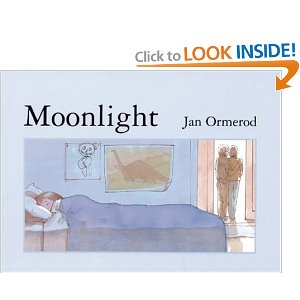
 Jan Ormerod.  Ms. Ormerod's wordless books, Sunshine and Moonlight, are two of my favorite wordless picture books.  Actually, they are two of my favorite picture books, with words or without, ever.  Her art in her other books never disappoints.  And strangely enough, she also illustrated a book by Linda Ashman, Mama's Day, a sweet tribute to the loving work mothers do every day.


Brian Wildsmith.  I had never heard of Brian Wildsmith until I began my search for different illustrated versions of Robert Louis Stevenson's A Child's Garden of Verses (more on that... someday!).  My 7-year-old and I were both captivated by his vibrant, modern style, which stood out especially among the more traditional art that usually accompanied these classic poems.  He is also the author-illustrator of several stories perhaps best described as modern animal fables as well as an assortment of concept books (alphabet, animal, counting), and has illustrated several other works.  Again, these are not my favorites in terms of the stories, but the art is consistently stunning.

Friday, July 6, 2012

Library Round-Up #6

Brief reviews of some of the poetry and picture books we have out from the library right now. My 7-year-old is whipping through chapter books so quickly I can't keep up but maybe soon she'll write her own reviews!


Press Here by Herve Tullet.  Worthy of all the buzz it's been getting, this interactive book has readers press and rub dots on the page, shake the book, and perform other acts in order to get the dots to move, multiply, or change in other ways on each successive page.  My 4-year-old loved being in on the joke: "You don't really have to press.  There's already more dots on the next page but I still like doing it." 

Sunflakes: Poems for Children edited by Lillian Moore and illustrated by Jan Ormerod.  I picked up this poetry anthology after having read and loved the title poem in a different anthology.  I didn't even realize at first that the illustrations are by one of my favorite children's book illustrators!  While the title poem, about building sunmen out of sunflakes and other such reversals, by Frank Asch, is probably still my favorite, this compilation captures the essence of childhood and is definitely worth a look, if not a purchase. 

The Art of Miss Chew by Patricia Polacco.  Another sophisticated autobiographical winner by Patricia Polacco.  Perfect for the aspiring artist and the teachers in your life.

All the Way to America: The Story of a Big Italian Family and a Little Shovel by Dan Yaccarino.  A lovely story about immigrants, tradition and family and the power of things to convey memories and values.

How Much Is A Million? by David Schwartz.  Similar in concept to How Many Jelly Beans? this book explains big numbers by showing how high a tower of a million, billion or trillion children would be, how large a bowl would be needed to hold a million, billion, or trillion goldfish and, perhaps most amusing, how long it would take to count to each number (and which of the counters would be dead, shown by gravestones, by the time the count was complete!).  Unlike How Many Jelly Beans? this book doesn't actually show a million, billion or trillion of anything, although it does show 100,000 tiny stars.  My 4-year-old is obsessed with both of these big-number books but I prefer this one.

Chloe, Instead by Micah Player.  My expectations for this one were so high they were bound to be disappointed and they were.  I love the cartoon-y, big-eyed children and the brightly colored illustrations but Chloe turns out to be a rather typical mischievous younger sibling who eats crayons and the like.  But the demonstration of how the underlying sibling relationship is a loving one is very sweet. 

The Mitten by Jan Brett.  A classic retelling of a Ukranian folktale.  My girls recognized that it was by the same author-illustrator as that of The Hat right away.

The Honeybee Man by Lela Nargi.  Award-winning, yet it didn't grab our attention and I found myself tripping over the words as I read it aloud.

Follow the Line Around the World by Laura Ljungkvist.  Not my favorite of the Follow the Line books in terms of the illustrations, but it held my 7-year-old's interest, rare for non-fiction for her.

I Feel Better With A Frog In My Throat: History's Strangest Cures by Carlyn Beccia.  After renewing this one from the library 5 or 6 times, I thought we'd never read it.  But then my 7-year-old picked it up the other day and was fascinated and loved the multiple choice format.  Another non-fiction winner.

My No, No, No Day! by Rebecca Patterson.  Adored by my younger daughter, I can't help but think of this as a pale imitation of Alexander and the Terrible, Horrible, No Good Very Bad Day (which is actually one of the results retrieved when you search for the Patterson book on Amazon).  However, it has its place as it is definitely geared toward a younger audience than that classic.

Forgive Me, I Meant to Do It: False Apology Poems by Gail Carson Levine.  The second book of poems we've read inspired by the famous William Carlos Williams poem, This Is Just to Say.  This one struck me as repetitive and required a good deal of background knowledge to get all the allusions.  However, I loved the first one we read, This Is Just to Say: Poems of Apology and Forgiveness  by Joyce Sidman, fictional apology poems and responses to them.


Don't Want to Go! by Shirley Hughes.  Ms. Hughes always captures the daily minutiae of childhood so perfectly and this book is no different.  A young child who doesn't want to go to a family friend's house while her mom has the flu ends the day by not wanting to leave the friend's house.  This one doesn't have any of the familiar Hughes characters like Alfie and isn't my absolute favorite of her books (that would be Dogger) but it's still a lovely, relatable story with Ms. Hughes trademark warm, realistic illustrations.  I had no idea she was still writing until we found this 2010 work at the library! 

What have you been reading from the library?

Saturday, March 17, 2012

Library Round-Up #4

This week's library haul in brief (some briefer than others):

Amelia and Eleanor Go For A Ride by Pam Munoz Ryan, pictures by Brian Selznick.  I found this book via Annie and Aunt (who currently have a great series of posts about books for the very earliest of emerging readers) and I can't say enough good things about it.  From the amazing black-and-white illustrations by yes, that Brian Selznick, to the wonderful writing, this book is a winner and perfect for Women's History Month.  It is not quite non-fiction, but is based on a true event and the author smartly includes a note at the end detailing what parts are true and where she took liberties.  Of course, it doesn't hurt that the story, about the friendship and adventures of two of the most admired women of the mid-twentieth century, provides great material.  This one's going on my to-buy list.  And now I'm interested in the author's book about Marian Anderson, too.


Posy by Linda Newbery and illustrated by Catherine Rayner.  This simple story about a cat's activities is elevated by the clever rhymes ("whiskers wiper/crayon swiper") and expressive illustrations.  I do wish, however, that the color palette had been enlivened a little.  The brown, black and light orange of the calico cat don't make for the brightest color scheme so less muted colors for the other items in the illustrations would have been nice.


Maudie and Bear by Jan Ormerod, illustrated by Freya Blackwood.  I can't decide what I think of this collection of five stories, well-regarded in its native Australia.  As the book jacket says, "Bear's world revolves around Maudie.  Maudie's world also revolves around Maudie."  The bear is clearly a stand-in for a parental figure and somewhat of a martyred one at that.  The sacrificial aspect and the second story, a take-off on the Three Bears which I think explores the guilt Goldilocks must have felt, don't sit right with me, but the quiet prose and illustrations are lovely.  I especially like how the illustrations, not the words, provide the punchlines in both The Bike Ride and Telling Stories.

Prudence Wants a Pet written by Cathleen Daly and illustrated by Stephen Michael King.  Another (I think Australian) book I'm ambivalent about.  Prudence wants a pet so desperately she adopts all kinds of inanimate objects until her parents finally succumb.  On a first reading, my girls thought the story was hysterical, but it didn't hold up as well upon rereading.  Truly clever moments (adopting a shoe and calling it Formal Footwear, since that is what it says inside) seem to highlight that the rest of the book falls short.  The part of the story about "sea buddies" was confusing to us (what are they exactly?  some type of plant?) and neither my girls or I were sure whether the pet at the end was a cat or a dog!  On the plus side, I love how the adults in the story are only depicted from the waist-down, a true child's eye view of the world (and reminiscent of the grown-ups in Charlie Brown).  Strangely, it is the third book I've read recently with inanimate objects as pets - the tween novel, When Life Gives You O.J. by Erica S. Perl and Otherwise Known as Sheila the Great by Judy Blume were the others.


Apple Pie ABC by Alison Murray.  I have a soft spot both for retro-looking illustrations and unique alphabet books and this book scores high  on both counts.  I can't think of another alphabet book that actually tells us a story like this one, although there must be one, right?  Also going on my to-buy list.


A Ball for Daisy by Chris Raschka.  Justly deserving of its Caldecott for the illustrations (I love the colors) but I found the plot of this wordless book a little thin.

My Rotten Redheaded Older Brother by Patricia Polacco.  A great semi-autobiographical book about sibling relationships with photos of the author and her real rotten redheaded older brother on the endpapers.

Listen to My Trumpet! by Mo Willems.  The latest in the Elephant and Piggie series, this one was definitely not my favorite.

Dumpling Days by Grace Lin.  The third book in Grace Lin's semi-autobiographical middle-grade series about Pacy Lin, a Taiwanese-American girl, which, like the first two (The Year of the Dog and The Year of the Rat), successfully explores immigrant identity and the difficulties of just growing up.  The kind and wise parents remind me of the Quimbys.  My only complaint is that the books are not very subtle, but that may be all for the best considering the target age group.

Have you or your kids read any of the above?  What did you think?

Friday, January 21, 2011

Without Saying a Word

I am not a visual person.  In college I made a friend accompany me to the art gallery to help me figure out what I was seeing for an assignment for Art History 101.  Post-college, I looked at the wordless Ikea directions with horror and confusion (not only was I confused about what to do, I was confused as to how anybody could think wordless instructions were useful) and immediately found some friends willing to help.  So it was much to my surprise that I discovered that several of my favorite picture books are wordless.

Perhaps my absolute favorite wordless books (if I had to choose) are Jan Ormerod's "bookend" pair (pun intended) Sunshine and Moonlight.  They both follow the same family (mom, dad, daughter) through the rituals of getting up in the morning and going to bed at night.  Despite the fact that they focus on what can be very hectic times of day, both books convey a kind of peacefulness.  I found them serendipitously at Books of Wonder, a fantastic independent children's bookstore here in New York.


All of Suzy Lee's books are amazing.  Wave tells the story of a little girl at the beach;
Mirror uses double-page spreads to turn the book into a mirror and Shadow shows how a little girl's imagination converts the shadows of ordinary items in her attic into monsters and animals in the jungle.  Shadow also uses double-page spreads.  It is a tall thin book but has to be turned horizontally to be "read."  I love how the protagonist in each book plays so happily all by herself without a toy in sight.


In the Town All Year 'Round by Rotraut Susanne Berner is a more traditional wordless book, in the vein of Richard Scarry.  I don't remember how I came across it originally but Playing by the Book's recent post about a similar book, It's Snowing in Animal Town by Hannamarie Ruohonen reminded me of it.  It follows the citizens of a single town throughout the year.  The book is divided into seasons and each has an introduction to some of the characters and clues about what to look for.  It is very detailed and rewards rereading with new discoveries each time. 

After reading Playing by the Book's posts about "reading" wordless books to and with your children http://www.playingbythebook.net/2011/01/05/listening-to-children-create-their-own-stories/ and http://www.playingbythebook.net/2010/05/30/going-to-the-zoo-zoo-zoo/ I was struck by a thought: to my non-reader and not-quite-a-reader, ALL books are wordless when an adult is not there.  Of course, my kids often "read" a book they have heard before using the words they have memorized or almost memorized, but they sometimes tell the story in their own words as well.  Hearing how they paraphrase the text makes for great eavesdropping!