Showing posts with label Animals. Show all posts

Friday, November 13, 2015

A Myriad, a Plethora, An Abundance of (Okay, Just Three) ... Books About Collective Nouns

From A Zeal of Zebras
I found A Zeal of Zebras: An Alphabet of Collective Nouns at a museum gift shop and was drawn in by the visually stunning cover.  As a word-lover, the topic of collective nouns also piqued my interest, and I was sold.  Although I wonder if these terms are ever actually used, their vivid imagery is irresistible.  I even picked up an adult version of this book and found gems such as "a squint of proofreaders!"   A Zeal of Zebras presents animals in alphabetical order and is as informative as it is gorgeous.

And you know how, once you notice something, it seems to be everywhere?  All of a sudden, I noticed books about collective nouns everywhere.

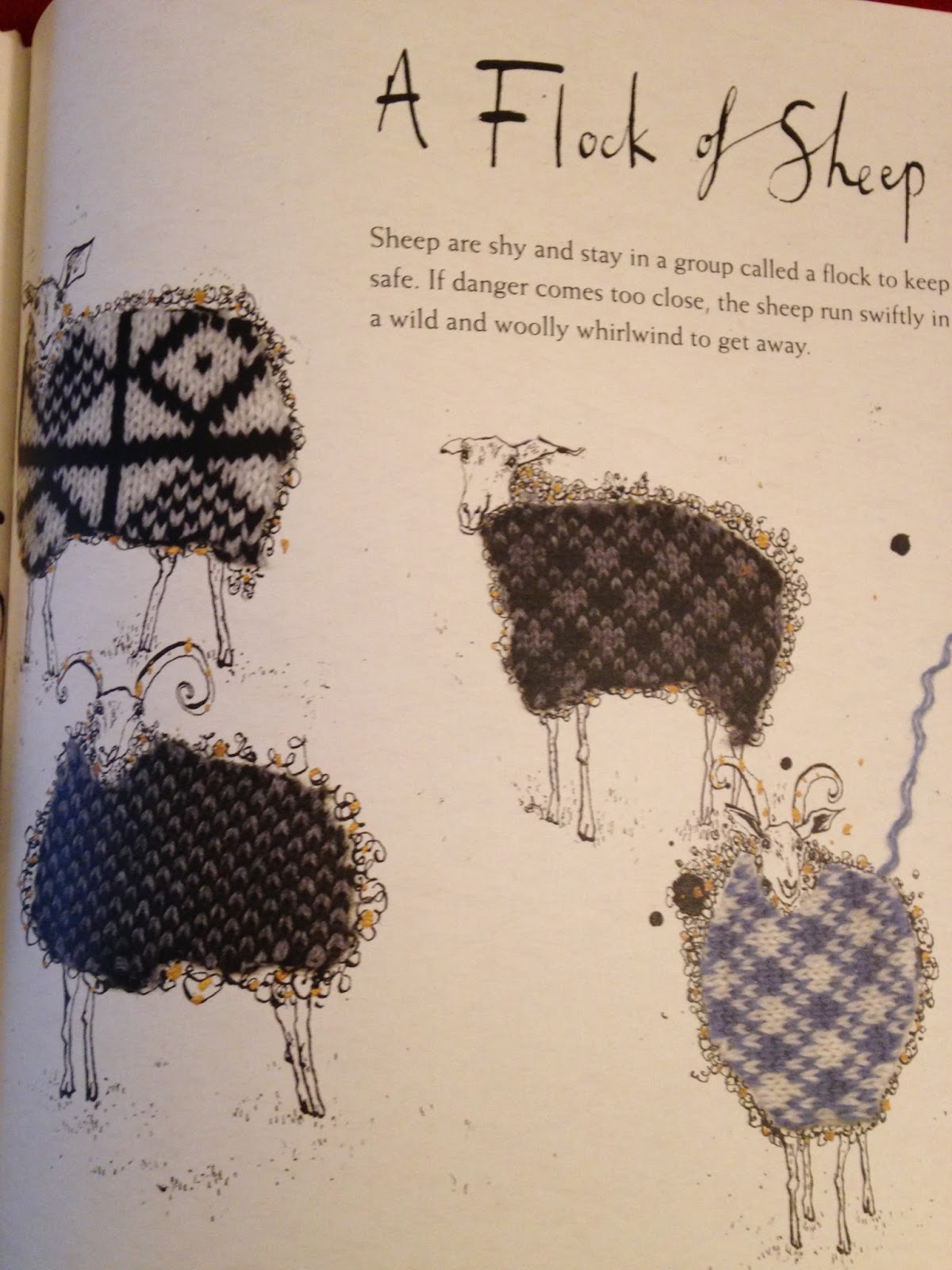
A flock of sheep from A Tower of Giraffes
A Tower of Giraffes: Animals in Groups takes the same tack, providing information about each animal and its community.  But while I loved the art (I dare you to not to touch the woolly-seeming sheep!), the animals seem arranged in no particular order and the book comes to an abrupt end.

An Ambush of Tigers: A Wild Gathering of Collective Nouns takes a completely different approach.  My wordplay-loving 7-year-old loved this rhyming book, which asks questions like "Would a labor of moles wear polka-dot ties when it goes to work for a business of flies?" and "When a murder of crows leaves barely a trace, is a sleuth of bears hot on the case?"  In a nice touch, it has a glossary which gives the alternate (more common) meaning for each word used to name an animal group.  Fun and funny, this is a more accessible introduction to collective nouns than a mere list.  But it lacks information about the animals and animal communities themselves, which is why these books work so well together.

A sleuth of bears
Interestingly enough, the books do not always use the same word for a group of animals.  An Ambush of Tigers and A Tower of Giraffes both feature flamingos  - but the former calls a group of them a bland "stand," whereas the latter identifies such a group as a much more vivid "flamboyance."  A romp of otters or a raft of them?


What is your favorite collective noun?

Wednesday, July 30, 2014

Why A Cat? Or A Badger? Or a ...?

I was reading Yoko's Show and Tell to my daughter who was home sick from camp when we started talking about the fact that Yoko and her family are cats.  My daughter pointed out that "they are so much like people that when you get really into the book, you forget they are cats."  Which begs the question, why make them animals in the first place?  And if an animal, why cats?

The same question could apply to many other books but the Frances books  by Russell Hoban immediately spring to mind.

Well, to find out, we went to the source.  My daughter wrote a letter to Rosemary Wells, asking her that very question.  I'll let you know if we hear back!


In the meantime, I'm asking all of YOU that question. Why do you think Rosemary Wells chose to make Yoko a cat?  Why did Russell Hoban choose to make Frances a badger?  Would the books work as well if Yoko were a bird?  If Frances were a kangaroo?

What other books come to mind with animal protagonists so successfully anthropomorphized that you (nearly) forget they are not human?

Monday, January 13, 2014

Library (and Bookstore) Round-up #14

Mini-reviews of what we're reading now.

The dough rises.  And rises.  And rises.
The Duchess Bakes a Cake by Virginia Kahl.  Introduced to us by our awesome, well-read, 12-year-old babysitter, this rhyming story "scans," as they say.  The Duchess goes a wee bit beyond her natural abilities and decides to bake a "luscious, light, delectable cake."  Although her mistakes with yeast and the hijinks that ensue are the subject of many a book (see my review of Bembelman's Bakery, published more than 20 years after this one, which was first published in 1955), this story is utterly delightful, made more so by the perfect rhymes and amusing drawings.
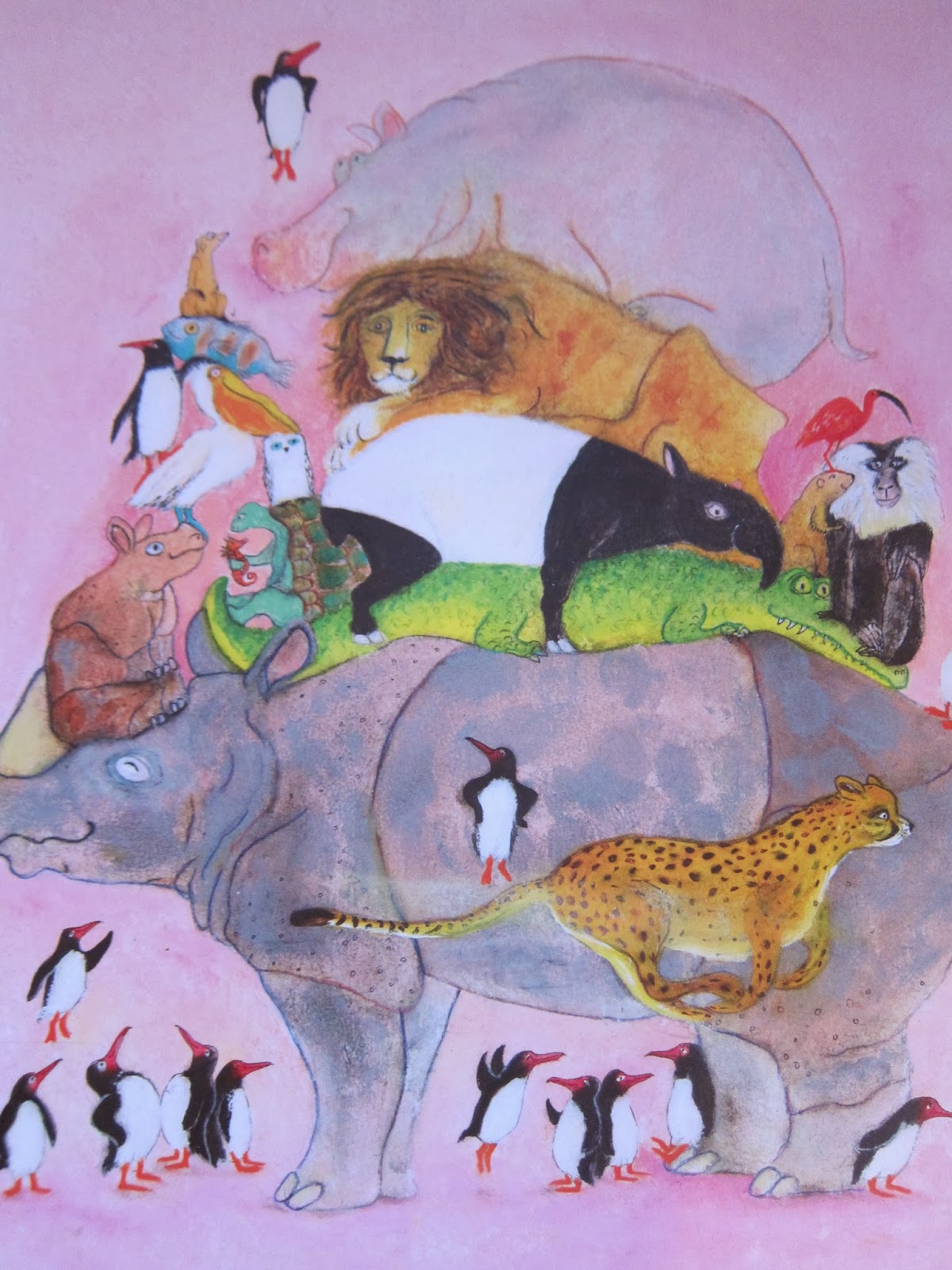
Jumping Penguins by Marije Tolman.  An assortment of utterly random, bizarre and perfectly fascinating animal facts accompanied by whimsical, watercolor illustrations.  You want to know how far caterpillars can throw their poop?  Then this is the book for you.

Old Henry
by Joan W. Blos.  Henry's house doesn't look like everyone else's on his block.  And apparently there is no neighborhood association to force him to mow his lawn or mend his fence.  Billed as a book about different people learning to live in harmony, I saw this more as a comforting book for the messy among us and an ode to how important community is.

Arthur and the Sword by Robert Sabuda.  Retold by Robert Sabuda and illustrated in his distinctive stained-glass style, this version was an excellent introduction to the folktale of King Arthur.  It is, however, the story only of Arthur and the sword - it does not tell the further tales of King Arthur and his court. 

 Wild by Emily Hughes.  After quite a bit of hype I was disappointed by this book.  The story of a child who is left in the woods and raised by animals, found by people and returned to "civilization," and, unable to adapt, returned to the forest, was, in my opinion, lacking in plot.  I can't see this one appealing to kids.

One Grain of Rice: A Mathematical Folktale
by Demi.  This is a beautifully illustrated version of a folktale which teaches the mathematical concept that doubling causes numbers to grow incredibly quickly.  The illustrations and folktale setting may even entrance the math phobic!

Brush of the Gods by Lenore Look, illustrated by Meilo So.   This picture book by Lenore Look, author of the chapter book series Ruby Lu (enjoyed by my older daughter last year), captivated my 6-year-old.  Using the limited available knowledge about the life of the famous Chinese painter Wu Daozi, Look tells a story about the power of art, as Wu's paintings, in her telling, literally come alive.

Christina Katerina and the Box
by (well-known children's book editor) Patricia Lee Gauch.  Another favorite of my kindergartener about the power of imagination.  A forgotten classic, its place usurped recently by other books of the same ilk such as Not a Box by Antoinette Portis and The Nowhere Box by Sam Zuppardi.

Forever by Emma Dodd.  This plotless promise of unconditional love from a mama polar bear to her cub is set against an Arctic landscape which is brought to shimmering life with shiny foil illustrations.  A bit gimmicky, but I fell for it anyway!

When Jessie Came Across the Sea
by Amy Hest.  In this beautiful story about a Jewish immigrant to America, a grandmother's bond with her granddaughter cannot be severed by time or distance.  An object - here a wedding ring - represents home, family, and history.  Other books with these themes include Patricia Polacco's  The Keeping Quilt and The Blessing Cup and Dan Yaccarino's All the Way to America: The Story of a Big Italian Family and a Little Shovel


My Name is Yoon by Helen Recorvits.  Another touching immigrant story about the power of names and family history. 

What are you reading?


Monday, April 4, 2011

Treasure Hunts

When we walk around our neighborhood, we see something you don't normally think of when you think of New York:  gargoyles.

Soup-eating, book-reading gargoyles!
 

And when Isabel Hill walks around New York, she sees animals.  Not real ones, but sculpted ones, hidden (to greater or lesser degrees) on buildings all over the city.  In Urban Animals, she takes us on a tour of her finds.  While the rhyming text is labored ("In this keystone with its tail in a curl/sits a busy city squirrel."), and the highlighting of architectural terms (defined in a glossary at the back of the book) is distracting, the photos themselves are compelling.  She includes a list cleverly titled "Animal Habitats" which gives the location of each animal depicted so the reader can follow in her footsteps (although the animals are located too far apart to see them all on the same trip).  And if you can't do that, or even if you can, you'll still be inspired to look a bit more closely at the buildings you pass each day.  Despite its flaws, this book will appeal to animal lovers, New York-ophiles and budding architecture buffs alike.


Stephen Johnson's Alphabet City and City by Numbers also prompt the reader to look at his or her environment from a new perspective.  In his paintings, the elements of city life suddenly reveal the shapes of letters and numbers, respectively.  My five-year-old, who until now had found these books boring, is suddenly fascinated by them.  I do wish Johnson had, like Hill, included a directory of where he found each of the images he chose.  While some are obvious (M is made with the arches of the Brooklyn Bridge, I'm pretty sure C is from the The Cathedral of St. John the Divine , just down the block from those gargoyles), others are impossible to place  (two floors of fire escape stairs form B, the three elements of a traffic light, when viewed in profile become E).  And are any of them actually in the New York City neighborhood known as Alphabet City?