Lately, I've gotten a LOT of requests for book suggestions from friends. Most of them have children between 3rd and 5th grade and have read a lot of the recently released books. Suggesting new books wasn't going to cut it with these kids. So instead, I went back in time. I looked to more obscure, forgotten classics, but also the books I read and loved as a kid (in the 80s!). I couldn't resist throwing in a few of my contemporary favorites, just in case they had somehow missed out on them. Also included is a list of classics that are still popular.
In no particular order...:
Oldies but Goodies
Tom's Midnight Garden by Philippa Pearce. Tom discovers a garden that only exists when the clock strikes thirteen.
Her Majesty, Grace Jones and The Boyhood of Grace Jones by Jane Langton. A girl uses her imagination to survive the Depression.
Mandy by Julie Andrews Edwards (yes, THAT Julie Andrews) (but please read The Secret Garden first!). An orphan girl makes a deserted cottage in the woods her private hideaway and finds peace, beauty, and friendship in nature.
The Last of the Really Great Whangdoodles by Julie Andrews Edwards. An adventure reminscent of The Phantom Tollbooth.
The Enormous Egg by Oliver Butterworth. Exactly what it sounds like!
Black and Blue Magic by Zilpha Keatley Snyder. Harry Houdini Marco is given the gift of flight and in turn gives the gift of believing in the impossible to others. See my discussion of it here.
The Saturdays and sequels by Elizabeth Enright. Four motherless children alternate having adventures in old New York on Saturdays.
The "Shoes" books by Noel Streatfeild (Ballet Shoes is the best). British orphans need to make their living on the stage.
Understood Betsy by Dorothy Canfield Fisher. A pampered orphaned city girl moves to live with family in the country and learns to - and that she can - take care of herself.
Daddy Long-Legs by Jean Webster. In this epistolary novel, an orphan writes letters to her mysterious benefactor.
Anna to the Infinite Power by Mildred Ames. Super-creepy book about a girl who doesn't know she's one of thousands of identical clones.
The Girl With Silver Eyes by Willo Davis Roberts. A girl discovers she has the power of telekinesis.
The Anastasia books by Lois Lowry. Laugh-out-loud funny.
In the Year of the Boar and Jackie Robinson by Bette Bao Lord. A Chinese immigrant girl finds that falling in love with baseball and the Brooklyn Dodgers is her route to becoming an American. Very funny, to boot.
For slightly older children
Across Five Aprils by Irene Hunt. Historical fiction about the Civil War.
Dicey's Song and sequels by Cynthia Voigt. A raw, poignant, heartbreaking story of abandoned siblings.
The Alice books by Phyllis Reynolds Naylor. A motherless girl copes with growing up.
When Hitler Stole Pink Rabbit by Judith Kerr. Anna and her German Jewish family flee their home as the Nazis come to power.
Some more recent favorites
The Evolution of Calpurnia Tate. Calpurnia Tate defies her mother's wishes that she be a proper young lady and instead pursues her love of science, guided by her grandfather.
The Fourteenth Goldfish by Jennifer Holm. Another wonderful grandfather-granddaughter scientist story.
Our Only May Amelia and The Trouble With May Amelia by Jennifer Holm. Completely different from The Fourteenth Goldfish, these books tell the story of a pioneer girl in Washington in 1899.
Where the Mountain Meets the Moon and Starry River of the Sky by Grace Lin. Beautifully written books in which the protagonists go on a journey (physical and spiritual) only to find that what they seek has been at home all along. With Chinese folktales embedded in the books, the complicated plot structures make these great read-alouds.
The Castle Corona by Sharon Creech. Neither the peasants nor the royals in this seeking story are fully satisfied.
A Mango-Shaped Space by Wendy Mass. The story of a girl with synesthesia.
Project Mulberry by Linda Sue Park. This book, about a Korean-American girl and her male friend who decide to enter a project about growing silkworms in the state fair is really about racism, ethnic identiy, assimilation, what it means to be an American, sustainable farming, and novel-writing itself.
Keeping Score by Linda Sue Park. Another story of a girl who loves baseball. But the subplot of a local soldier who comes home from the Korean War with PTSD makes this a story for older readers.
Twerp and Finding the Worm by Mark Goldblatt. These coming-of-age in 1960s Queens are based on the author's own life and deal with issues big and small, including friendship and religion. A tragedy in the second book may make this more appropriate for older children.
The Magic Half by Annie Barrows and Seven Stories Up by Laurel Snyder. Time travel and sibling relationships make for fun books. Read more about them here.
Breathing Room by Marsha Hayles. A historical novel set in a tuberculosis sanitorium against the backdrop of World War II.
Out of My Mind by Sharon Draper. A tear-jerker about a brilliant girl unable to talk because of cerebral palsy and what happens when she finally becomes able to communicate.
And just in case you missed these classics (horrors!):
The Mixed-Up Files of Mrs. Basil E. Frankweiler by E.L. Konigsburg. Claudia and her brother James run away to the Metropolitan Museum of Art and become intrigued by the a mystery regarding the provenance of a sculpture.
A Wrinkle in Time by Madeleine L'Engle. Tessering, good versus evil, and smart women scientists make a great trifecta.
Heidi by Johanna Spyri. An orphan is taken care of by her hermit grandfather and finds peace, beauty, and friendship in nature.
The Secret Garden by Frances Hodgson Burnett. An orphan has to live with a distant relative and finds peace, beauty, and friendship in nature. Sound familiar? I strongly recommend reading this one out loud due to the Cockney-accented English of some of the characters.
A Little Princess by Frances Hodgson Burnett. A pampered child who suddenly experiences a turn of fortune draws on her inner strength to survive.
Tuck Everlasting by Natalie Babbit. Would it really be good to live forever?
Bridge to Terabithia by Katherine Paterson. Classic tearjerker.
The Westing Game by Ellen Raskin. A puzzle of a book.
The Phantom Tollbooth by Norton Juster. Word play and math concepts galore.
The Witch of Blackbird Pond by Elizabeth George Speare. Historical fiction about the Salem witch trials.
Julie of the Wolves by Jean Craighead George. Classic survival story.
Island of the Blue Dolphins by Scott O'Dell. Another survival story.
Caddie Woodlawn by Carol Rylie Brink. Caddie does not want to be a proper young lady in 1864 Wisconsin.
Please tell me if this list is helpful! Which of these do you remember reading as a child? What did I leave out?
Showing posts with label Middle-grade fiction. Show all posts
Showing posts with label Middle-grade fiction. Show all posts
Wednesday, November 11, 2015

Tuesday, October 1, 2013
Library Round-up #11, Part 2: Chapter Books
Mini-reviews of the middle-grade chapter books we currently have out from the library.

Project Mulberry by Linda Sue Park. This book, about a Korean-American girl and her male friend who decide to enter a project about growing silkworms in the state fair, is really about much more. MUCH more. It's about racism (particularly mistrust and misunderstandings between Asians and blacks), ethnic identity and assimilation, what it means to be an American, sustainable farming, and novel-writing itself. The chapters are interspersed with transcripts of "conversations" between the author and her protagonist. My daughter gave this one 5 stars and I do too! Also a fun book for those of us who are always on the hunt for books mentioned in other books. The author actually lists the books mentioned in the text at the end, with the page numbers they are mentioned on, a great bonus since one of the books is identified only by a character in it, not the title, in the text.
 Breathing Room by Marsha Hayles. A historical novel set in a tuberculosis sanatorium in Minnesota in 1940. The protagonist Evvy struggles to deal with the imposed isolation and rest (at the beginning she is not even allowed to sit up, read, or talk!!), her homesickness (and especially how she misses her twin brother and her father), the deaths of fellow patients, her own mortality, her difficult relationship with her mother, her friendship with the first Jew she has ever met, and the news out of Europe. The historical note at the end about tuberculosis and the history of its treatment in the U.S. is very informative. As a bonus, this book also mentions another book; Evvy receives Poems for Every Mood, compiled by Harriet Moore, as a Christmas present from her mother. A fast-paced absorbing read about a topic most of us know little about.
Fun fact: the authors of Project Mulberry and Breathing Room are writing-critque partners. (I know this since I always read the WHOLE book - foreword, acknowledgements, and all!)
The Terrible Thing That Happened to Barnaby Brocket by John Boyle. This book has an intriguing premise: Barnaby Brocket is born without being affected by gravity. That is, he floats. His parents, who only want to be normal and avoid all attention (in rebellion against their own parents, who were attention-seeking), "accidentally" let him float away at age 8. As we follow Barnaby on adventures around (and out of) the world, he - and we - encounter a series of characters, all who have been rejected by their parents for being different from them, from a pair of lesbians (the subject is treated obliquely and I'm not sure my daughter fully understood their relationship), to an artist whose father wanted him to join the family business. I read this book aloud to my 8-year old and the idea that parents might not love their children unconditionally shocked her. While I thought the treatment of the subject was heavy-handed, with too many examples, she liked it and said "But that's the whole point of the book." Again, I think I expect too much subtlety than is appropriate for the intended audience.
The Best Christmas Pageant Ever by Barbara Robinson. I only discovered this classic when it's author died and it was mentioned in her obituaries. The poor, wild. ignorant Herdman children bring an unintended touch of authenticity to this reenactment of the Christmas story by having the Wise Men bring Mary and Joseph a ham, and having Mary burping the baby Jesus. Robinson manages to be funny and touching at the same time, not an easy combination to pull off. I'm looking forward to reading The Best School Year Ever by the same author.
Family Tree #1: Better to Wish by Ann M. Martin. The first in a series of books following a family through the generations, this one focuses on Abby, who is 8 years old in 1930, during the depths of The Great Depression. A nice but ultimately forgettable historical novel.
Millicent Min, Girl Genius by Lisa Yee. This story of an intellectually gifted but socially awkward 11-year-old who tries to change who she is to make friends but in the end finds it is best to be true to herself was a mildly entertaining but predictable read.
Have you or your children read any of these? What did you think? What middle-grade fiction have you been reading lately?

Project Mulberry by Linda Sue Park. This book, about a Korean-American girl and her male friend who decide to enter a project about growing silkworms in the state fair, is really about much more. MUCH more. It's about racism (particularly mistrust and misunderstandings between Asians and blacks), ethnic identity and assimilation, what it means to be an American, sustainable farming, and novel-writing itself. The chapters are interspersed with transcripts of "conversations" between the author and her protagonist. My daughter gave this one 5 stars and I do too! Also a fun book for those of us who are always on the hunt for books mentioned in other books. The author actually lists the books mentioned in the text at the end, with the page numbers they are mentioned on, a great bonus since one of the books is identified only by a character in it, not the title, in the text.

Fun fact: the authors of Project Mulberry and Breathing Room are writing-critque partners. (I know this since I always read the WHOLE book - foreword, acknowledgements, and all!)
The Terrible Thing That Happened to Barnaby Brocket by John Boyle. This book has an intriguing premise: Barnaby Brocket is born without being affected by gravity. That is, he floats. His parents, who only want to be normal and avoid all attention (in rebellion against their own parents, who were attention-seeking), "accidentally" let him float away at age 8. As we follow Barnaby on adventures around (and out of) the world, he - and we - encounter a series of characters, all who have been rejected by their parents for being different from them, from a pair of lesbians (the subject is treated obliquely and I'm not sure my daughter fully understood their relationship), to an artist whose father wanted him to join the family business. I read this book aloud to my 8-year old and the idea that parents might not love their children unconditionally shocked her. While I thought the treatment of the subject was heavy-handed, with too many examples, she liked it and said "But that's the whole point of the book." Again, I think I expect too much subtlety than is appropriate for the intended audience.
The Best Christmas Pageant Ever by Barbara Robinson. I only discovered this classic when it's author died and it was mentioned in her obituaries. The poor, wild. ignorant Herdman children bring an unintended touch of authenticity to this reenactment of the Christmas story by having the Wise Men bring Mary and Joseph a ham, and having Mary burping the baby Jesus. Robinson manages to be funny and touching at the same time, not an easy combination to pull off. I'm looking forward to reading The Best School Year Ever by the same author.
Family Tree #1: Better to Wish by Ann M. Martin. The first in a series of books following a family through the generations, this one focuses on Abby, who is 8 years old in 1930, during the depths of The Great Depression. A nice but ultimately forgettable historical novel.
Millicent Min, Girl Genius by Lisa Yee. This story of an intellectually gifted but socially awkward 11-year-old who tries to change who she is to make friends but in the end finds it is best to be true to herself was a mildly entertaining but predictable read.
Have you or your children read any of these? What did you think? What middle-grade fiction have you been reading lately?
Sunday, July 21, 2013
Novel(la)-Length Fairy and Folk Tales
 Recently, we have read several books which I would consider novel- or novella-length fairy tales. One was Happily Ever After, which I gave to my daughter for her birthday. Two others were Grace Lin's Where the Mountain Meets the Moon and Starry River of the Sky, both of which fall into this category doubly, as not only are they fairy tales themselves (the protagonists go on a (physical) journey only to find that what they are seeking is really back where they started) but within each book are modern retellings of traditional Chinese folktales.
  And then I read The Castle Corona by Sharon Creech. Of course I had heard of the author, had read her award-winning Walk Two Moons (which underwhelmed me) and her picture book A Fine, Fine School, but I had never heard of this book. Is it just because it was published in between when I was the target audience and when I started reading children's books again (2007)? Have you heard of it? Read it?
 If not, you should. Written by Ms. Creech and "illuminated" by David Diaz, this novel takes us into a kingdom with spoiled royals and good, honest peasants, who are all seeking something. The illustrations, the typeface, the illuminated letters that begin each chapter help transport us to this magical, timeless place, an alternate-universe Italy (all the characters have Italian names) without cellphones or chamber pots, with a castle that creaks and groans and is trying to tell its inhabitants something (reminiscent of the castle in Tuesdays at the Castle and Wednesdays in the Tower by Jessica Day George). During the course of the novel, both we and the characters learn about the power of words and stories (just as we do in Grace Lin's works) and that material possessions cannot bring happiness (although without a full belly it is hard to be completely happy). In a somewhat comedic, modern touch, the king's (and later, queen's) personal "hermits" act as the royals' therapists.
 I loved traveling to the kingdom of Corona and I think your middle-grader (and you!) will love it too.
Sunday, February 3, 2013
Why Middle-Grade Fiction?

This weekend I attended a panel discussion at the NYPL entitled Middle Grade: Surviving the YA Onslaught about how middle-grade novels are being rebranded as Young Adult (YA). The panelists were authors Jeanne Birdsall (The Penderwicks series), N.D. Wilson (The Dragon's Tooth), Adam Gidwitz (In a Glass Grimmly) and Rebecca Stead (When You Reach Me, Liar and Spy). I was especially fascinated by how these authors considered their readers and the age of their readers as they wrote. They didn't just write a children's book that turned out to be middle-grade fiction; they purposely chose their audience and tailored their writing to it. That might be obvious to the writers among you but it wasn't to me.
I appreciated the comment that they write for middle-graders because "they have all the intelligence and none of the hormones" as well as Jeanne Birdsall's idea that the author assures the middle-grade reader of "safe passage" through the book. I love middle-grade fiction for its story-telling, its exploration of identity, friendship, and family. I'd say middle-grade readers are ages 8-12, although the upper end of that spectrum overlaps with YA. (I wish there were a different name for this audience, though; middle-grade has unfortunate connotations of mediocrity.)
The blog From the Mixed-Up Files, written by a group of middle-grade authors, has some great quotes about middle-grade fiction and its intended audience.
Being in middle grade is like being in limbo. You're not a little kid anymore, yet you're not a full-fledged teen. I love writing middle grade novels. It's an exciting and scary age, and the gateway to becoming who we are meant to be. Lisa Yee
Middle grade readers are intrepid explorers: excited, unafraid, seeking the clues that will show them the way to the larger world. Stephanie Greene
Middle grade fiction is for the young (or young at heart) person with one foot on the playground and the other foot on the path to growing up. It is for readers who are still filled with wonder but who have also begun to feel the weight of their internal and external world.
Middle grade is that age when you believe you're old enough, but often need confirmation from your parents that you really are. Jody Feldman
Middle-grade is what Natalie Babbitt once called 'the last best years of childhood.' I have never felt anything more intensely or deeply in the rest of my life, as what I felt then, and it's those extremes of joy and sorrow, caused by events that can seem so small and insignificant to others, that I try to capture and honor in my books.
To me, middle grade means that wonderful place sandwiched between easy readers for the very young and the mature, issue-centered books for young adults. Middle grade readers are still happily hunkered down in childhood, eager to move on from the more 'babyish' fare of their beginner reading days but not ready for (or even wanting) the more mature topics of teen reads.
I believe the books we read at this age have a certain power. The characters can live on inside us and help us figure out who we want to be, and what we want to do with our lives. I wanted to write for this age to give something back to the next generation of readers the types of books that meant so much to me.
Middle grade is a magical time when you're no longer a baby and not quite a teenager. The only thing that could be better than being a middle-grader is writing for them. Laurie Friedman
Which of these quotes do you like? What do you think is special and important about middle-grade fiction?
Friday, September 21, 2012
Library Round-up #7
More mini-reviews of our recent borrowings.
Picture Books

Goldilocks and the Three Dinosaurs as retold by Mo Willems. As soon as I got home with this book I handed it to, nope, not my kids, but my husband. I knew he'd appreciate the parodic, absurdist, sarcastic humor. And he did. A few days later I read it to my girls and, not surprisingly, they didn't really get it. It went over my 4-year-old's head completely. My seven-year-old got that there were jokes and got that the sarcastic parts meant exactly their opposites, but didn't understand why that should be funny. This is, in my opinion, one of those picture books that is really meant for grown-ups or older children, both because of the humor and because of the fact that it refers to other literature. Willems has the luxury of being so popular that parents are going to buy this either not realizing that it's not meant for (young) kids or not caring. It is, however, perfect for an older class's unit on fairy tales.
 Woof Meow Tweet-Tweet by Cecile Boyer. Another picture book for grown-ups, this time for those interested in design. In each place where you would expect to find a picture of an animal, you find the word that represents the sound the animal makes. The book is beautiful but has no plot, being called halfway through (and rightfully so from a story-oriented perspective) by my 4-year-old, "boring."

Mom, It's My First Day of Kindergarten! by Hyewon Yum. This book about a boy's first day of kindergarten is really about the truth that the parents are often more anxious about this big day than the new student. But while the concept is sweet, the execution, starting with the title, lacks any subtlety. A nice but not necessary addition to the first-day-of-kindergarten canon.
The Word Collector by Sonja Wimmer. This book is just impossible to read. With words and letters that fly in all directions over the page it was very frustrating to read; so much so, in fact, that there is actually a guide at the end of the books, which reprints the text of each page in usual left-to-right fashion. Of course, flipping to the back after each page is not practical. Finally, I found the blunt message about the power of words to bring peace, love and understanding sappy as well. Tangent: The format made me think of the new Haggadah edited by Jonathan Safran Foer, which I was excited to check out and then so disappointed with - with footnotes and commentary placed perpendicular to the main text, the book is unwieldy under even the best of circumstances, which being at a table full of nice china and ritual items certainly is not.
Middle Grade Fiction
Liar and Spy by Rebecca Stead. Less intricately plotted than her amazing When You Reach Me, Liar and Spy is still a fun, enjoyable read with a believable narrator in Georges (the "s" is silent). I guessed one of the twists but not the other. A city child myself, I especially like Ms. Stead's depictions of city life in both books. And as a parent, I appreciate the good relationships her protagonists have with theirs. A water tower on top of the building would have made the great cover perfect.
Nerd Camp by Elissa Brent Weissman. Another middle-grade book about identity and fitting in, popular themes for this age group. Gabe, desperate to impress his about-to-be-stepbrother Zach, tries to keep the true nature of his summer camp (it's a gifted enrichment program) a secret. The format, in which lists Gabe makes are interspersed throughout the narrative, is funny and appealing. One side itemizes the cool, non-nerdy things Gabe does (e.g. karaoke); the other lists the nerdy aspects of each (e.g. the song Gabe sang was a list of the countries of the world... in alphabetical order!). Although the themes are addressed overtly, I'm starting to realize that the middle-grade audience may not be quite ready for subtlety... or at least that books which address these themes overtly have a place.
Three Times Lucky by Sheila Turnage. A spunky heroine, quirky Southerners, a small town - this sounds like books you've read before, right? Here the ingredients add up... if not to something new exactly, to something very enjoyable. The lesson that your family is comprised of those you love you, and whom you love, is a nice one. Some heavier themes, including domestic abuse, not to mention kidnapping and murder, make this a book for the older end of the middle-grade audience.
What books have you checked out from the library recently?
Picture Books

Goldilocks and the Three Dinosaurs as retold by Mo Willems. As soon as I got home with this book I handed it to, nope, not my kids, but my husband. I knew he'd appreciate the parodic, absurdist, sarcastic humor. And he did. A few days later I read it to my girls and, not surprisingly, they didn't really get it. It went over my 4-year-old's head completely. My seven-year-old got that there were jokes and got that the sarcastic parts meant exactly their opposites, but didn't understand why that should be funny. This is, in my opinion, one of those picture books that is really meant for grown-ups or older children, both because of the humor and because of the fact that it refers to other literature. Willems has the luxury of being so popular that parents are going to buy this either not realizing that it's not meant for (young) kids or not caring. It is, however, perfect for an older class's unit on fairy tales.
 Woof Meow Tweet-Tweet by Cecile Boyer. Another picture book for grown-ups, this time for those interested in design. In each place where you would expect to find a picture of an animal, you find the word that represents the sound the animal makes. The book is beautiful but has no plot, being called halfway through (and rightfully so from a story-oriented perspective) by my 4-year-old, "boring."
Mom, It's My First Day of Kindergarten! by Hyewon Yum. This book about a boy's first day of kindergarten is really about the truth that the parents are often more anxious about this big day than the new student. But while the concept is sweet, the execution, starting with the title, lacks any subtlety. A nice but not necessary addition to the first-day-of-kindergarten canon.
The Word Collector by Sonja Wimmer. This book is just impossible to read. With words and letters that fly in all directions over the page it was very frustrating to read; so much so, in fact, that there is actually a guide at the end of the books, which reprints the text of each page in usual left-to-right fashion. Of course, flipping to the back after each page is not practical. Finally, I found the blunt message about the power of words to bring peace, love and understanding sappy as well. Tangent: The format made me think of the new Haggadah edited by Jonathan Safran Foer, which I was excited to check out and then so disappointed with - with footnotes and commentary placed perpendicular to the main text, the book is unwieldy under even the best of circumstances, which being at a table full of nice china and ritual items certainly is not.
Middle Grade Fiction
Liar and Spy by Rebecca Stead. Less intricately plotted than her amazing When You Reach Me, Liar and Spy is still a fun, enjoyable read with a believable narrator in Georges (the "s" is silent). I guessed one of the twists but not the other. A city child myself, I especially like Ms. Stead's depictions of city life in both books. And as a parent, I appreciate the good relationships her protagonists have with theirs. A water tower on top of the building would have made the great cover perfect.
Nerd Camp by Elissa Brent Weissman. Another middle-grade book about identity and fitting in, popular themes for this age group. Gabe, desperate to impress his about-to-be-stepbrother Zach, tries to keep the true nature of his summer camp (it's a gifted enrichment program) a secret. The format, in which lists Gabe makes are interspersed throughout the narrative, is funny and appealing. One side itemizes the cool, non-nerdy things Gabe does (e.g. karaoke); the other lists the nerdy aspects of each (e.g. the song Gabe sang was a list of the countries of the world... in alphabetical order!). Although the themes are addressed overtly, I'm starting to realize that the middle-grade audience may not be quite ready for subtlety... or at least that books which address these themes overtly have a place.
Three Times Lucky by Sheila Turnage. A spunky heroine, quirky Southerners, a small town - this sounds like books you've read before, right? Here the ingredients add up... if not to something new exactly, to something very enjoyable. The lesson that your family is comprised of those you love you, and whom you love, is a nice one. Some heavier themes, including domestic abuse, not to mention kidnapping and murder, make this a book for the older end of the middle-grade audience.
What books have you checked out from the library recently?
Thursday, October 6, 2011
Trips Back in Time... In More Ways Than One
It's a cliche to say that books let us journey to other places and other eras. It's not trite, though, because it's true. Recently, two books of middle-grade fiction let me travel to all kinds of places. But best of all, they let me travel back to the time when I read these type of books as a member of their intended audience. As a child, I loved reading (of course!) and I had a special affection for historical novels (The Witch of Blackbird Pond was one of my favorites). Rediscovering that pleasure has been a gift.

If only The Evolution of Calpurnia Tate by Jacqueline Kelly had been around back then! I loved, loved, loved this book! I loved the setting (Texas, 1899), I loved the story, I loved the writing, I loved the cover, and, most of all, I loved 11-year-old Calpurnia, a budding naturalist with an interest in evolution, who is constrained by the mores of her time. Luckily, she has a mentor in her grandfather but the book's ending left a question in my mind of whether Calpurnia would fulfill her intellectual potential or be forced by circumstance into a life she considered domestic slavery. This passage, about Calpurnia's discovery that there are other women scientists, and that she is not the only one of "her kind," like the last firefly of the season, was one of my favorites: "How sad to be the last of your kind, flashing your signal in the dark, alone, to nothingness. But I was not alone, was I? I had learned that there were others of my kind out there." I hope that those others see Calpurnia's flashing signal. I know that readers of this book will.
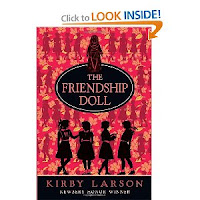
After visiting turn-of-the-last-century Texas, I traveled to New York, Chicago, rural Kentucky and across the country with an Okie child and her dad, all just before or during the Great Depression in Kirby Larson's The Friendship Doll. Following the travels of Miss Kanagawa, one of the fifty-eight Friendship Dolls sent to America by the Japanese in 1927, I criss-crossed the continent, meeting the children who awaken Miss Kanagawa's heart, and whose hearts she touches. For in the tradition of Rumer Godden's works about dolls (which I now feel compelled to reread), Miss Kanagawa is not a mere inanimate plaything. She "speaks" to children and they hear her, loud and clear and, just as they learn from her, she learns from them. However, just as I got into each story (the book is divided into separate chapters for each of the important children in Miss Kanagawa's "life"), it would end! In addition, some of the plot twists seem unnecessarily sad. (Then again, sappy endings can be annoying too - I guess I'm never satisfied!). Finally, the book jacket suggests that the reader may solve the mystery of the thirteen missing Friendship Dolls, but that mystery does not figure into the book at all. Perhaps the author was hoping a reader would turn out to be the owner of one of the missing dolls? I liked that Ms. Larson provided notes at the end, indicating which parts of the story were true to history and which she took liberties with, as well as noting where some of the Friendship Dolls can be seen.
As for adult historical fiction, I recently enjoyed The American Heiress by Daisy Goodwin.
What are your favorite historical novels, either for adults or kids? What kind of books take you back to your childhood reading habits?

If only The Evolution of Calpurnia Tate by Jacqueline Kelly had been around back then! I loved, loved, loved this book! I loved the setting (Texas, 1899), I loved the story, I loved the writing, I loved the cover, and, most of all, I loved 11-year-old Calpurnia, a budding naturalist with an interest in evolution, who is constrained by the mores of her time. Luckily, she has a mentor in her grandfather but the book's ending left a question in my mind of whether Calpurnia would fulfill her intellectual potential or be forced by circumstance into a life she considered domestic slavery. This passage, about Calpurnia's discovery that there are other women scientists, and that she is not the only one of "her kind," like the last firefly of the season, was one of my favorites: "How sad to be the last of your kind, flashing your signal in the dark, alone, to nothingness. But I was not alone, was I? I had learned that there were others of my kind out there." I hope that those others see Calpurnia's flashing signal. I know that readers of this book will.

After visiting turn-of-the-last-century Texas, I traveled to New York, Chicago, rural Kentucky and across the country with an Okie child and her dad, all just before or during the Great Depression in Kirby Larson's The Friendship Doll. Following the travels of Miss Kanagawa, one of the fifty-eight Friendship Dolls sent to America by the Japanese in 1927, I criss-crossed the continent, meeting the children who awaken Miss Kanagawa's heart, and whose hearts she touches. For in the tradition of Rumer Godden's works about dolls (which I now feel compelled to reread), Miss Kanagawa is not a mere inanimate plaything. She "speaks" to children and they hear her, loud and clear and, just as they learn from her, she learns from them. However, just as I got into each story (the book is divided into separate chapters for each of the important children in Miss Kanagawa's "life"), it would end! In addition, some of the plot twists seem unnecessarily sad. (Then again, sappy endings can be annoying too - I guess I'm never satisfied!). Finally, the book jacket suggests that the reader may solve the mystery of the thirteen missing Friendship Dolls, but that mystery does not figure into the book at all. Perhaps the author was hoping a reader would turn out to be the owner of one of the missing dolls? I liked that Ms. Larson provided notes at the end, indicating which parts of the story were true to history and which she took liberties with, as well as noting where some of the Friendship Dolls can be seen.
As for adult historical fiction, I recently enjoyed The American Heiress by Daisy Goodwin.
What are your favorite historical novels, either for adults or kids? What kind of books take you back to your childhood reading habits?
Subscribe to:
Posts (Atom)