For the second year in a row, I am running a mock Caldecott competition at my daughters' school.
I nominated 12 books this year. There were lots of wonderful books that have also been mentioned as possible contenders, but I couldn't include all of them.
Although the Caldecott committee is only supposed to consider the quality of the work, I try to present the students with a mix of books: diverse in subject matter, medium, ethnic background of the author/illustrator/characters, fiction and nonfiction.
So without further ado, our 2016 nominees are [drum roll]:
A Fine Dessert: Four Centuries, Four Families, One Delicious Treat by Emily Jenkins, illustrated by Sophie Blackall
In a Village by the Sea by Muon Van, illustrated by Amy Chu
Tricky Vic: The Impossibly True Story of the Man Who Sold the Eiffel Tower, written and illustrated by Greg Pizzoli
Waiting, written and illustrated by Kevin Henkes
My Pen, written and illustrated by Christopher Myers
Drum Dream Girl: How One Girl's Courage Changed Music by Margarita Engle, illustrated by Rafael Lopez
Water is Water: A Book About the Water Cycle by Miranda Paul, illustrated by Jason Chin
The Whisper, written and illustrated by Pamela Zagarenski
Finding Winnie: The True Story of the World's Most Famous Bear by Lindsay Mattick, illustrated by Sophie Blackall
Home, written and illustrated by Carson Ellis
We Forgot Brock!, written and illustrated by Carter Goodrich
Lenny & Lucy by Phillip C. Stead, illustrated by Erin E. Stead
Are you running or participating in a mock Caldecott this year? Is your child? What books are on your short list?
Showing posts with label School library. Show all posts
Showing posts with label School library. Show all posts
Sunday, November 29, 2015

Sunday, November 8, 2015
The Joy and Frustration of Empty Shelves
Purchasing books for the school library is an exercise in balancing the constraints of money, space, and mission (to educate? to entertain?) with the students' requests for certain books and the popularity (possibly short-lived) of certain series.

When I see empty shelves because all the books have been checked out, I am thrilled that we have books that the kids love, and I regret I don't - can't - have more of them. The Wimpy Kid shelf is perpetually empty, as are the shelves designated for other popular series, such as Captain Underpants and Big Nate, as well as the graphic novel shelf. I have four copies of Smile and it is rarely back in the library for more than a few minutes. I encourage the children, particularly the ones who I know have regular access to the public library, to seek them out there, but you know kids. It's all about immediate gratification.
We don't have more than four copies of any book. Our school has 600 students and the library can't consist just of Wimpy Kid and books by Raina Telgemeier, much as the students might wish it did! (Oh, and Minecraft - which the children always request and of which we have none. Because I refuse to have video-game or television or movie based books in the school library.) With some of these series consisting of 10 books or more, if I had four copies of each one... well, you see the problem. And what happens in a few years, if Wimpy Kid et al. is no longer popular?
However, because of the way we schedule library time, the first class to grab those Wimpy Kid books keeps getting them. They come on the first Monday of the year, take them out, and then every time they return them, they circulate to other children in the same class. Thursday classes are out of luck. We need a new system.
One idea I've proposed is that that every time a Wimpy Kid or other similarly popular book is returned, we should not let it immediately recirculate. We should hold it until the next class comes in, or even until the next day. As a matter of policy - and simplicity - we don't allow holds on books.
How many copies of popular books do you have at your/your child's school library? How do you make sure as many children as possible have access to them?
Photos of the books I DID purchase to follow in a later post!

When I see empty shelves because all the books have been checked out, I am thrilled that we have books that the kids love, and I regret I don't - can't - have more of them. The Wimpy Kid shelf is perpetually empty, as are the shelves designated for other popular series, such as Captain Underpants and Big Nate, as well as the graphic novel shelf. I have four copies of Smile and it is rarely back in the library for more than a few minutes. I encourage the children, particularly the ones who I know have regular access to the public library, to seek them out there, but you know kids. It's all about immediate gratification.
 |
| A rare sighting of TWO Wimpy Kid books on the shelf! |
However, because of the way we schedule library time, the first class to grab those Wimpy Kid books keeps getting them. They come on the first Monday of the year, take them out, and then every time they return them, they circulate to other children in the same class. Thursday classes are out of luck. We need a new system.
One idea I've proposed is that that every time a Wimpy Kid or other similarly popular book is returned, we should not let it immediately recirculate. We should hold it until the next class comes in, or even until the next day. As a matter of policy - and simplicity - we don't allow holds on books.
How many copies of popular books do you have at your/your child's school library? How do you make sure as many children as possible have access to them?
Photos of the books I DID purchase to follow in a later post!
Monday, November 2, 2015
Let's Go On A Treasure Hunt!
Let's go on a treasure hunt! What are we hunting? Words! And where are we hunting for them? In books!

In an effort to bring back dictionary usage, I wracked my brain for something that would make vocabulary fun. I'm not sure this will work, but I figured it was worth a try. I picked 10 difficult words and students will get points for: (1) finding the words in books they are reading; (2) guessing the meaning from context; (3) looking the definition up in the dictionary; (4) identifying the word's part of speech; (5) listing synonyms and antonyms of the word. May the best reader win!

In an effort to bring back dictionary usage, I wracked my brain for something that would make vocabulary fun. I'm not sure this will work, but I figured it was worth a try. I picked 10 difficult words and students will get points for: (1) finding the words in books they are reading; (2) guessing the meaning from context; (3) looking the definition up in the dictionary; (4) identifying the word's part of speech; (5) listing synonyms and antonyms of the word. May the best reader win!
Thursday, October 15, 2015
What Wouldn't You Want to Live Without?
What wouldn't you want to live without?

Chocolate? Google? Pictures? Snuggling? Cheese? Those were some of the answers our students and parents gave when we asked them that question.
 Last spring I purchased 40+ books in the You Wouldn't Want to... series (You Wouldn't Want to Live Without... Electricity/ Books/ Fire; You Wouldn't Want to Be A... Suffragist/ An Aztec Sacrifice; you get the idea!) for the school library. I knew they would be popular once they made it onto the shelves this fall, but I still wanted to draw the students' attention to this new collection. I left out slips of paper asking what they couldn't live without and tons of children (and a few parents) filled them out and, as expected, the books have proved popular.
 These books are not the type of nonfiction I usually like. I find a lot of today's nonfiction too busy (I did not grow up with all the screens and video games that get today's kids used to seeing lots of graphics and scattered information on each page). And while I think there is a place for nonfiction that provides snippets of information, I think they have to be supplemented if students want to delve more deeply into a topic. Finally, these books feel a bit gimmicky to me - they make everything about history gross, horrific and negative.
Despite myself, I do like these books. I find they go more in depth than others of this type. They are less busy than, say, the Magic School Bus books, which I find dizzying. The topics are interesting. When you think of things you wouldn't want to live without, clean water and toilets come to mind, and are covered by entries in this series, but you probably wouldn't think of things that you think you would want to live without, like insects, or extreme weather, which also are covered here. Similarly, being a suffragist or a samurai or a gladiator might sound really cool... until you read these books.
So, what wouldn't you want to live without?

Chocolate? Google? Pictures? Snuggling? Cheese? Those were some of the answers our students and parents gave when we asked them that question.
  |
| Zombies scary stuf! [sic] |
 Last spring I purchased 40+ books in the You Wouldn't Want to... series (You Wouldn't Want to Live Without... Electricity/ Books/ Fire; You Wouldn't Want to Be A... Suffragist/ An Aztec Sacrifice; you get the idea!) for the school library. I knew they would be popular once they made it onto the shelves this fall, but I still wanted to draw the students' attention to this new collection. I left out slips of paper asking what they couldn't live without and tons of children (and a few parents) filled them out and, as expected, the books have proved popular.
 These books are not the type of nonfiction I usually like. I find a lot of today's nonfiction too busy (I did not grow up with all the screens and video games that get today's kids used to seeing lots of graphics and scattered information on each page). And while I think there is a place for nonfiction that provides snippets of information, I think they have to be supplemented if students want to delve more deeply into a topic. Finally, these books feel a bit gimmicky to me - they make everything about history gross, horrific and negative.
 |
| Star Wars |
Despite myself, I do like these books. I find they go more in depth than others of this type. They are less busy than, say, the Magic School Bus books, which I find dizzying. The topics are interesting. When you think of things you wouldn't want to live without, clean water and toilets come to mind, and are covered by entries in this series, but you probably wouldn't think of things that you think you would want to live without, like insects, or extreme weather, which also are covered here. Similarly, being a suffragist or a samurai or a gladiator might sound really cool... until you read these books.
So, what wouldn't you want to live without?
Tuesday, May 19, 2015
Play Along At Home!
At school it's time for our spring library contest! The students have to figure out what the books have in common. This time the contest is divided in two - one for first and second graders and one for third through fifth graders.
 |
| Bulletin board courtesy of the 4th Grade Library Club |
Grades 1 and 2
Knuffle Bunny by Mo Willems
Dogger by Shirley Hughes
A Pocket for Corduroy by Don
Freeman
Grades 3-5
When You Reach Me by Rebecca
Stead
Tom's Midnight Garden by
Philippa Pearce
Half Magic by Edward
Eager
Seven Stories Up by Laurel
Snyder
Please enter your guess in the comments!
Good luck!
Tuesday, February 10, 2015
Let's Mock Testing
Last week the library was shut for 3 mornings for mock testing. This week the library is shut for 2 mornings for mock testing. Not real testing, mock testing.
Let's mock testing then. Here goes:
1. What is the best way to prepare students for a test?
a. Mock testing and lots of it
b. Teaching the material in an engaging way
c. Encouraging students to reading and pursue their own interests, as students can do in the library
2. What is the best way to encourage a love of learning?
a. Mock testing and lots of it
b. Teaching the material in an engaging way
c. Encouraging students to reading and pursue their own interests, as students can do in the library
3. What is the best way to improve students' language skills?
a. Mock testing and lots of it
b. Teaching the material in an engaging way
c. Encouraging students to reading and pursue their own interests, as students can do in the library
4. What is the best way to measure student progress in the elementary years?
a. Through tests written and graded by people who don't know the students
b. Through a portfolio of work
c. Through a test written by the teacher who taught the material
d. B & C
5. What is the best way to teach elementary school students?
a. Work backwards by preparing for a test written by other people
b. Teach the material in an engaging way, allowing for the occasional tangent dictated by the students' interests
6. What is the best homework for elementary school students?
a. None
b. Some review
c. Projects that can only be done with parental help
d. Projects that can be done alone
e. Reading
f. Worksheets with the words "Test Prep" plastered all over them.
In case it's not clear, I object to BOTH the mock testing and the fact that any of it takes place in the school library, thereby depriving classes of their library period. (Students who require special accommodations, such as extra time, are tested in the library.) The library is also used for nearly every meeting or event that takes place in the building. Yes, our school is in Manhattan, and yes, it's only 3 stories, and yes, we have limited space, but is there really no other room that can be used? No one would dream of using the art room or the music room. Why not?
Let's mock testing then. Here goes:
1. What is the best way to prepare students for a test?
a. Mock testing and lots of it
b. Teaching the material in an engaging way
c. Encouraging students to reading and pursue their own interests, as students can do in the library
2. What is the best way to encourage a love of learning?
a. Mock testing and lots of it
b. Teaching the material in an engaging way
c. Encouraging students to reading and pursue their own interests, as students can do in the library
3. What is the best way to improve students' language skills?
a. Mock testing and lots of it
b. Teaching the material in an engaging way
c. Encouraging students to reading and pursue their own interests, as students can do in the library
4. What is the best way to measure student progress in the elementary years?
a. Through tests written and graded by people who don't know the students
b. Through a portfolio of work
c. Through a test written by the teacher who taught the material
d. B & C
5. What is the best way to teach elementary school students?
a. Work backwards by preparing for a test written by other people
b. Teach the material in an engaging way, allowing for the occasional tangent dictated by the students' interests
6. What is the best homework for elementary school students?
a. None
b. Some review
c. Projects that can only be done with parental help
d. Projects that can be done alone
e. Reading
f. Worksheets with the words "Test Prep" plastered all over them.
In case it's not clear, I object to BOTH the mock testing and the fact that any of it takes place in the school library, thereby depriving classes of their library period. (Students who require special accommodations, such as extra time, are tested in the library.) The library is also used for nearly every meeting or event that takes place in the building. Yes, our school is in Manhattan, and yes, it's only 3 stories, and yes, we have limited space, but is there really no other room that can be used? No one would dream of using the art room or the music room. Why not?
Sunday, February 8, 2015
My First Book Challenge(s)
Although I run the school library, I'm not there full-time. When I arrived the other afternoon, another parent volunteer reported to me that a third-grade teacher who is, shall we say, quirky, had requested (demanded?) that the fantastic (my adjective, not hers) graphic novel Smile be taken off that shelves as it was "inappropriate." She had put post-its on specific pages that involved "boy talk" and a game of Spin the Bottle. She objected to the part where Raina's friends encourage her to "glam up" to garner male attention.
Of course, like most censors, she had completely missed the point of the book: that girls should be themselves and should be comfortable with their appearance.
The book is so popular, and deservedly so, that I actually ordered 3 copies of it (and 3 each of Raina Telgemeier's other books), which is pretty much unheard of for me.
But I'm in a bit of a tough spot here. I'm an unpaid volunteer, not an employee. And I'm not the principal's favorite. I must admit, I'm thinking of compromising and taking the book off the shelf when her class comes. It is more appropriate for 4th and 5th grade, that is true. And some classroom teachers do retain veto power of what books their students check out from the school library. Certainly in the future she would not permit her students to check Smile out, so I'm just short-circuiting the process.
To some extent, I "censor" all the time, whenever I make choices for the library. This is, after all, a school library, serving children ages 4-11. Moreover, we have limited space. I keep in mind those limitations when I purchase books. I don't buy "superhero" books or Minecraft books or comic books for the school library, despite student requests. But the only book I've ever removed from the shelves for inappropriateness was The Hunger Games.
Wow, that sounds a lot like rationalizing, doesn't it? I feel like I'm colluding in censorship. What would you do?
Meanwhile, another volunteer reported that a parent came in, angry that his child kept coming home with books "too hard" for him. She referred him to the classroom teacher. I would have suggested that he read the books to his child. And that reading above your level can open up a whole new world.
I do feel like I've just gotten my librarian wings, though... or perhaps pages?
Of course, like most censors, she had completely missed the point of the book: that girls should be themselves and should be comfortable with their appearance.
The book is so popular, and deservedly so, that I actually ordered 3 copies of it (and 3 each of Raina Telgemeier's other books), which is pretty much unheard of for me.
But I'm in a bit of a tough spot here. I'm an unpaid volunteer, not an employee. And I'm not the principal's favorite. I must admit, I'm thinking of compromising and taking the book off the shelf when her class comes. It is more appropriate for 4th and 5th grade, that is true. And some classroom teachers do retain veto power of what books their students check out from the school library. Certainly in the future she would not permit her students to check Smile out, so I'm just short-circuiting the process.
To some extent, I "censor" all the time, whenever I make choices for the library. This is, after all, a school library, serving children ages 4-11. Moreover, we have limited space. I keep in mind those limitations when I purchase books. I don't buy "superhero" books or Minecraft books or comic books for the school library, despite student requests. But the only book I've ever removed from the shelves for inappropriateness was The Hunger Games.
Wow, that sounds a lot like rationalizing, doesn't it? I feel like I'm colluding in censorship. What would you do?
Meanwhile, another volunteer reported that a parent came in, angry that his child kept coming home with books "too hard" for him. She referred him to the classroom teacher. I would have suggested that he read the books to his child. And that reading above your level can open up a whole new world.
I do feel like I've just gotten my librarian wings, though... or perhaps pages?
Monday, February 2, 2015
Heresy or a Valid Exercise of Discretion?
 |
| New Books Shelfie |
 |
| For younger readers |
 |
| For older readers |
 But what about books that come with a call number that I feel will relegate the book to the status of buried treasure, where no one will find it? What about the Guiness World Records, which the students LOVE, but will never find under its 031 call number? That one they can at least ask for by name. But what about a book like Brown Girl Dreaming? Most of them have never heard of the book or Jacqueline Woodson. They are certainly not going to ask for it or for books by or about her and will never find it in the biography section, which is how it came coded to us (and how it's shelved at the NYPL). Why isn't it shelved in poetry? Even there, it's unlikely to be found. Sure, I can promote it, put it on a display, but once it's time to change the display, it disappears again into the recesses of the biography or poetry sections.
What about this book on women in Congress? It came to us with a call number of 320.08, which is, by all rights, where it belongs. But no one - no one - will find it there. What about the 900s for history? I haven't decided on this one yet...
And why, why, why did Smile come to us with a call number in the 700s? This one was an easy call - it will get a G for graphic novel (as it does in the NYPL).
 |
| Non-fiction |
P.S. About this post's title: you can tell I used to be a lawyer, right?
Sunday, February 1, 2015
"Becust the pichrs toc to me" [sic]
 |
| One first grader's opinion |
 |
| Another first grader's ballot: "The colors poped [sic]." |
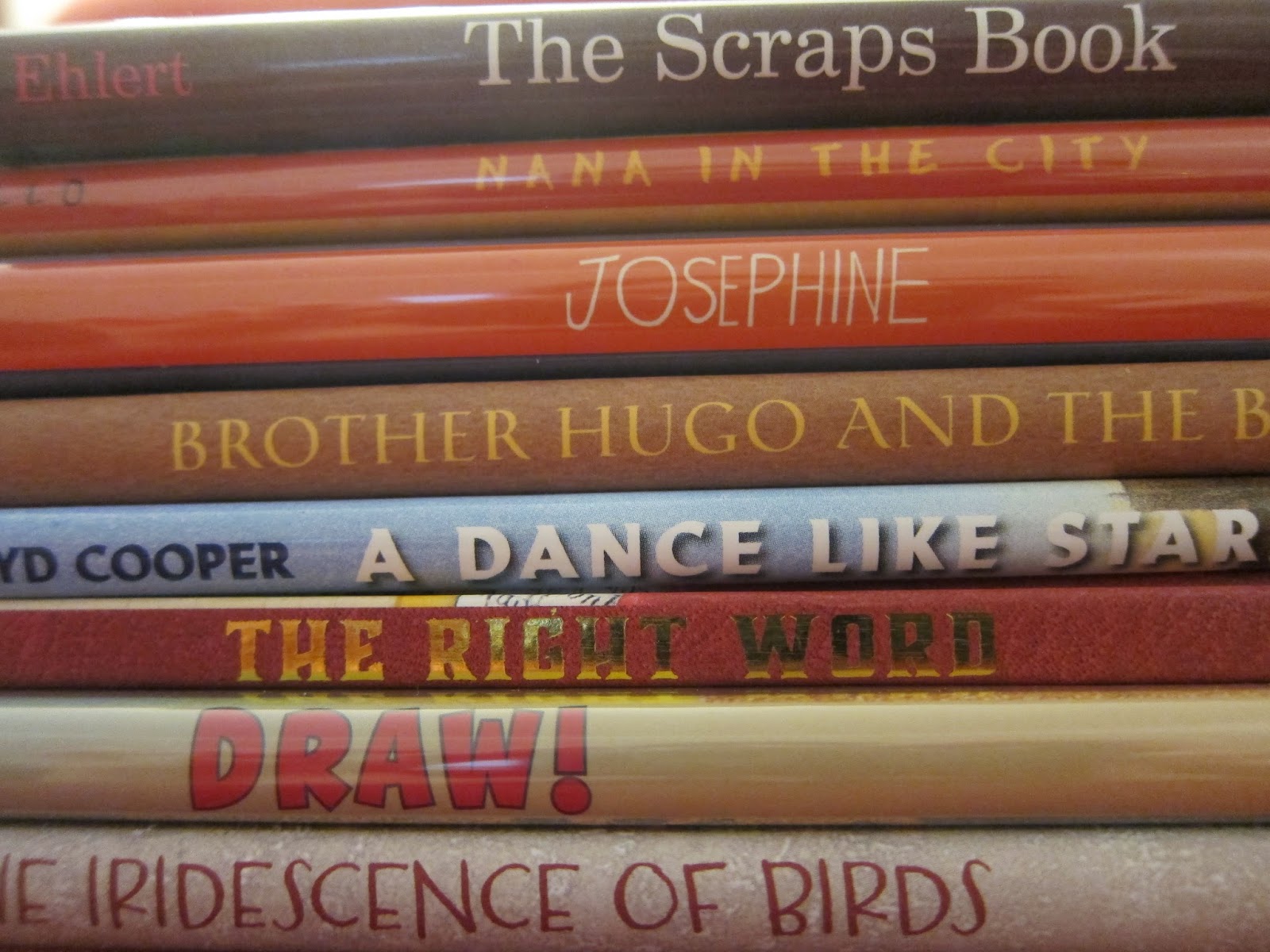
1. Draw!: 102 points (20 first place votes, 15 second place votes, 12 third place votes)
 |
| Fourth graders liked Flashlight |
2. Flashlight: 76 points (17 first place, 11 second place, 3 third place)
3. The Iridescence of Birds: 49 points (9 first place, 8 second place, 6 third place)
4. The Right Word: Roget and His Thesaurus: 48 points (10 first place, 8 second place, 6 third place)
 |
| A first grader gets right to the point. |
5. Viva Frida: 42 points (4 first place, 6 second place, 3 third place)
6. Nana in the City: 39 points (5 first place, 7 second place, 10 third place)
6. The Scraps Book: 39 points (4 first place, 9 second place, 9 third place)
6. A Dance Like Starlight: 39 points (5 first place, 8 second place, 8 third place)
6. Josephine: 39 points (6 first place, 6 second place, 9 third place)
7. Brother Hugo and the Bear: 33 points (4 first place, 7 second place, 7 third place)
Friday, January 16, 2015
My Caldecott Votes
Art is a matter of personal taste. There's no getting around it. Sure, you can judge artists based on technical mastery, but when you have talented artists working in different styles, media, and palettes, a lot comes down to personal taste. Which is why awards like the Caldecott are so interesting. The committee members who award the Caldecott change every year, which means that, while there's no predicting who will win, different types of art and artists are given a chance. It also means knowing that if only the committee from year X judged in year Y, the line-up would be completely different.
So what follows is my take on our school's mock Caldecott nominees.

 The Right Word: Roget and His Thesaurus by Jen Bryant, illustrated by Melissa Sweet. Sweet's work is always beautiful and intricate. I recently went to the Original Art exhibit at The Society of Illustrators and one of her works for this book was shown. It had so much layering and depth in person, it was astonishing. I love how she incorporates synonyms and words into her collages. But I keep hesitating. There's something about the art here that seems a little too busy, a little distracting. Unlike her work in Firefly July, which is simpler and more pure, somehow, or her work in Brave Girl, which her collage style fits perfectly, given that the story is about the garment industry. Finally, I know this is not supposed to be a consideration, but there's something that bothers me when an illustrator's work feels repetitive. It is nice - especially for children - to be able to recognize an illustrator's work at a glance, but sometimes it feels unoriginal.


 Nana in the City by Lauren Castillo. I love this one! I love how the playful, almost childlike style complements the fact that the child is the narrator. I also like how the illustrations add to the story; for example, when the grandma gives money to a homeless person, which is not explicitly mentioned in the text. Her depiction of New York is beautiful but not completely idealized. The buildings are so tall they literally cannot be contained on the page. And the grandmother's relationship with the boy is so tender.
 Flashlight by Lizi Boyd. The use of the flashlight to illuminate areas of the pictures is ingenious but I feel like the use of cut-outs as well is overkill. I feel like it actually takes away from the other elements.
The Iridescence of Birds: A Book About Henri Matisse by Patricia Maclachlan, illustrated by Hadley Hooper. This book has been growing on me. The use of the blue-gray colors capture the drabness of where Matisse grew up and the contrast with the colors and patterns of the textiles he loved is dramatic.


 Josephine: The Dazzling Life of Josephine Baker by Patricia Hruby Powell, illustrated by Christian Robinson. When I saw this book, I had a sense of deja vu. Where had I seen it before? It turns out I was thinking of another book illustrated by Christian Robinson, Harlem's Little Blackbird, a biography of Florence Mills, which treats a similar topic and uses a similar color palette. Which brings me to the same complaint I had about Melissa Sweet's work. Can you tell which picture above is from which book? Nevertheless, I love the colors - mustardy yellow, mossy green, persimmon orange. The use of different fonts here is stunning and Robinson really captures a sense of movement and jazziness in still pictures. This one might be my favorite!

Viva Frida by Yuyi Morales and Tim O'Meara (photographer). Okay, I know it's not a technical term, but this book creeped me out!

 Brother Hugo and the Bear by Katy Beebe, illustrated by S.D. Schindler. Original with a wonderful incorporation of the style of medieval illuminated manuscripts which fits the text perfectly.
So in the end, out of these, I think I'd rank Josephine or Nana in the City first, followed by The Right Word. Tune in next time to find out what I think of other contenders that didn't make it into our school competition.
So what follows is my take on our school's mock Caldecott nominees.
The Right Word: Roget and His Thesaurus by Jen Bryant, illustrated by Melissa Sweet. Sweet's work is always beautiful and intricate. I recently went to the Original Art exhibit at The Society of Illustrators and one of her works for this book was shown. It had so much layering and depth in person, it was astonishing. I love how she incorporates synonyms and words into her collages. But I keep hesitating. There's something about the art here that seems a little too busy, a little distracting. Unlike her work in Firefly July, which is simpler and more pure, somehow, or her work in Brave Girl, which her collage style fits perfectly, given that the story is about the garment industry. Finally, I know this is not supposed to be a consideration, but there's something that bothers me when an illustrator's work feels repetitive. It is nice - especially for children - to be able to recognize an illustrator's work at a glance, but sometimes it feels unoriginal.
Draw! by Raul Colon. Technically lovely, this style - and palette - do not appeal to me. I can't cite a specific reason!
Nana in the City by Lauren Castillo. I love this one! I love how the playful, almost childlike style complements the fact that the child is the narrator. I also like how the illustrations add to the story; for example, when the grandma gives money to a homeless person, which is not explicitly mentioned in the text. Her depiction of New York is beautiful but not completely idealized. The buildings are so tall they literally cannot be contained on the page. And the grandmother's relationship with the boy is so tender.Flashlight by Lizi Boyd. The use of the flashlight to illuminate areas of the pictures is ingenious but I feel like the use of cut-outs as well is overkill. I feel like it actually takes away from the other elements. The Iridescence of Birds: A Book About Henri Matisse by Patricia Maclachlan, illustrated by Hadley Hooper. This book has been growing on me. The use of the blue-gray colors capture the drabness of where Matisse grew up and the contrast with the colors and patterns of the textiles he loved is dramatic.
Josephine: The Dazzling Life of Josephine Baker by Patricia Hruby Powell, illustrated by Christian Robinson. When I saw this book, I had a sense of deja vu. Where had I seen it before? It turns out I was thinking of another book illustrated by Christian Robinson, Harlem's Little Blackbird, a biography of Florence Mills, which treats a similar topic and uses a similar color palette. Which brings me to the same complaint I had about Melissa Sweet's work. Can you tell which picture above is from which book? Nevertheless, I love the colors - mustardy yellow, mossy green, persimmon orange. The use of different fonts here is stunning and Robinson really captures a sense of movement and jazziness in still pictures. This one might be my favorite!
The Scraps Book: Notes from a Colorful Life by Lois Ehlert. Beautiful and so interesting. My younger daughter says Lois Ehlert's books are boring but this book about how she makes those boring books is interesting! But since it is an amalgam of her earlier work, a collage of collages in a way, I feel like it is lacking an element of originality that is award-worthy.
Viva Frida by Yuyi Morales and Tim O'Meara (photographer). Okay, I know it's not a technical term, but this book creeped me out!
A Dance Like Starlight: One Ballerina's Dream by Kristy Dempsey, illustrated by Floyd Cooper. Painterly. The expression on the girl's face is one of sheer joy.
Brother Hugo and the Bear by Katy Beebe, illustrated by S.D. Schindler. Original with a wonderful incorporation of the style of medieval illuminated manuscripts which fits the text perfectly. So in the end, out of these, I think I'd rank Josephine or Nana in the City first, followed by The Right Word. Tune in next time to find out what I think of other contenders that didn't make it into our school competition.
Monday, January 12, 2015
The Standings
 So, after approximately a week of voting, here are the current standings. I gave each book 3 points for each first-place vote, 2 points for each second-place vote, and 1 point for each third-place vote. Draw! is far in the lead and has been since the very beginning. It has been very educational for me, seeing what appeals to the kids. My order would be completely different!
Most of the votes so far come from second-graders. They are old enough to understand the project and read the instructions, yet they are not in a "testing grade." Sad to say, but that is certainly a factor.
In order of how they currently stand in the voting:
2 The Right Word: Roget and His Thesaurus: 33 points (8 first place, 2 second place, 5 third place)
3. Flashlight: 31 points (4 first place, 8 second place, 3 third place) (This one moved from a distant last place at the end of last week.)
 4. Nana in the City: 30 points (4 first place, 6 second place, 6 third place)
5. Josephine: 28 points (5 first place, 4 second place, 5 third place)
6. Viva Frida: 27 points (6 first place, 3 second place, 3 third place)
7. Brother Hugo and the Bear: 26 points (4 first place, 5 second place, 4 third place)
8. The Scraps Book: 25 points (3 first place, 5 second place, 6 third place)
8. A Dance Like Starlight: 25 points (4 first place, 3 second place, 7 third place)
9. The Iridescence of Birds: 22 points (3 first place, 5 second place, 3 last place)
Wednesday, December 24, 2014
The Mockdecott is Coming!

I am the volunteer librarian at my daughters’ K-5 school. The library does NOT get a lot of love and support from the administration, and even the teachers who love it are pressed for time. However, I’m making our first attempt at a mock Caldecott this year. I picked our 10 nominees based mostly on online "buzz," . I also wanted some diversity of subjects, genre, illustrators, artistic styles and media, and wordless books as well as those with text. In a school that is nearly half Latino and a quarter black, I wanted the students to see themselves reflected either in the subject matter and/or the authors and illustrators themselves in at least some of the books. Of course, those are all factors that the committee is not supposed to consider. But my goals are a bit different. Here is my list, in no particular order:
 The Right Word: Roget and His Thesaurus by Jen Bryant, illustrated by Melissa Sweet
Draw! by Raul Colon
The Iridescence of Birds: A Book About Henri Matisse by Patricia Maclachlan, illustrated by Hadley Hooper
Josephine: The Dazzling Life of Josephine Baker by Patricia Hruby Powell, illustrated by Christian Robinson
The Scraps Book: Notes from a Colorful Life by Lois Ehlert
Viva Frida by Yuyi Morales and Tim O'Meara (photographer)
A Dance Like Starlight: One Ballerina's Dream by Kristy Dempsey, illustrated by Floyd Cooper
I'm asking the students - and teachers - to rank their top three. I'll rank mine in an upcoming post. What are yours? Or do you have other favorites this year?
Do you do a mock Caldecott at your school? Are your criteria for choosing nominees different from those considered by the real Caldecott committee?
Do you do a mock Caldecott at your school? Are your criteria for choosing nominees different from those considered by the real Caldecott committee?
Wednesday, December 17, 2014
What Is Wrong With This Picture?
I'm running a mock Caldecott this year!!
I haven't been posting much because I'm now basically running my daughters' school library. As a volunteer. And I have wanted to tell you about all the interesting things I've been doing there, such as our "guess the theme" competition and the 4th Grade Library Club, but I've been too busy actually doing them to write about them.
But I couldn't resist posting this. In preparation for our mock Caldecott (or our Mockdecott, as my husband christened it), I did some research about the award.
And then, when wrapping various Chanukah and birthday gifts, I came across this:

Let's go in for a close-up, shall we?

Do you see what I see? Tell me in the comments!
I let Amazon, where I purchased the book, know, and I emailed Grace Lin as well. Let's see if I hear back.
I haven't been posting much because I'm now basically running my daughters' school library. As a volunteer. And I have wanted to tell you about all the interesting things I've been doing there, such as our "guess the theme" competition and the 4th Grade Library Club, but I've been too busy actually doing them to write about them.
But I couldn't resist posting this. In preparation for our mock Caldecott (or our Mockdecott, as my husband christened it), I did some research about the award.
And then, when wrapping various Chanukah and birthday gifts, I came across this:
Let's go in for a close-up, shall we?
Do you see what I see? Tell me in the comments!
I let Amazon, where I purchased the book, know, and I emailed Grace Lin as well. Let's see if I hear back.
Friday, September 27, 2013
How The New Curriculum + The Common Core = Less Reading
As I've mentioned before, I volunteer at my daughters' public school, entirely parent-run library. This year, as we sat down with the administration to arrange the class schedule, we were informed that teachers had been approaching the administration and requesting that they only bring their classes to the library every other week, rather than every week. The reason? The new curriculum. Whether it's due to the curriculum itself requiring more time, or the fact that the teachers are - rightly - overwhelmed by being handed a new curriculum with no time to review it before using it (in fact, our school did not even have the ELA curriculum on the first day of school and as of now is only in possession of Unit 1; rumor has it that other units are not even written yet!), it is just sad that the alleged raising of standards results in teachers feeling that they don't have time to allow their students - many of whom do not or cannot go to the public library - to choose their own books.
One last word about the Common Core. I got a peek at the kindergarten ELA curriculum the other day. The curriculum our school is using is Ready-Gen by - who else? - Pearson, it of the completely mismanaged G&T testing. It includes such gems as having 5-year-olds draw pictures of past-tense verbs like "quacked" and "flapped" (the first unit is on ducks), words like "distance" (not a short or long distance, just distance), leaves little space for the children to write, and what space there is are lines that are too small for typically-oversized kindergarten handwriting. I almost cried.
How is the Common Core working out in your school?
One last word about the Common Core. I got a peek at the kindergarten ELA curriculum the other day. The curriculum our school is using is Ready-Gen by - who else? - Pearson, it of the completely mismanaged G&T testing. It includes such gems as having 5-year-olds draw pictures of past-tense verbs like "quacked" and "flapped" (the first unit is on ducks), words like "distance" (not a short or long distance, just distance), leaves little space for the children to write, and what space there is are lines that are too small for typically-oversized kindergarten handwriting. I almost cried.
How is the Common Core working out in your school?
Monday, January 30, 2012
Weeding Progress Report
I wrote earlier about weeding the fiction collection of my daughter's school library. So far, I've removed approximately 50-60 books, which is probably only about 1000 strong (excluding certain series like Magic Treehouse, Cam Jansen, A to Z Mysteries, etc.). On principle alone I've removed any "movie novelizations" or books adapted from television shows (like one horrific take-off on Little House on the Prairie). I've kept all the books that we have by certain authors, including Betsy Byars, Beverly Cleary, Andrew Clements, Sharon Creech and others, even though I don't see them flying off the shelves - both because while I'm familiar with the author in general, I'm not familiar enough with each book individually to determine which should be kept and which shouldn't and because I know some students like to read as many books by their favorite author as they can get their hands on, varying quality be damned. I've kept only one copy of classics, award winners, and other books that look worthwhile but that just aren't getting read, like Julie of the Wolves (even without circulation records, I can assure, kids are not lining up for this one) and Lois Lowry's Anastasia books, although I'm personally a big fan. And now that I finally have access to some circulation records, I'll be going through the shelves again.
So, how am I doing? And when you weed, do you aim to remove a certain percentage of your current collection?
So, how am I doing? And when you weed, do you aim to remove a certain percentage of your current collection?
Monday, January 9, 2012
Weeding Fiction: Advice Needed!
I volunteer at my daughter's public school library and have been tasked with weeding its fiction collection (excluding picture books). Here's my problem: unlike non-fiction, which can become obviously out-of-date, fiction doesn't age in the same way. Sure, some old books become dated but other old books become classics. So how do I figure out which are which (other than the obvious, well-known classics or award-winners)?
This is an urban public school which serves a primarily poor population, many of whom speak a language other than English at home. The kids' favorite books are the Wimpy Kid books and books of that ilk. Anything in a diary format and/or with illustrations is popular. As I reviewed the fiction shelves, I found tons of books which I've never seen children take out: books from the 60s and 70s, historical fiction, books about Native Americans, and so on. Those books are, to put it mildly, not exactly flying off the shelves. But some of them are great books. So... how do I decide which books to keep?
Any advice is appreciated.
This is an urban public school which serves a primarily poor population, many of whom speak a language other than English at home. The kids' favorite books are the Wimpy Kid books and books of that ilk. Anything in a diary format and/or with illustrations is popular. As I reviewed the fiction shelves, I found tons of books which I've never seen children take out: books from the 60s and 70s, historical fiction, books about Native Americans, and so on. Those books are, to put it mildly, not exactly flying off the shelves. But some of them are great books. So... how do I decide which books to keep?
Any advice is appreciated.
Sunday, November 13, 2011
How'd I Do?: Librarian for A Day... Or Two Hours


 My daughter's public school library is run and staffed entirely by volunteers. I work a two-hour shift once a week. The job consists mostly of checking books in and out, shelving, and handling clerical tasks (pasting new bar codes on books, for example). But every now and then a student comes in who really loves books and actually asks my advice. One of them came in last week and again today. When I first met her last week, she was looking for a book on John Adams because, "he's my favorite president." Today this fourth grader, clearly a strong reader with lots of interests told me, "I'm just looking for a really good book. Any recommendations?" Browsing our (fairly limited) shelves, I suggested Anne of Green Gables by L.M. Montgomery, The Doll's House by Rumer Godden, The Phantom Tollbooth by Norton Juster, Tuck Everlasting by Natalie Babbitt, Half Magic by Edward Eager and When You Reach Me by Rebecca Stead. She ended up taking Anne of Green Gables and Robinson Crusoe by Daniel Defoe (her own idea), both of which she was adamant about wanting to make sure were not "children's editions." I assured her I would never give her a children's edition! She spent so long making up her mind that her teacher sent another student from her class looking for her. She made being a librarian for a few hours really fun!
With my oldest child only 6 and having only recently started reading middle-grade and YA fiction as an adult, I am still working on recommending books for this age group. So, how'd I do?
Subscribe to:
Posts (Atom)