The letter Z has it hard, being stuck at the end of the alphabet. Lots of alphabet books play with this theme, with Z and other letters towards the back of the alphabet wishing to be bumped up to the front of the line, among them Z is for Moose, A Call for A New Alphabet, and AlphaOops!: The Day Z Went First. But who knew that Benjamin Franklin wrote a sketch suggesting exactly that?
In Jill Lepore's fascinating and beautifully written biography of Franklin's sister Jane, Book of Ages: The Life and Opinions of Jane Franklin, she quotes from this very work, entitled The Petition of the Letter Z. Franklin writes that Z laments "That he is not only plac'd at the Tail of the Alphabet, when he had as much Right as an other to be at the Head; but is, by the Injustice of his Enemies totally excluded from the Word WISE, and his place injuriously filled by a little, hissing, crooked, serpentine, venomous Letter called S." Lepore writes that "The letter Z's petition is denied, however, the judges urging, 'that Z be admonished to be content with his Station, forbear Reflections upon his Brother Letters, & remember his own small Usefulness, and the little Occasion there is for him in the Republick of Letters, since S, whom he so despises, can well serve instead of him.'"
Franklin also developed a new alphabet, seeking to create a one-to-one correspondence between letters and sounds. That is, each letter would only make one sound (unlike c, as we use it) and each sound would only be represented by a single letter (that is, sounds like "ch" would not need to be represented by two letters). Obviously, it never caught on. But such an alphabet would have proved useful to those without formal education, like Franklin's sister Jane, as well as to those who, despite their education, find English spelling almost impossible. Because the spelling of American English has changed over time, and because Jane Franklin's lack of a formal education meant her spelling was largely phonetic, Lepore writes in a note to the reader, "All original English spellings have been retained. Spelling is part of the story." I told you her writing was beautiful! Even in a note to the reader.
And Z never seems to give up hope.
What other books do you know where Z seeks a more prominent position in the alphabet?
Showing posts with label ABC books. Show all posts
Showing posts with label ABC books. Show all posts
Saturday, November 23, 2013

Thursday, September 19, 2013
Library (and Bookstore) Round-up #11, Part 1: Picture Books and Early Readers
Reviews of the latest picture books we have out from the library... or couldn't resist buying!

 The Twins' Blanket by Hyewon Yum. A sweet story about twin sisters who have shared everything since - and including - the womb - as well as a bed and a blanket. When their mother decides it is time for them to each have her own bed and blanket, she settles sibling rivalry over who should keep the original blanket with a satisfying Solomonic decision that provides each girl with a memento of their shared nights together. The first time the girls retire to their new beds and blankets, they discover that they can't fall asleep without each other. They hold hands across the divide between their beds and fall asleep, alone yet together, for the first time. The illustrations here, with the endpapers done in the pattern each girl chooses for her own blanket, are beautiful, with bright bold colors. It is amazing how many themes Yum addresses in this short, seemingly simple picture book: about siblings, twins, sharing, rivalry, parenting, bedtime, loveys and more. The author description states that Yum is herself a twin, and her understanding of the special relationship twins have is very much in evidence here. A perfect baby gift for new twin girls.
 Ling and Ting Share a Birthday. Another book about twin girls, this time an early reader! The sequel to Ling and Ting: Not Exactly the Same!, this book contains six stories about the girls' birthday and how they, too, like to share everything. My five-year-old loves the first one so I actually purchased this one. A great addition.
 A Funny Little Bird by Jennifer Yerkes. This book's stunning artwork,
with its amazing use of negative space, is the real
draw (tee-hee) here. The plot, with its lesson about being humble and using your talents to help others, and the
seemingly sudden ability of the invisible bird to make other animals
invisible, is much weaker. But the illustrations more than make up for
it.
A Funny Little Bird by Jennifer Yerkes. This book's stunning artwork,
with its amazing use of negative space, is the real
draw (tee-hee) here. The plot, with its lesson about being humble and using your talents to help others, and the
seemingly sudden ability of the invisible bird to make other animals
invisible, is much weaker. But the illustrations more than make up for
it.

ABC is for Circus by Patrick Hruby. What a shame that this alphabet book, with its vibrant, unique illustrations, wasn't published when my daughters were toddlers! Unfortunately, my daughter have long outgrown alphabet books, but I highly recommend it to anyone with children in their life who are the right age for it.

Rifka Takes a Bow by Betty Rosenberg Perlov. The debut book by a 96-year-old author. Isn't that reason enough to check this book out? This book is set in the heyday of the Yiddish theatre in the 1920s, for which the author's parents actually performed, wrote, and produced. However, I found the exaggerated, cartoony illustrations, combined with the varying fonts which wander across the page, to be too busy for my taste.
What picture books do you have out from the library now?
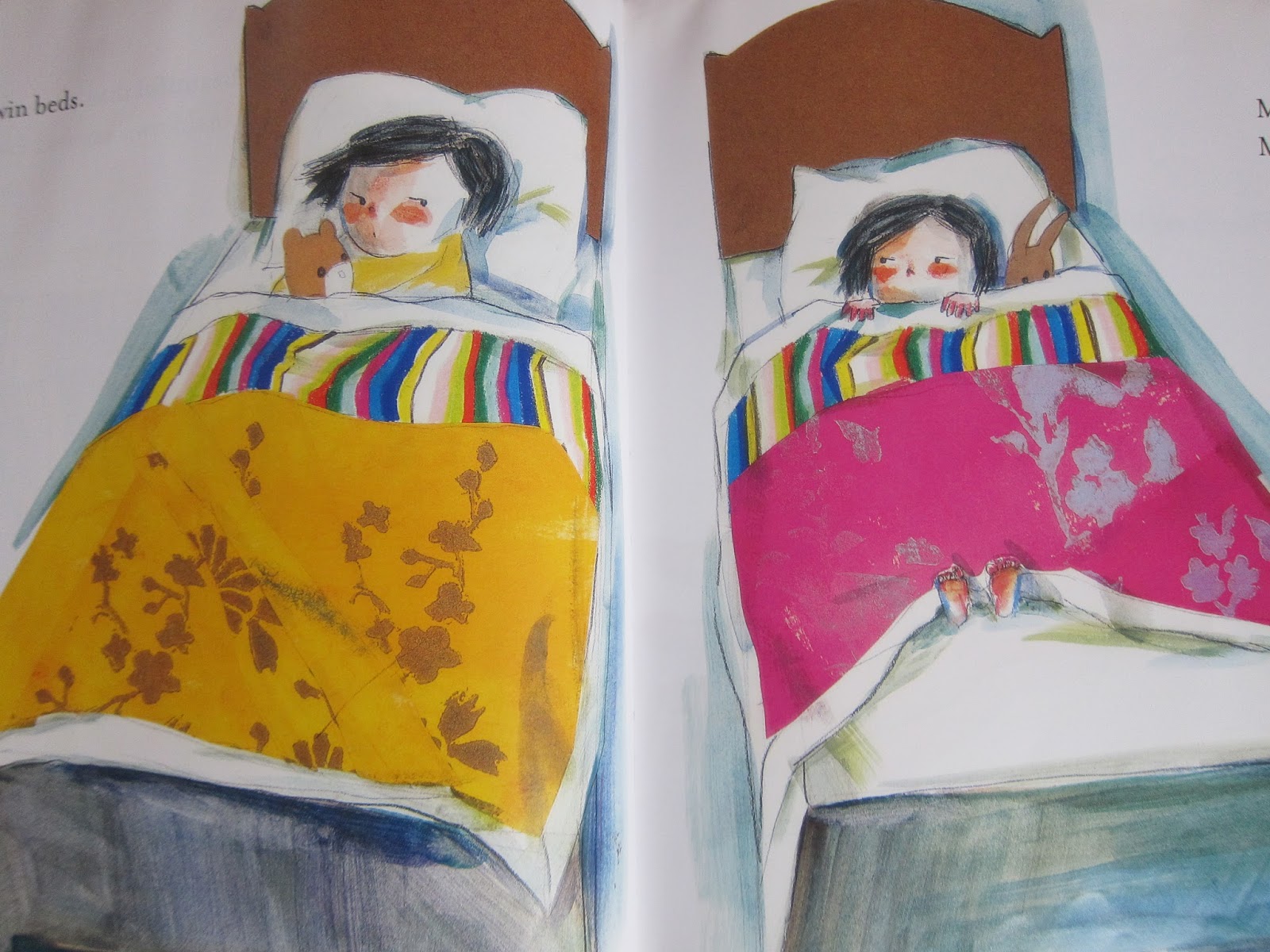
 The Twins' Blanket by Hyewon Yum. A sweet story about twin sisters who have shared everything since - and including - the womb - as well as a bed and a blanket. When their mother decides it is time for them to each have her own bed and blanket, she settles sibling rivalry over who should keep the original blanket with a satisfying Solomonic decision that provides each girl with a memento of their shared nights together. The first time the girls retire to their new beds and blankets, they discover that they can't fall asleep without each other. They hold hands across the divide between their beds and fall asleep, alone yet together, for the first time. The illustrations here, with the endpapers done in the pattern each girl chooses for her own blanket, are beautiful, with bright bold colors. It is amazing how many themes Yum addresses in this short, seemingly simple picture book: about siblings, twins, sharing, rivalry, parenting, bedtime, loveys and more. The author description states that Yum is herself a twin, and her understanding of the special relationship twins have is very much in evidence here. A perfect baby gift for new twin girls.
 Ling and Ting Share a Birthday. Another book about twin girls, this time an early reader! The sequel to Ling and Ting: Not Exactly the Same!, this book contains six stories about the girls' birthday and how they, too, like to share everything. My five-year-old loves the first one so I actually purchased this one. A great addition.
  A Funny Little Bird by Jennifer Yerkes. This book's stunning artwork,
with its amazing use of negative space, is the real
draw (tee-hee) here. The plot, with its lesson about being humble and using your talents to help others, and the
seemingly sudden ability of the invisible bird to make other animals
invisible, is much weaker. But the illustrations more than make up for
it.
A Funny Little Bird by Jennifer Yerkes. This book's stunning artwork,
with its amazing use of negative space, is the real
draw (tee-hee) here. The plot, with its lesson about being humble and using your talents to help others, and the
seemingly sudden ability of the invisible bird to make other animals
invisible, is much weaker. But the illustrations more than make up for
it. 
ABC is for Circus by Patrick Hruby. What a shame that this alphabet book, with its vibrant, unique illustrations, wasn't published when my daughters were toddlers! Unfortunately, my daughter have long outgrown alphabet books, but I highly recommend it to anyone with children in their life who are the right age for it.

Rifka Takes a Bow by Betty Rosenberg Perlov. The debut book by a 96-year-old author. Isn't that reason enough to check this book out? This book is set in the heyday of the Yiddish theatre in the 1920s, for which the author's parents actually performed, wrote, and produced. However, I found the exaggerated, cartoony illustrations, combined with the varying fonts which wander across the page, to be too busy for my taste.
What picture books do you have out from the library now?
Tuesday, February 5, 2013
Truly Vintage Alphabet Books


 Over the weekend we went to the New-York Historical Society Museum & Library (yes, they put a hyphen in New-York). Our first stop was not the DiMenna Children's History Museum but a small exhibit on the fourth floor of a collection of not just model trains but all their accoutrements - train stations, miniature figurines, merry-go-rounds, and more. There was a pamphlet available for a self-guided scavenger hunt and it was a blast. Then we headed downstairs for the Children's Museum. My older daughter loved it (her class has been having regular visits from an educator from the Society) but I was unimpressed, except by these vintage alphabet books and games.
There's a reason the Historical Society has been given the nickname "New York City's attic!"
Friday, February 1, 2013
ABC Books: Works of Art, Humor, or Pedagogy?


 I love alphabet books. Like certain poetry forms, the limits imposed by the form can be one of their strengths. But they can also get repetitive and unoriginal. For example, I thought the non-traditional alphabet books, Z is for Moose (reviewed here) and A Call for a New Alphabet were unique and funny. In both of those, a letter towards or at the end of the alphabet wants to be moved up in the world. But when I saw A is for Musk Ox and A is for Salad (which, to be fair, was published the earliest of the four mentioned here), I just thought, How many of these types of alphabet books do we need?!? A is for Musk Ox follows the pattern of Z is for Moose and A Call for a New Alphabet, as the musk ox pastes the word musk ox over the correct word for each letter (e.g., on the cover you can see that it is covering up the word apple). A is for Salad has an "incorrect" word choice for each letter... but a picture of an animal that does start with that letter eating or doing the "incorrect thing: e.g. the F page says "F is for soup" but depicts a frog eating that soup. These books appeal to a very narrow audience - children who already know the alphabet and are old enough to get the joke, yet young enough not to be bored or turned off by an alphabet book. These are works of humor more than teaching tools.
In The Absolutely Awful Alphabet by Mordicai Gerstein and An Annoying ABC by Barbara Bottner and illustrated by Michael Emberly, each letter does (or names a person who does) something bad to the next letter or person.
 Denise Fleming's Alphabet Under Construction also has a plot, as a mouse creates each letter of the alphabet, airbrushing the A, gluing the G, kinking the K (my favorite) and finally zipping the Z. I prefer these, as they do have a plot. My favorite alphabet book with a plot is Alison Murray's Apple Pie ABC which I review here.
 There is room on the bookshelf, of course, for all types of alphabet books. But not my bookshelf, in my small NYC apartment. I'll stick to my old favorites, discussed here and here, many of which are works of art more than humor or pedagogy. The rest I'll just borrow from the library.
What would make you buy an alphabet book? Which would you buy as a gift? To teach your own child? For a classroom? For a library?
Sunday, April 29, 2012
Library Round-Up #5
Brief reviews of some of the books from our recent library haul:

How Many Jelly Beans? by Andrea Menotti. Despite the rave reviews this one is getting, it just doesn't do it for me. I know it's a concept book but still... a little more plot, please. Not to mention that I don't understand the choice to write out many of the numbers rather than represent them numerically. 1,000 and 100,000 are shown numerically, but why not 10 and 1,000,000? Seeing all those zeros is another way of getting the message across, not to mention it helps children associate the quantity with its numerical representation. Also, my daughter - the older one! - tore the giant gatefold the first time she opened it... it's really just too big for kids to manage without guidance. It is nice, though, that because of this book my 4-year-old grasped the idea that "The smaller they are, the more that fit on a page." The way the idea of division was portrayed was great, too, with the idea of 1,000 jelly beans in a year being shown as 2 or 3 per day on calendar pages.
Neville by Norton Juster. My 4-year-old really likes this book about a boy who moves to a new town and uses an ingenious - or, depending on your perspective, strange and perhaps counterproductive - technique to make new friends. To give it away, he goes around calling for Neville, who is, of course, himself. I just don't get it. What's going to happen tomorrow when all his new friends find out who he really is?
 Z is for Moose by Kelly Bingham. In the tradition of A Call for a New Alphabet, a letter towards - or at - the end of the alphabet wants to be moved up and just won't take no for an answer!
Thunder Cake by Patricia Polacco. Not a new book, I put this one on hold when I saw it... somewhere! My kids love it and now want me to try the cake recipe at the end... which calls for a rather strange secret ingredient. Do I dare?
BookSpeak! by Laura Purdie Salas. A great concept, these poems about books are a bit uneven in execution. I liked Hydrophobiac, about a book's worst fear, and the one about bookplates the best.
Forget-Me-Nots: Poems to Learn by Heart edited by Mary Ann Hoberman. I'm still on the hunt for the perfect poetry compilation or two to add to our collection and I don't think this one is it. A nice enough collection but it didn't grab me. I have the Random House Book of Poetry for Children on hold and I suspect it is going to be the winner.
Owen Foote, Second Grade Strongman by Stephanie Greene. I requested this from the library because the author wrote the Posey books that my daughter loves. I knew it was about a boy who is small for his age and wants to be stronger and bigger. But even so I thought the idea of body image was handled without any subtlety. To be fair, I stopped reading it to my daughter after chapter 2. For a child with body image problems this might be a good choice, but for a child without one, it will only give him or her something new to worry about.
Green by Laura Vaccaro Seeger. Beautiful but just not substantive enough to engage my girls.

How Many Jelly Beans? by Andrea Menotti. Despite the rave reviews this one is getting, it just doesn't do it for me. I know it's a concept book but still... a little more plot, please. Not to mention that I don't understand the choice to write out many of the numbers rather than represent them numerically. 1,000 and 100,000 are shown numerically, but why not 10 and 1,000,000? Seeing all those zeros is another way of getting the message across, not to mention it helps children associate the quantity with its numerical representation. Also, my daughter - the older one! - tore the giant gatefold the first time she opened it... it's really just too big for kids to manage without guidance. It is nice, though, that because of this book my 4-year-old grasped the idea that "The smaller they are, the more that fit on a page." The way the idea of division was portrayed was great, too, with the idea of 1,000 jelly beans in a year being shown as 2 or 3 per day on calendar pages.
Neville by Norton Juster. My 4-year-old really likes this book about a boy who moves to a new town and uses an ingenious - or, depending on your perspective, strange and perhaps counterproductive - technique to make new friends. To give it away, he goes around calling for Neville, who is, of course, himself. I just don't get it. What's going to happen tomorrow when all his new friends find out who he really is?

Thunder Cake by Patricia Polacco. Not a new book, I put this one on hold when I saw it... somewhere! My kids love it and now want me to try the cake recipe at the end... which calls for a rather strange secret ingredient. Do I dare?
BookSpeak! by Laura Purdie Salas. A great concept, these poems about books are a bit uneven in execution. I liked Hydrophobiac, about a book's worst fear, and the one about bookplates the best.
Forget-Me-Nots: Poems to Learn by Heart edited by Mary Ann Hoberman. I'm still on the hunt for the perfect poetry compilation or two to add to our collection and I don't think this one is it. A nice enough collection but it didn't grab me. I have the Random House Book of Poetry for Children on hold and I suspect it is going to be the winner.
Owen Foote, Second Grade Strongman by Stephanie Greene. I requested this from the library because the author wrote the Posey books that my daughter loves. I knew it was about a boy who is small for his age and wants to be stronger and bigger. But even so I thought the idea of body image was handled without any subtlety. To be fair, I stopped reading it to my daughter after chapter 2. For a child with body image problems this might be a good choice, but for a child without one, it will only give him or her something new to worry about.
Green by Laura Vaccaro Seeger. Beautiful but just not substantive enough to engage my girls.
Saturday, March 17, 2012
Library Round-Up #4
This week's library haul in brief (some briefer than others):
Amelia and Eleanor Go For A Ride by Pam Munoz Ryan, pictures by Brian Selznick. I found this book via Annie and Aunt (who currently have a great series of posts about books for the very earliest of emerging readers) and I can't say enough good things about it. From the amazing black-and-white illustrations by yes, that Brian Selznick, to the wonderful writing, this book is a winner and perfect for Women's History Month. It is not quite non-fiction, but is based on a true event and the author smartly includes a note at the end detailing what parts are true and where she took liberties. Of course, it doesn't hurt that the story, about the friendship and adventures of two of the most admired women of the mid-twentieth century, provides great material. This one's going on my to-buy list. And now I'm interested in the author's book about Marian Anderson, too.

Posy by Linda Newbery and illustrated by Catherine Rayner. This simple story about a cat's activities is elevated by the clever rhymes ("whiskers wiper/crayon swiper") and expressive illustrations. I do wish, however, that the color palette had been enlivened a little. The brown, black and light orange of the calico cat don't make for the brightest color scheme so less muted colors for the other items in the illustrations would have been nice.
 Maudie and Bear by Jan Ormerod, illustrated by Freya Blackwood. I can't decide what I think of this collection of five stories, well-regarded in its native Australia. As the book jacket says, "Bear's world revolves around Maudie. Maudie's world also revolves around Maudie." The bear is clearly a stand-in for a parental figure and somewhat of a martyred one at that. The sacrificial aspect and the second story, a take-off on the Three Bears which I think explores the guilt Goldilocks must have felt, don't sit right with me, but the quiet prose and illustrations are lovely. I especially like how the illustrations, not the words, provide the punchlines in both The Bike Ride and Telling Stories.
Prudence Wants a Pet written by Cathleen Daly and illustrated by Stephen Michael King. Another (I think Australian) book I'm ambivalent about. Prudence wants a pet so desperately she adopts all kinds of inanimate objects until her parents finally succumb. On a first reading, my girls thought the story was hysterical, but it didn't hold up as well upon rereading. Truly clever moments (adopting a shoe and calling it Formal Footwear, since that is what it says inside) seem to highlight that the rest of the book falls short. The part of the story about "sea buddies" was confusing to us (what are they exactly? some type of plant?) and neither my girls or I were sure whether the pet at the end was a cat or a dog! On the plus side, I love how the adults in the story are only depicted from the waist-down, a true child's eye view of the world (and reminiscent of the grown-ups in Charlie Brown). Strangely, it is the third book I've read recently with inanimate objects as pets - the tween novel, When Life Gives You O.J. by Erica S. Perl and Otherwise Known as Sheila the Great by Judy Blume were the others.

Apple Pie ABC by Alison Murray. I have a soft spot both for retro-looking illustrations and unique alphabet books and this book scores high on both counts. I can't think of another alphabet book that actually tells us a story like this one, although there must be one, right? Also going on my to-buy list.
A Ball for Daisy by Chris Raschka. Justly deserving of its Caldecott for the illustrations (I love the colors) but I found the plot of this wordless book a little thin.
My Rotten Redheaded Older Brother by Patricia Polacco. A great semi-autobiographical book about sibling relationships with photos of the author and her real rotten redheaded older brother on the endpapers.
Listen to My Trumpet! by Mo Willems. The latest in the Elephant and Piggie series, this one was definitely not my favorite.
Dumpling Days by Grace Lin. The third book in Grace Lin's semi-autobiographical middle-grade series about Pacy Lin, a Taiwanese-American girl, which, like the first two (The Year of the Dog and The Year of the Rat), successfully explores immigrant identity and the difficulties of just growing up. The kind and wise parents remind me of the Quimbys. My only complaint is that the books are not very subtle, but that may be all for the best considering the target age group.
Have you or your kids read any of the above? What did you think?
Amelia and Eleanor Go For A Ride by Pam Munoz Ryan, pictures by Brian Selznick. I found this book via Annie and Aunt (who currently have a great series of posts about books for the very earliest of emerging readers) and I can't say enough good things about it. From the amazing black-and-white illustrations by yes, that Brian Selznick, to the wonderful writing, this book is a winner and perfect for Women's History Month. It is not quite non-fiction, but is based on a true event and the author smartly includes a note at the end detailing what parts are true and where she took liberties. Of course, it doesn't hurt that the story, about the friendship and adventures of two of the most admired women of the mid-twentieth century, provides great material. This one's going on my to-buy list. And now I'm interested in the author's book about Marian Anderson, too.

Posy by Linda Newbery and illustrated by Catherine Rayner. This simple story about a cat's activities is elevated by the clever rhymes ("whiskers wiper/crayon swiper") and expressive illustrations. I do wish, however, that the color palette had been enlivened a little. The brown, black and light orange of the calico cat don't make for the brightest color scheme so less muted colors for the other items in the illustrations would have been nice.
 Maudie and Bear by Jan Ormerod, illustrated by Freya Blackwood. I can't decide what I think of this collection of five stories, well-regarded in its native Australia. As the book jacket says, "Bear's world revolves around Maudie. Maudie's world also revolves around Maudie." The bear is clearly a stand-in for a parental figure and somewhat of a martyred one at that. The sacrificial aspect and the second story, a take-off on the Three Bears which I think explores the guilt Goldilocks must have felt, don't sit right with me, but the quiet prose and illustrations are lovely. I especially like how the illustrations, not the words, provide the punchlines in both The Bike Ride and Telling Stories.
Prudence Wants a Pet written by Cathleen Daly and illustrated by Stephen Michael King. Another (I think Australian) book I'm ambivalent about. Prudence wants a pet so desperately she adopts all kinds of inanimate objects until her parents finally succumb. On a first reading, my girls thought the story was hysterical, but it didn't hold up as well upon rereading. Truly clever moments (adopting a shoe and calling it Formal Footwear, since that is what it says inside) seem to highlight that the rest of the book falls short. The part of the story about "sea buddies" was confusing to us (what are they exactly? some type of plant?) and neither my girls or I were sure whether the pet at the end was a cat or a dog! On the plus side, I love how the adults in the story are only depicted from the waist-down, a true child's eye view of the world (and reminiscent of the grown-ups in Charlie Brown). Strangely, it is the third book I've read recently with inanimate objects as pets - the tween novel, When Life Gives You O.J. by Erica S. Perl and Otherwise Known as Sheila the Great by Judy Blume were the others.

Apple Pie ABC by Alison Murray. I have a soft spot both for retro-looking illustrations and unique alphabet books and this book scores high on both counts. I can't think of another alphabet book that actually tells us a story like this one, although there must be one, right? Also going on my to-buy list.
A Ball for Daisy by Chris Raschka. Justly deserving of its Caldecott for the illustrations (I love the colors) but I found the plot of this wordless book a little thin.
My Rotten Redheaded Older Brother by Patricia Polacco. A great semi-autobiographical book about sibling relationships with photos of the author and her real rotten redheaded older brother on the endpapers.
Listen to My Trumpet! by Mo Willems. The latest in the Elephant and Piggie series, this one was definitely not my favorite.
Dumpling Days by Grace Lin. The third book in Grace Lin's semi-autobiographical middle-grade series about Pacy Lin, a Taiwanese-American girl, which, like the first two (The Year of the Dog and The Year of the Rat), successfully explores immigrant identity and the difficulties of just growing up. The kind and wise parents remind me of the Quimbys. My only complaint is that the books are not very subtle, but that may be all for the best considering the target age group.
Have you or your kids read any of the above? What did you think?
Thursday, November 24, 2011
Alphabet Books for All Ages

 While I loved the accurately self-described "retro-modern" art of Paul Thurlby's Alphabet, I was a little surprised when both my children did as well. Usually I think of alphabet books as being geared towards younger children or being so sophisticated that they are really for adults. But this one appealed to my 3-year-old, just because of her love of letters (she is learning to write and loves figuring out what letter a given word starts with) and the illustrations. We had borrowed it from the library and when she received it as a gift she exclaimed, "I love this book!" Meanwhile, my 6-year-old really appreciated the visual puns. In this book, as is typical for alphabet books, each letter is assigned a word (e.g., A is for Awesome, etc.) but then, in a unique stroke, the picture depicting that word also incorporates the shape of the letter itself. When my 6-year-old grasped that the arms "catching" the ball were shaped like the letter C, her face registered understanding and delight. My favorite is J for Jazz, with a saxophone in the shape of the letter J.

 A few weeks ago, my mom handed me Animalphabet, published by the Metropolitan Museum and which she bought for $4 at the Strand who-knows-when. Thanks, Mom! Here the puns are verbal (and, befitting the title, animal-related) and matched with works from the museum's collection. So K is for Kitty Litter and is paired with a Currier & Ives painting of a cat and her kittens, a group of donkeys is an Ass-embly, and C shows the emblem of Luke the Evangelist, or a Holy Cow. While this is more of an alphabet book for adults, I love having it in my collection.
What is your favorite alphabet book?
Sunday, September 11, 2011
To Brooklyn... and Beyond!

 Venturing beyond Brooklyn, the same blurb also mentions NYC ABC put out by the Metropolitan Museum of Art. Not to be confused with ABC NYC: A Book About Seeing New York City, a worthy book in its own right, NYC ABC features New York City as depicted in works in the museum's collection. ABC NYC, on the other hand, depicts each letter in alphabetical order as found somewhere in the city. For parents, the article also mentions a tongue-in-cheek book, 101 Reasons to Leave New York by Howard Jordan.
 There are tons of other books which feature New York City generally or Brooklyn specifically. Four of them are on my list of assigned reading for my husband: A Tree Grows in Brooklyn by Betty Smith, From the Mixed-up Files of Mrs. Basil E. Frankweiler by E. L. Konigsburg, Marjorie Morningstar by Herman Wouk and Time and Again by Jack Finney. I mention another New York City alphabet book as well as one featuring the local "fauna" here. And of course, set in Brooklyn is the modern classic, Knuffle Bunny: A Cautionary Tale by Brooklyn resident Mo Willems and its sequels.
What are your favorite children's and adult books about or set in Brooklyn? New York City?
Monday, April 4, 2011
Treasure Hunts
When we walk around our neighborhood, we see something you don't normally think of when you think of New York: gargoyles.

 Soup-eating, book-reading gargoyles!


Stephen Johnson's Alphabet City and City by Numbers also prompt the reader to look at his or her environment from a new perspective. In his paintings, the elements of city life suddenly reveal the shapes of letters and numbers, respectively. My five-year-old, who until now had found these books boring, is suddenly fascinated by them. I do wish Johnson had, like Hill, included a directory of where he found each of the images he chose. While some are obvious (M is made with the arches of the Brooklyn Bridge, I'm pretty sure C is from the The Cathedral of St. John the Divine , just down the block from those gargoyles), others are impossible to place (two floors of fire escape stairs form B, the three elements of a traffic light, when viewed in profile become E). And are any of them actually in the New York City neighborhood known as Alphabet City?


And when Isabel Hill walks around New York, she sees animals. Not real ones, but sculpted ones, hidden (to greater or lesser degrees) on buildings all over the city. In Urban Animals, she takes us on a tour of her finds. While the rhyming text is labored ("In this keystone with its tail in a curl/sits a busy city squirrel."), and the highlighting of architectural terms (defined in a glossary at the back of the book) is distracting, the photos themselves are compelling. She includes a list cleverly titled "Animal Habitats" which gives the location of each animal depicted so the reader can follow in her footsteps (although the animals are located too far apart to see them all on the same trip). And if you can't do that, or even if you can, you'll still be inspired to look a bit more closely at the buildings you pass each day. Despite its flaws, this book will appeal to animal lovers, New York-ophiles and budding architecture buffs alike.


Stephen Johnson's Alphabet City and City by Numbers also prompt the reader to look at his or her environment from a new perspective. In his paintings, the elements of city life suddenly reveal the shapes of letters and numbers, respectively. My five-year-old, who until now had found these books boring, is suddenly fascinated by them. I do wish Johnson had, like Hill, included a directory of where he found each of the images he chose. While some are obvious (M is made with the arches of the Brooklyn Bridge, I'm pretty sure C is from the The Cathedral of St. John the Divine , just down the block from those gargoyles), others are impossible to place (two floors of fire escape stairs form B, the three elements of a traffic light, when viewed in profile become E). And are any of them actually in the New York City neighborhood known as Alphabet City?
Thursday, January 6, 2011
Let’s Start at the Very Beginning…
A very good place to start.
When you read you begin with ABC...
And so, I wanted to share with you my current favorite ABC Book, Gyo Fujikawas's A to Z Picture Book.

This ABC book has gorgeous, old-fashioned illustrations and lots of quirky images for each letter. For A we see, among many, many other things, two children have an "argument," getting "angry" and then coming to an "agreement." Turn the page and there is a double-page spread of a young girl in a marshy area "all alone." Fujikawa alternates black-and-white illustrations with full-color ones. (Could there have been a production reason for this? Anybody out there know?) For C we see a multitude of black-and-white illustrations, then turn the page to see another double-page color spread of a "city" (I'm guessing it's New York from the bridges and water towers). I love that she picked a word that started with a soft C sound, rather than just sticking to the usual hard C words (cat, car and so on). Thanks to the blog, Vintage Kids' Books My Kid Loves for introducing me to this author-illustrator.
 The Sleepy Little Alphabet: A Bedtime Story from Alphabet Town by Judy Sierra, illustrated by Melissa Sweet is also very popular in this house. None of the lower-case letters want to go to bed, although their upper-case moms and dads try their best to get them to do so. Told in rhyme, there is also hidden in each picture at least one object that starts with the featured letter. And on the nightstand of one of the letters is this very book, a find my kids delighted in!

When you read you begin with ABC...
And so, I wanted to share with you my current favorite ABC Book, Gyo Fujikawas's A to Z Picture Book.
This ABC book has gorgeous, old-fashioned illustrations and lots of quirky images for each letter. For A we see, among many, many other things, two children have an "argument," getting "angry" and then coming to an "agreement." Turn the page and there is a double-page spread of a young girl in a marshy area "all alone." Fujikawa alternates black-and-white illustrations with full-color ones. (Could there have been a production reason for this? Anybody out there know?) For C we see a multitude of black-and-white illustrations, then turn the page to see another double-page color spread of a "city" (I'm guessing it's New York from the bridges and water towers). I love that she picked a word that started with a soft C sound, rather than just sticking to the usual hard C words (cat, car and so on). Thanks to the blog, Vintage Kids' Books My Kid Loves for introducing me to this author-illustrator.
The Sleepy Little Alphabet: A Bedtime Story from Alphabet Town by Judy Sierra, illustrated by Melissa Sweet is also very popular in this house. None of the lower-case letters want to go to bed, although their upper-case moms and dads try their best to get them to do so. Told in rhyme, there is also hidden in each picture at least one object that starts with the featured letter. And on the nightstand of one of the letters is this very book, a find my kids delighted in!Finally, an alphabet book for parents: The ABCs of Rock by Melissa Duke Mooney illustrated by Print Mafia. Each letter is associated with a rock band or star. The illustrations, by Print Mafia, a duo who has designed actual rock posters, have a similar style throughout despite the variety of styles of the musicians. Bust the book is still full of fun visuals. I'm thinking this would provide a good variation on an alphabet game on long car rides, if anyone still plays those in this age of portable DVD players.
What are some of your favorite ABC books?
Subscribe to:
Posts (Atom)