Showing posts with label New York setting. Show all posts

Sunday, January 7, 2018

A Dinosaur's (Literary) Ancestors

"Real dinosaurs didn't like attention.  They didn't want anyone to see them.  That's why Bolivar lived in the busiest city in the world."


Bolivar has been getting a lot of justly deserved attention.  But he is not the first (fictional) dinosaur to find refuge in New York.

That would be - I think - Sinclair Sophocles, The Baby Dinosaur.  Published in its author's and illustrator's home of Vienna in 1971 and published in English in the United States in 1974, Sinclair has Bolivar beat by over 40 years.


You might think that a lot has changed in 40 years, and a lot has.  People lament the gentrification and write odes (through rose-colored glasses, in my opinion, possibly even hot-pink) to the gritty days of yore.

But some things never change.

In Sinclair Sophocles Friederike Mayrocker wrote, "You are probably wondering why the people in the street did not stare or scream when they saw a baby dinosaur walking by.  I am wondering, too, but the fact is - no one did.  People who live in cities are often like that."

Were truer words ever spoken (or written)?  We New Yorkers pride ourselves on not staring - not at celebrities, not at crazy people, not at the strange outfits or the strange things people carry with them.  Some people disparage this attitude as isolating.  We prefer to see it as respecting people's privacy.  Therefore people of all stripes, clothing and headgear- and dinosaurs - can ride the subway in peace.

Bolivar rides the subway undisturbed and unnoticed

The Lizard form the Park rides the subway, undisturbed and unnoticed

Man with giant red mouse ears rides the subway, undisturbed but noticed by me

Shopping at Fairway, of course
The 1 train does not stop here!
Bolivar is strikingly beautiful and detailed, leading to cries of recognition (Fairway! the subway tiles!) and the occasional calling out of an error (the 1 train does not stop at 81st St for the Museum of Natural History; that would be the B and C trains).  There also some clever visual jokes, some New York-related (the local hot dog joint is the Papaya Czar rather than the Papaya King) and some not (Sybil's mom uses a Pineapple brand laptop (or perhaps Pomegranate)).  The themes of friendship and when privacy becomes isolation, when anonymity turns into loneliness are treated with a light touch.

But for my money, Sinclair Sophocles is the winner here.  Both Bolivar and Sinclair are stories of a friendship between a child a dinosaur.  Both are absurd, although Sinclair Sophocles ventures into the surreal with a talking furniture dust cover that renders the wearer invisible.  But Sinclair elevates the theme of friendship with its beautiful ending, when Sinclair flashes his "promised sign" of forever friendship in the sky: the infinity sign.


After Sinclair Sophocles came the dinosaurs of Hudson Talbott's We're Back: A Dinosaur's Story (disappointing, in my opinion), followed by Mark Pett's Lizard from the Park, both of which, amazingly, feature the dinosaurs camouflaged as balloons the Thanksgiving Day Parade:


If we expand our search to include not just dinosaurs but reptiles in New York City more generally, we have Lyle the Crocodile who made his first appearance in 1962 in the classic The House on East 88th Street and Have You Seen My Dragon?, published in 2014.  And in Chalk (2010) we have a playground structure shaped like a dinosaur coming alive in a city that, while not specifically New York, certainly could be.


And underlying it all is that old "alligator in the sewer" urban legend, which dates back until at least the 1930s.  Steve Light, author and illustrator of Have You Seen My Dragon? notes that his father used to claim that the steam coming out of manhole covers was the breath of a dragon.

There is something about the intersection of the wild and the civilized and the line between privacy and isolation that fascinate us.  Perhaps that is why the legend of the urban dinosaur, unlike the dinosaur itself, will never become extinct.

Sunday, August 27, 2017

HalleluYAH! HalleluYAH!

After my last post about books set in NYC, I picked up another book I'd been meaning to read, Jeremy Fink and the Meaning of Life, only to discover it too was set in New York.  But it got the details wrong and those mistakes nearly ruined the book for me.  True, the protagonist is a bit of an anxious kid, afraid to travel by himself in the city.  But certainly he's traveled with his mom!  My kids - and all those I know - know to use a Metrocard on the bus and to signal for their stop!  (In fact, NYC kids, from toddlerhood, beg to be the one to ring for their stop.  It's kind of like pressing the elevator button.)   All New York kids, except the most sheltered and wealthy, which Jeremy and his friend Lizzie clearly are not, would know these things.  Despite an appearance by the Museum of Natural History, this book could have been set anywhere.  Those two facts make it ineligible for my next books-set-in-NYC post.

Days later, a friend posted a photo of a page from Rachel Vail's book, Well, That Was Awkward on Facebook, in which the characters hear the "Halleluyah Guy" (a real, older man who walks the streets of the Upper West Side from approximately 100th to 110th St. shouting, "Glor-EE!  Glor-EE!  Jesus.  Jesus.  Jesus.  HalleluYAH!  HalleluYAH!"  and are relieved that he is well since they haven't heard him in a while.  The Facebook thread blew up with current and former Upper West Siders sharing their reminiscences about Halleluyah Guy and, just like the characters, sharing their concerns about whether he was still with us, until one commenter finally said she'd heard him recently.  Now THAT'S authenticity for you.

So I picked up the book, and on nearly every page was a reference to my neighborhood.  I drove my husband nuts by telling him about every mention of our local pizza place, bakery, bagel shop.  I started to wonder if the book was too authentic - too specific to a time and place to be universal.  (It's really specific.  Only people who lived between 96th St. and 112th St. and Amsterdam Avenue to Riverside knew what we were talking about.  Upper West Siders who live in the 70s had no idea.)  But it's not.  It's really about relationships - familial, platonic, and romantic.  It manages the trick of being both universal and specific, and its authenticity and accuracy have earned it a place on my next list of New York city books.

What errors in a book ruined or almost ruined a book for you?

Monday, July 24, 2017

New and New to Me New York Books

There must be more books written about and/or set in New York than any other city in the world. London might come close, Paris should be up there, but New York has to be the winner, don't you think?  I have absolutely no evidence to back up this claim, but it's my story and I'm stickin' to it. Here are some of them:

Picture Books

New

Stop Feedin' Da Boids by James Sage, illustrated by Pierre Pratt.   I wanted to love this book.  I love the title, resuscitating as it does a nearly-gone New York accent.  The first full double-page spread by illustrator Pierre Pratt of a scene in Brooklyn with the Brooklyn Bridge in the distance is perfection.  With its bright colors and its diversity of Brooklyn residents - a Hasid, a man in a wheelchair, a Muslim, a dogwalker, a skateboarder - it's both visually beautiful and so evocative of its setting.  And it's resurrection of the classic New York accent - perfect.  But the plot is lacking.  Swand, having moved from the country, is eager to find any signs of nature in New York. But soon her building is overrun with pigeons - and their noise and filth - due to her feeding them. The solution is obvious: stop feedin' da boids!  But it takes far too many pages to get there and the journey is not worth it.  Nonetheless, this book prompted me to check out Pratt's other work.  He's prolific, and I'd never heard of him before.


Pax and Blue by Lori Richmond. Another pigeon book.  This time, a pigeon ends up in the subway. Sweet but not saccharine, with more great NYC illustrations, including subway illustrations.  I love how only the title character is in color.


New to Me

Rosa-Too-Little, written and illustrated by Sue Felt.  One of my newly discovered finds, this book, published in 1950, is set uptown, seemingly in Spanish Harlem and features the local library branch.  So of course I love it! The street scene art is fantastic.


One Monday Morning by Uri Shulevitz.  A little boy who lives in a tenement building and takes the D train finds a way to amuse himself on a rainy day.  While the street sign is not easy to read, I'm pretty sure it says Broome Street.

Chapter Books


New

The Goat by Anne Fleming.  I wrote about this one here.  Love it.

The Doorman's Repose, written and illustrated by Chris Raschka.  This volume of interconnected stories set in a single apartment building, 777 Garden Avenue, a fictional short street that I imagine something like Claremont or Manhattan Avenue, is just so good.  From the doorman (think of Henry, featured in Judy Blume's Fudge books, but with more gravitas), the elevator (Otis, naturally), the cranky busybody (recalling Mrs. Mind-Your-Own-Business of Johanna Hurwitz's Riverside Kids series), the local mice  (one a psychiatrist (this must be the Upper West Side), who has learned her specialty by residing in the tissue box of her human equivalent, and a jazz musician, who has learned his art by living in a double bass), the super (Clementine's dad?), this book gives life to some of the "eight million stories" in the city.

Lucky Broken Girl by Ruth Behar.  In this semi-autobiographical novel, a Cuban Jewish immigrant girl to oft-literarily-neglected Queens is bedridden for a year after a car accident, and learns who her friends really are.  (Other books set in Queens include Gina by Bernard Waber (picture book), Twerp and its sequel Finding the Worm by Mark Goldblatt, and, in YA, Burn Baby Burn by Meg Medina.)

Apartment 1986 by Lisa Papademetriou.  Another book I wanted to like more than I did.  Callie skips school one day, but playing hooky suddenly becomes a habit she can't break.  Add in parents who are acting strangely, financial fraud, and a grandmother with a secret boyfriend, plus a friend facing a debilitating illness, and it all seemed a bit much to me.

York: The Shadow Cipher by Laura Ruby.  Set in a present-day but alternate NYC, where the subways are immaculate and never break down.  On second thought, maybe it's not just an alternate NYC but a fantasy NYC.  I just started reading this aloud to my 9-year-old.  I'll keep you posted!

New to Me

Stoneflight by Georgess McHargue.  Janie is stuck in the city for the summer.  Her parents are preoccupied with their jobs and their faltering marriage.  She takes refuge in her Morningside Height's building's rooftop, where she, by force of will (heart?) brings the stone carved griffin that stands atop it to life.  With scenes at the local library branch, the main 42nd street building, and a "vacation" in her uncle's Upper East Side townhouse, combined with flights on the griffin over Manhattan, I don't understand how this book has ever gone out of print. It's similarities to the recent adult book, The Gargoyle Hunters (preteen protagonist named - you guessed it, Griffin -  whose parents' marriage is on the rocks) makes me wonder whether that book's author read Stoneflight before he wrote his book.

Same Sun Here by Silas House and Neela Vaswani.  I grew up on the Lower East Side and I knew that this book featured letters between from a girl living there and a penpal in Kentucky.  And yet even I  was set around the turn or beginning of the last century, in the Lower East Side's heyday, as if real, young people don't live there anymore.  Of course, I was wrong.  Written in 2008 and set contemporaneously, this epistolary novel features Meena, a young Indian immigrant, on the LES, and River, a young boy who lives in Kentucky.  Meena has only recently rejoined her family in NYC from India after her parents and brother finally had enough money to pay for her to rejoin them. While the book deals with many of the issues you would expect - feelings of abandonment, homesickness - it also addresses body image (Meena writes to River about shaving her legs, which he is not pleased about, and her brother is the person who teaches her how), interracial relationships (her brother's girlfriend is Latina) and a sibling relationship that seems a little too good to be true.  And on River's side, the focus is on the environmental disaster of mountaintop removal done to facilitate coal mining.  The two bond over the stereotypes that both of them face but the book never seems preachy.


The Wizard of Washington Square by Jane Yolen.  David, new to NYC, meets the Wizard of Washington Square.  I have one quibble with  this book.  The boy's dog goes missing and his parents don't notice?!?  But it makes up for it with great descriptions of Washington Square Park in the late '60s, with people signing petitions without reading them, everyone having long hair, and a reference to the IRT (subway). And do those illustrations look familiar? Why, yes they do.  Do they perhaps remind you of a boy who's having a bad day?  A terrible day?  A terrible, horrible, no good, very bad day?  They should!  Ray Cruz is indeed the illustrator here.

What are your favorite new or lesser known children's books set in New York?


Wednesday, May 10, 2017

And the 2018 Newbery Goes To...

You heard it here first.  The 2018 Newbery is going to go to Anne Fleming's The Goat. Set in New York City, mostly in a single apartment building, it is funny yet deep, smart yet wacky and whimsical (without being annoying), surreal yet realistic, and utterly, completely original.


It is not a typical coming-of-age story.  There is no divorce, no friendship triangles, no crushes, no school drama.  In fact, there's no school.  There is no sibling rivarly (there are no siblings).  There is no conflict between a tween and her parents, no embarrassment as they all skip to Follow the Yellow Brick Road in public.  This all makes for a nice change from the usual middle-grade chapter book fare.

There *is* an orphan and death and 9/11, but ten years on, in a totally matter-of-fact, non-tear-jerker-ish way.

There is a musical about soccer (Americanized from hockey) moms.

There is a man who's had a stroke, a blind science-fiction-writing skateboarder, and an immigrant grandmother from an unnamed country.

There is an 11-year-old girl named Kid and her parents, Lisa and Bobby, and a dog named Cat.

And yes, there is a goat.

Or is there?

Sunday, August 21, 2016

Yay for YA!

I'm not a big reader of YA.  Too much sappy romance, too many vampires, too many dead parents.  I know, there's plenty of YA that does not include any of those elements.  But I don't have the time or energy to seek those out.   But every now and then, a YA book will grab me.  A friend will recommend it, or a review will catch my eye, or I'll hear about a book that interests me and only realize later that it's been classified as Young Adult by... someone!  (Whom?  The publisher?  The Library of Congress?  The author?)

In the last 6 months or so, I have read three stand-out novels that someone, somewhere, has deemed Young Adult.

Conviction by Kelly Loy Gilbert, seems at first to be a book about baseball, but is really about faith, love, parenting, siblinghood, morality, the justice system, and a tug-of-war between familial loyalty and truth.  When I first started the book, I assumed the title referred to a belief system, but as I kept reading, I realized it also referred, cleverly, to a finding of guilty in the criminal justice system.  A fabulous book for adults, young and otherwise.

I picked up Burn Baby Burn for it's NYC 1977 Summer (Son of Sam, the blackout) setting.   Although I am too young to remember that summer, I lived through it, and am convinced I have a sort of collective memory about it, combined with living in NYC through the 80s and 90s.  Author Meg Medina, thankfully, does not wear rose-colored glasses and lament the gentrification of the city since then (yes, artist could afford apartments here back then, but they often got mugged as they traveled to and from them!).  Her 1977 Queens is the real deal, with a serial killer on the loose and looting erupting during the blackout.  But her characters have their problems writ small (although not to them), too.  Nora is eager to graduate high school and start her "real life" but her teachers are trying to convince her she's college material.  She has a crush on a coworker and there is domestic violence at home, of a sort not often addressed in fiction.  Again, you don't have to be a young adult to enjoy this book.  In fact, you will probably enjoy it more if you lived through that summer or lived in New York during its grittier days.

I've lately become intrigued by books set in the Middle Ages, possibly because there suddenly seem to be a slew of them being published (it's a bit of a chicken-and-egg scenario),  or maybe because of my daughter's fifth grade class trip to a place called Medieval Times.  With the publication of the highly anticipated The Inquisitor's Tale: Or, The Three Magical Children and Their Holy Dog in September, the trend continues.  In the meantime, pick up The Passion of Dolssa (written, strangely enough in my opinion, by the author of The Scandalous Sisterhood of Prickwillow Place, a perfectly fine book, but far inferior to this one) to satisfy your medieval cravings.  Dolssa believes she has a direct relationship with Jesus, who she says appears to her, and who endows her with the power to heal and work other miracles.  The Church has labelled her, and other women like her, a heretic. Dolssa takes refuge in a medieval village where three sisters protect her.  The middle sister, the local matchmaker, narrates the story.  However, I must make one confession.  At the very end of the book there is an epilogue of sorts.  An old woman is in prison and is speaking to someone outside the prison with instructions.  I could not figure out who the woman is.  Apparently I was not the only one who was confused (sigh of relief!), because the author posted an explanation online.  Nonetheless, the book is wonderful despite this lack of clarity (or perhaps despite my denseness!).

What YA books have you read and enjoyed?

Thursday, January 17, 2013

One-Hit Wonder No More: Kate Feiffer

You know how, when you find a book you really love, you immediately go out and try to find all the other books that author's written.  Well, that's what I do anyway.  And it is so disappointing when none of the author's other works live up to the promise of the first one you read (which may not be the first one the author wrote).


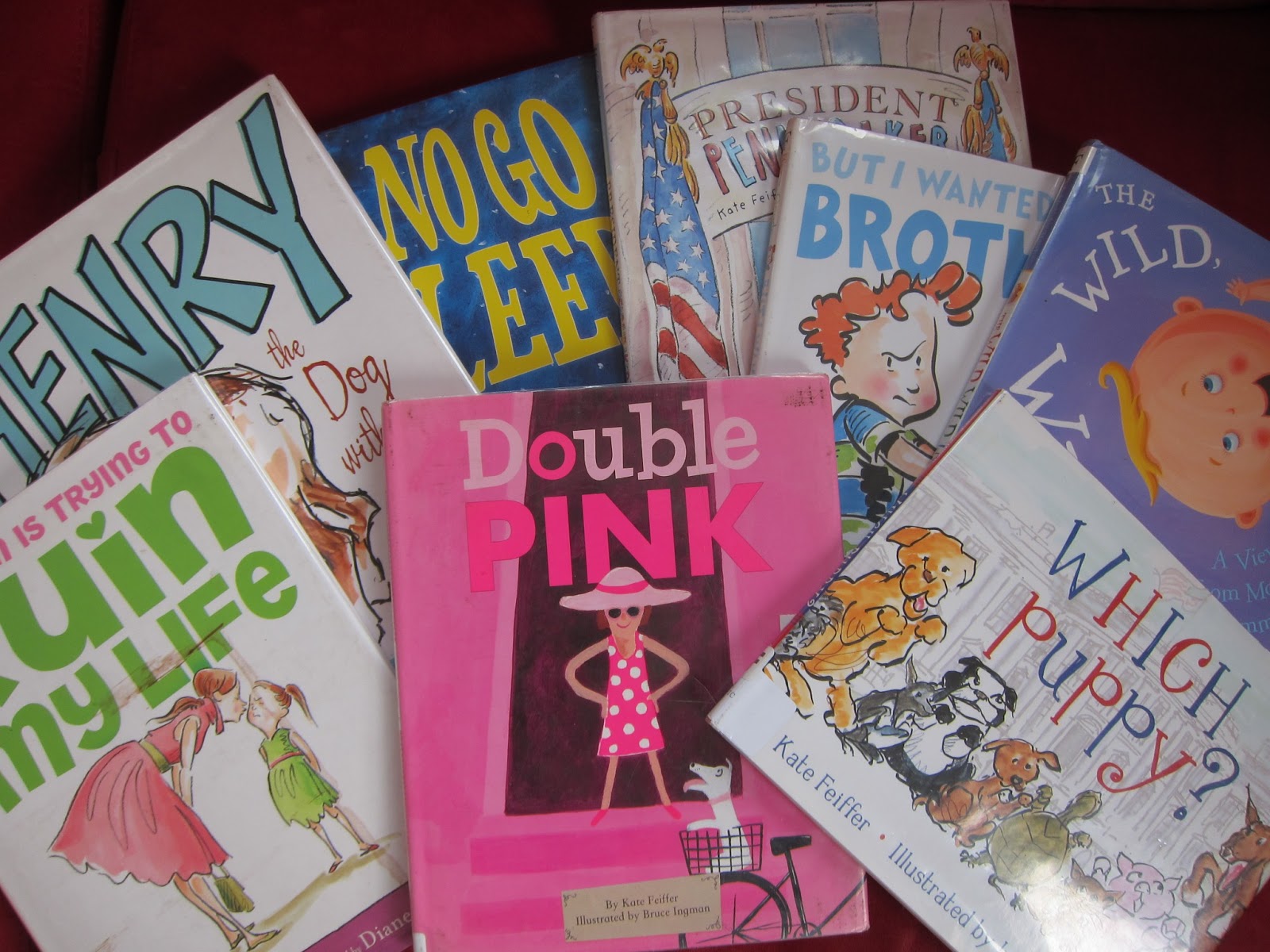
That's what happened to me and Kate Feiffer, at least with regard to her picture books.  I loved, loved, LOVED My Side of the Car, published in April 2011 and illustrated by her famous father, Jules Feiffer.  I had no idea that it wasn't her first book or even that she'd written other books.  But then I saw that she'd just come out with No Go Sleep! (2012), also illustrated by her father and when I reserved that at the library, I discovered a number of other books by her.  In order of publication they are: Henry the Dog With No Tail (2007) (illustrated by Jules Feiffer), My Mom Is Trying to Ruin My Life (March 2009) (illustrated by Diane Goode), Which Puppy? (April 2009) (illustrated by Jules Feiffer), The Wild, Wild Inside: A View From Mommy's Tummy! (March 2010) (illustrated by Laura Huliska-Beith), But I Wanted a Baby Brother! (May 2010) (illustrated by Diane Goode), The Problem With the Puddles (June 2011) (a chapter book illustrated by Tricia Tusa), President Pennybaker (January 2012) (illustrated by Diane Goode), Signed by Zelda (April 2012) (also a chapter book), and Double Pink (2013) (illustrated by Bruce Ingman).

The picture books weren't bad.  They just weren't special.  In No Go Sleep! I could relate to the parent of a child who adamantly refuses to go to sleep... until he just can't resist any longer.  In My Mom Is Trying to Ruin My LifeFeiffer achieves a nice balance of a protagonist who is utterly embarrassed by her parents yet still needs them.  Henry the Dog With No Tail  had some clever wordplay (Henry seeks a tail at the tailor's and asks a wagon maker to make it wag) but again lacked the zing of my favorite.  Double Pink, about a girl who takes her love of pink to such extremes that she ends up camouflaged in her pink room, was cute but nothing more.  Which Puppy?, about the Obamas' search for the perfect dog, The Wild, Wild Inside: A View From Mommy's Tummy! and President Pennybaker were also merely cute and silly. But I Wanted a Baby Brother!, well-written as it is, ends conventionally with protagonist Oliver discovering that his baby sibling is fun, even if she is a girl.

Then I discovered Ms. Feiffer had written two chapter books.  Would they redeem her in my eyes?  Would they ever!

The quirky characters, family troubles, a New York City setting and a unique type of mystery in Signed by Zelda reminded me of both Rebecca Stead's Liar and Spy and From the Mixed-up Files of Mrs. Basil E. Frankweiler but didn't feel derivative or unoriginal. 11-year-old Nicky Gibson suspects his father is responsible for his grandmother's disappearance.  With the help of his new upstairs handwriting-obsessed neighbor, Savannah-transplant Lucy Bertel and a talking pigeon, they work to solve the mystery.  And while I thought the ending very upsetting and the issue it raised (elder abuse) glossed over too quickly, I found the rest of the book an engrossing read.  (My daughter refused to read it on the grounds that she suspected it was too scary.)

However, she loved Ms. Feiffer's other novel, The Problem With the Puddles, so much that she asked to buy it so she could reread it.  With that endorsement, I had to read it too!  It has a more farcical plot but was also fun read and its constant wordplay (a character who can never say anything once but always adds synonyms, often mangled, such as cinnamons) was reminiscent of The Phantom Tollbooth, which just happened to be illustrated by Ms. Feiffer's father.  The premise, involving a family in which the parents cannot agree over the smallest thing, including their child's name (whom they call variously Emily and Ferdinanda and whom everyone else calls Baby, the name on her birth certificate), is outrageous and the antics only get wilder from there.

Is there an author (or illustrator) who had one book you loved and were subsequently disappointed?  Do you have any favorite children's authors or illustrators who have done both picture books and chapter books you liked?  (By the way, Jules Feiffer has also written both picture books and children's chapter books, as well as written for adults and is best known as a cartoonist.  But he is a subject for another day.)