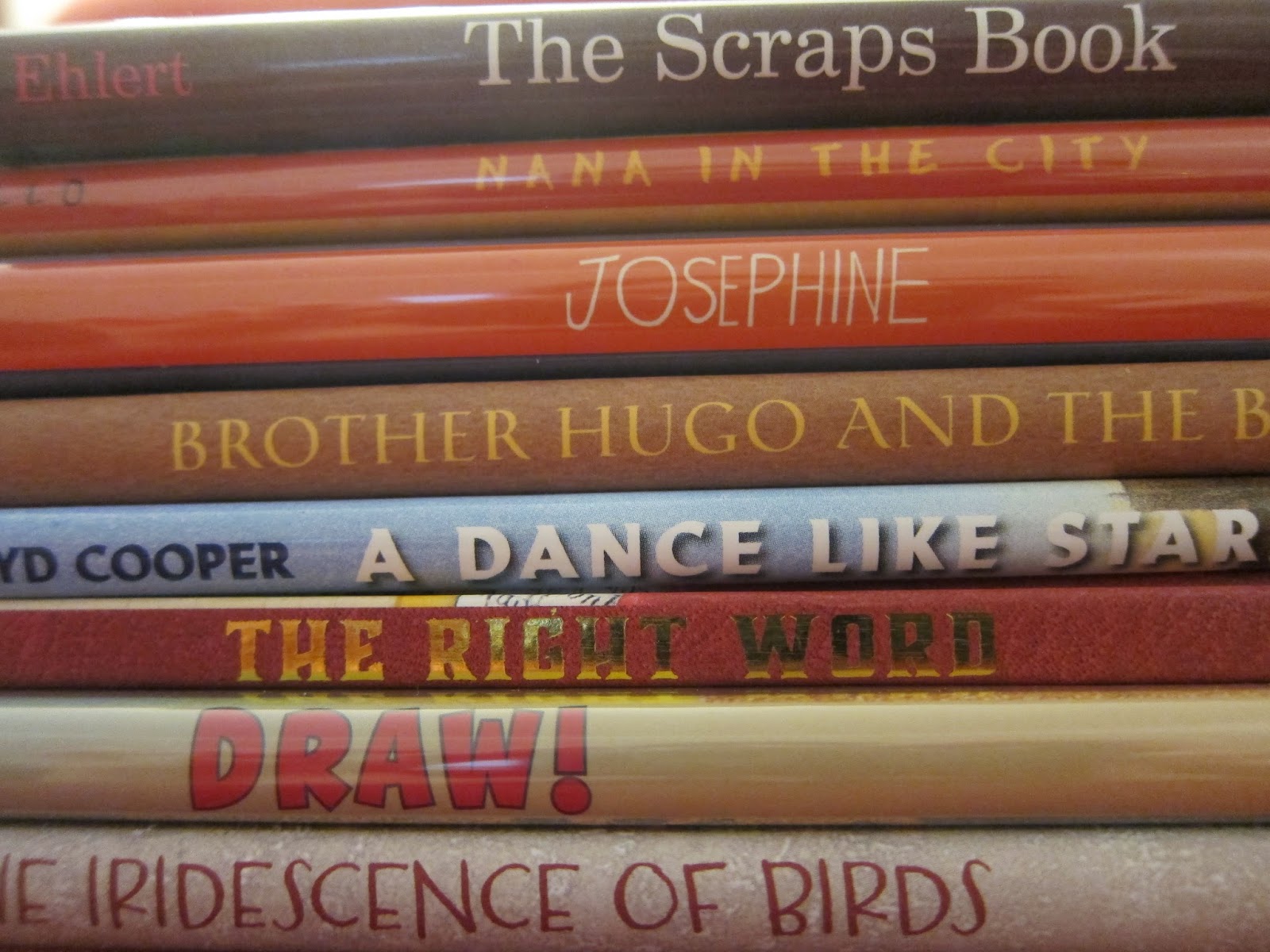
On the eve, literally, of the announcement of the winners of the Caldecott and Newbery medals tomorrow morning, along with a slew of other awards, I tallied our school's votes just in time.
I selected 12 nominees:
Kindergartners and first-graders voted only for their favorite; everyone else voted for their top three. A book got 3 points for a first-place vote, 2 for a second-place vote, and 3 for a third-place vote.
The winner was... (drumroll)... The Wolf, the Duck & the Mouse!
It was followed closely by After the Fall (How Humpty Dumpty Got Back Up Again), then Big Cat, Little Cat, and then The Book of Mistakes.
I can't wait to find out whether any of our choices were selected by the ALA.
May the best book win!
A lot of reading, a little bit of parenting, a helping of education policy, and a taste of NYC from a library school drop-out and mom of two.
Showing posts with label Mock Caldecott. Show all posts
Sunday, February 11, 2018
Sunday, January 10, 2016
The Results: Mockdecott 2016
The votes, all 162 of them, are in. I have tallied and multiplied and added and my school's mock Caldecott winner was Drum Dream Girl!
The standings were as follows:
Did the fact that I read Drum Dream Girl and We Forgot Brock! to many classes play a role? I'm sure. In retrospect, I wish I'd omitted We Forgot Brock! (which admittedly had a story that really appealed to the children) from the nominees and replaced it with Last Stop on Market Street. I also wish I could have included Wait.
I'm looking forward to the announcements of the real awards tomorrow!
The standings were as follows:
- Drum Dream Girl: How One Girl's Courage Changed Music by Margarita Engle, illustrated by Rafael Lopez
- We Forgot Brock!, written and illustrated by Carter Goodrich
- Finding Winnie: The True Story of the World's Most Famous Bear by Lindsay Mattick, illustrated by Sophie Blackall
- Tricky Vic: The Impossibly True Story of the Man Who Sold the Eiffel Tower, written and illustrated by Greg Pizzoli
- A Fine Dessert: Four Centuries, Four Families, One Delicious Treat by Emily Jenkins, illustrated by Sophie Blackall
- In a Village by the Sea by Muon Van, illustrated by Amy Chu
- My Pen, written and illustrated by Christopher Myers
- Waiting, written and illustrated by Kevin Henkes
- Water is Water: A Book About the Water Cycle by Miranda Paul, illustrated by Jason Chin
- Home, written and illustrated by Carson Ellis
- Lenny & Lucy by Phillip C. Stead, illustrated by Erin E. Stead
- The Whisper, written and illustrated by Pamela Zagarenski
Did the fact that I read Drum Dream Girl and We Forgot Brock! to many classes play a role? I'm sure. In retrospect, I wish I'd omitted We Forgot Brock! (which admittedly had a story that really appealed to the children) from the nominees and replaced it with Last Stop on Market Street. I also wish I could have included Wait.
I'm looking forward to the announcements of the real awards tomorrow!
Sunday, November 29, 2015
Mockdecott 2016!
For the second year in a row, I am running a mock Caldecott competition at my daughters' school.
I nominated 12 books this year. There were lots of wonderful books that have also been mentioned as possible contenders, but I couldn't include all of them.
Although the Caldecott committee is only supposed to consider the quality of the work, I try to present the students with a mix of books: diverse in subject matter, medium, ethnic background of the author/illustrator/characters, fiction and nonfiction.
So without further ado, our 2016 nominees are [drum roll]:
A Fine Dessert: Four Centuries, Four Families, One Delicious Treat by Emily Jenkins, illustrated by Sophie Blackall
In a Village by the Sea by Muon Van, illustrated by Amy Chu
Tricky Vic: The Impossibly True Story of the Man Who Sold the Eiffel Tower, written and illustrated by Greg Pizzoli
Waiting, written and illustrated by Kevin Henkes
My Pen, written and illustrated by Christopher Myers
Drum Dream Girl: How One Girl's Courage Changed Music by Margarita Engle, illustrated by Rafael Lopez
Water is Water: A Book About the Water Cycle by Miranda Paul, illustrated by Jason Chin
The Whisper, written and illustrated by Pamela Zagarenski
Finding Winnie: The True Story of the World's Most Famous Bear by Lindsay Mattick, illustrated by Sophie Blackall
Home, written and illustrated by Carson Ellis
We Forgot Brock!, written and illustrated by Carter Goodrich
Lenny & Lucy by Phillip C. Stead, illustrated by Erin E. Stead
Are you running or participating in a mock Caldecott this year? Is your child? What books are on your short list?
I nominated 12 books this year. There were lots of wonderful books that have also been mentioned as possible contenders, but I couldn't include all of them.
Although the Caldecott committee is only supposed to consider the quality of the work, I try to present the students with a mix of books: diverse in subject matter, medium, ethnic background of the author/illustrator/characters, fiction and nonfiction.
So without further ado, our 2016 nominees are [drum roll]:
A Fine Dessert: Four Centuries, Four Families, One Delicious Treat by Emily Jenkins, illustrated by Sophie Blackall
In a Village by the Sea by Muon Van, illustrated by Amy Chu
Tricky Vic: The Impossibly True Story of the Man Who Sold the Eiffel Tower, written and illustrated by Greg Pizzoli
Waiting, written and illustrated by Kevin Henkes
My Pen, written and illustrated by Christopher Myers
Drum Dream Girl: How One Girl's Courage Changed Music by Margarita Engle, illustrated by Rafael Lopez
Water is Water: A Book About the Water Cycle by Miranda Paul, illustrated by Jason Chin
The Whisper, written and illustrated by Pamela Zagarenski
Finding Winnie: The True Story of the World's Most Famous Bear by Lindsay Mattick, illustrated by Sophie Blackall
Home, written and illustrated by Carson Ellis
We Forgot Brock!, written and illustrated by Carter Goodrich
Lenny & Lucy by Phillip C. Stead, illustrated by Erin E. Stead
Are you running or participating in a mock Caldecott this year? Is your child? What books are on your short list?
Sunday, February 1, 2015
"Becust the pichrs toc to me" [sic]
| One first grader's opinion |
| Another first grader's ballot: "The colors poped [sic]." |
1. Draw!: 102 points (20 first place votes, 15 second place votes, 12 third place votes)
| Fourth graders liked Flashlight |
2. Flashlight: 76 points (17 first place, 11 second place, 3 third place)
3. The Iridescence of Birds: 49 points (9 first place, 8 second place, 6 third place)
4. The Right Word: Roget and His Thesaurus: 48 points (10 first place, 8 second place, 6 third place)
| A first grader gets right to the point. |
5. Viva Frida: 42 points (4 first place, 6 second place, 3 third place)
6. Nana in the City: 39 points (5 first place, 7 second place, 10 third place)
6. The Scraps Book: 39 points (4 first place, 9 second place, 9 third place)
6. A Dance Like Starlight: 39 points (5 first place, 8 second place, 8 third place)
6. Josephine: 39 points (6 first place, 6 second place, 9 third place)
7. Brother Hugo and the Bear: 33 points (4 first place, 7 second place, 7 third place)
Friday, January 16, 2015
My Caldecott Votes
Art is a matter of personal taste. There's no getting around it. Sure, you can judge artists based on technical mastery, but when you have talented artists working in different styles, media, and palettes, a lot comes down to personal taste. Which is why awards like the Caldecott are so interesting. The committee members who award the Caldecott change every year, which means that, while there's no predicting who will win, different types of art and artists are given a chance. It also means knowing that if only the committee from year X judged in year Y, the line-up would be completely different.
So what follows is my take on our school's mock Caldecott nominees.

The Right Word: Roget and His Thesaurus by Jen Bryant, illustrated by Melissa Sweet. Sweet's work is always beautiful and intricate. I recently went to the Original Art exhibit at The Society of Illustrators and one of her works for this book was shown. It had so much layering and depth in person, it was astonishing. I love how she incorporates synonyms and words into her collages. But I keep hesitating. There's something about the art here that seems a little too busy, a little distracting. Unlike her work in Firefly July, which is simpler and more pure, somehow, or her work in Brave Girl, which her collage style fits perfectly, given that the story is about the garment industry. Finally, I know this is not supposed to be a consideration, but there's something that bothers me when an illustrator's work feels repetitive. It is nice - especially for children - to be able to recognize an illustrator's work at a glance, but sometimes it feels unoriginal.

Nana in the City by Lauren Castillo. I love this one! I love how the playful, almost childlike style complements the fact that the child is the narrator. I also like how the illustrations add to the story; for example, when the grandma gives money to a homeless person, which is not explicitly mentioned in the text. Her depiction of New York is beautiful but not completely idealized. The buildings are so tall they literally cannot be contained on the page. And the grandmother's relationship with the boy is so tender.
Flashlight by Lizi Boyd. The use of the flashlight to illuminate areas of the pictures is ingenious but I feel like the use of cut-outs as well is overkill. I feel like it actually takes away from the other elements.
The Iridescence of Birds: A Book About Henri Matisse by Patricia Maclachlan, illustrated by Hadley Hooper. This book has been growing on me. The use of the blue-gray colors capture the drabness of where Matisse grew up and the contrast with the colors and patterns of the textiles he loved is dramatic.
Josephine: The Dazzling Life of Josephine Baker by Patricia Hruby Powell, illustrated by Christian Robinson. When I saw this book, I had a sense of deja vu. Where had I seen it before? It turns out I was thinking of another book illustrated by Christian Robinson, Harlem's Little Blackbird, a biography of Florence Mills, which treats a similar topic and uses a similar color palette. Which brings me to the same complaint I had about Melissa Sweet's work. Can you tell which picture above is from which book? Nevertheless, I love the colors - mustardy yellow, mossy green, persimmon orange. The use of different fonts here is stunning and Robinson really captures a sense of movement and jazziness in still pictures. This one might be my favorite!
Viva Frida by Yuyi Morales and Tim O'Meara (photographer). Okay, I know it's not a technical term, but this book creeped me out!
Brother Hugo and the Bear by Katy Beebe, illustrated by S.D. Schindler. Original with a wonderful incorporation of the style of medieval illuminated manuscripts which fits the text perfectly.
So in the end, out of these, I think I'd rank Josephine or Nana in the City first, followed by The Right Word. Tune in next time to find out what I think of other contenders that didn't make it into our school competition.
So what follows is my take on our school's mock Caldecott nominees.

The Right Word: Roget and His Thesaurus by Jen Bryant, illustrated by Melissa Sweet. Sweet's work is always beautiful and intricate. I recently went to the Original Art exhibit at The Society of Illustrators and one of her works for this book was shown. It had so much layering and depth in person, it was astonishing. I love how she incorporates synonyms and words into her collages. But I keep hesitating. There's something about the art here that seems a little too busy, a little distracting. Unlike her work in Firefly July, which is simpler and more pure, somehow, or her work in Brave Girl, which her collage style fits perfectly, given that the story is about the garment industry. Finally, I know this is not supposed to be a consideration, but there's something that bothers me when an illustrator's work feels repetitive. It is nice - especially for children - to be able to recognize an illustrator's work at a glance, but sometimes it feels unoriginal.
Draw! by Raul Colon. Technically lovely, this style - and palette - do not appeal to me. I can't cite a specific reason!
The Iridescence of Birds: A Book About Henri Matisse by Patricia Maclachlan, illustrated by Hadley Hooper. This book has been growing on me. The use of the blue-gray colors capture the drabness of where Matisse grew up and the contrast with the colors and patterns of the textiles he loved is dramatic.
Josephine: The Dazzling Life of Josephine Baker by Patricia Hruby Powell, illustrated by Christian Robinson. When I saw this book, I had a sense of deja vu. Where had I seen it before? It turns out I was thinking of another book illustrated by Christian Robinson, Harlem's Little Blackbird, a biography of Florence Mills, which treats a similar topic and uses a similar color palette. Which brings me to the same complaint I had about Melissa Sweet's work. Can you tell which picture above is from which book? Nevertheless, I love the colors - mustardy yellow, mossy green, persimmon orange. The use of different fonts here is stunning and Robinson really captures a sense of movement and jazziness in still pictures. This one might be my favorite!
The Scraps Book: Notes from a Colorful Life by Lois Ehlert. Beautiful and so interesting. My younger daughter says Lois Ehlert's books are boring but this book about how she makes those boring books is interesting! But since it is an amalgam of her earlier work, a collage of collages in a way, I feel like it is lacking an element of originality that is award-worthy.
Viva Frida by Yuyi Morales and Tim O'Meara (photographer). Okay, I know it's not a technical term, but this book creeped me out!
A Dance Like Starlight: One Ballerina's Dream by Kristy Dempsey, illustrated by Floyd Cooper. Painterly. The expression on the girl's face is one of sheer joy.
Brother Hugo and the Bear by Katy Beebe, illustrated by S.D. Schindler. Original with a wonderful incorporation of the style of medieval illuminated manuscripts which fits the text perfectly. So in the end, out of these, I think I'd rank Josephine or Nana in the City first, followed by The Right Word. Tune in next time to find out what I think of other contenders that didn't make it into our school competition.
Monday, January 12, 2015
The Standings
Most of the votes so far come from second-graders. They are old enough to understand the project and read the instructions, yet they are not in a "testing grade." Sad to say, but that is certainly a factor.
In order of how they currently stand in the voting:
2 The Right Word: Roget and His Thesaurus: 33 points (8 first place, 2 second place, 5 third place)
3. Flashlight: 31 points (4 first place, 8 second place, 3 third place) (This one moved from a distant last place at the end of last week.)
5. Josephine: 28 points (5 first place, 4 second place, 5 third place)
6. Viva Frida: 27 points (6 first place, 3 second place, 3 third place)
7. Brother Hugo and the Bear: 26 points (4 first place, 5 second place, 4 third place)
8. The Scraps Book: 25 points (3 first place, 5 second place, 6 third place)
8. A Dance Like Starlight: 25 points (4 first place, 3 second place, 7 third place)
9. The Iridescence of Birds: 22 points (3 first place, 5 second place, 3 last place)
Subscribe to:
Posts (Atom)