In December, I accompanied my daughter's class to the exhibit The Snowy Day and the Art of Ezra Jack Keats opens at The Jewish Museum. The museum educator did a fabulous job and the kids were really engaged. But I didn't have a chance to take in the exhibit the way I really wanted to. So this past weekend, I went back, with my husband, but without kids, and took my time. It was worth it! While seeing a painting up close is certainly different from seeing a reproduction (seeing the brushstrokes, the thickness and texture of the paint), somehow that felt even more true to me when it comes to collage. I, at least, can't tell from reading Ezra Jack Keats's work that the illustrations are often collage, but when you see the originals up-close, it's a different story. The exhibit closes soon, so go if you can!
If you've already seen the exhibit, what did you think?
What other children's book illustrators work primarily in collage? Lois Ehlert and Eric Carle come to mind. Who else?
Tuesday, January 17, 2012

Friday, January 13, 2012
Retro Reading: Two Fabulous Links
Billy Parrott, an NYPL librarian, has a fabulous post about what Sally Draper would have been reading in 1964-65. I have to agree with the commenters who suggested Marjorie Morningstar, A Tree Grows in Brooklyn (two of my favorites!), Peyton Place, and the works of e.e. cummings and Rachel Carson.
Today Betsy Bird has a follow-up post with a challenge to identify what Sally is actually reading in photographic stills from the Mad Men TV Show.
Go, check them both out and add your thoughts!
Today Betsy Bird has a follow-up post with a challenge to identify what Sally is actually reading in photographic stills from the Mad Men TV Show.
Go, check them both out and add your thoughts!
Thursday, January 12, 2012
Library Loot #13
For the kids:


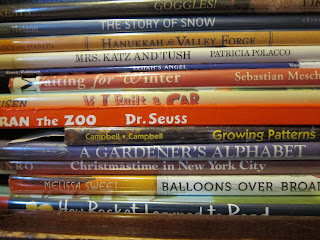
Not pictured: Over and Under the Snow by Kate Messner; Dreams by Ezra Jack Keats, Mama's Saris by Pooja Makhijani (we loved this book and my 4-year-old went around for days afterwards draping her dresses over one shoulder like a sari), Homer the Library Cat by Reeve Lindbergh (yes, that Lindbergh!), Love, Mouserella by David Ezra Stein, Spring Is Here by Will Hillenbrand, I Had A Favorite Dress by Boni Ashburn, Spunky Tells All by Ann Cameron and Blood and Goo and Boogers Too! by Steve Alton, Nick Sharratt and Jo Moore.
For me:

Not pictured: A Mango-Shaped Space by Wendy Mass.


Not pictured: Over and Under the Snow by Kate Messner; Dreams by Ezra Jack Keats, Mama's Saris by Pooja Makhijani (we loved this book and my 4-year-old went around for days afterwards draping her dresses over one shoulder like a sari), Homer the Library Cat by Reeve Lindbergh (yes, that Lindbergh!), Love, Mouserella by David Ezra Stein, Spring Is Here by Will Hillenbrand, I Had A Favorite Dress by Boni Ashburn, Spunky Tells All by Ann Cameron and Blood and Goo and Boogers Too! by Steve Alton, Nick Sharratt and Jo Moore.
For me:

Not pictured: A Mango-Shaped Space by Wendy Mass.
Monday, January 9, 2012
Weeding Fiction: Advice Needed!
I volunteer at my daughter's public school library and have been tasked with weeding its fiction collection (excluding picture books). Here's my problem: unlike non-fiction, which can become obviously out-of-date, fiction doesn't age in the same way. Sure, some old books become dated but other old books become classics. So how do I figure out which are which (other than the obvious, well-known classics or award-winners)?
This is an urban public school which serves a primarily poor population, many of whom speak a language other than English at home. The kids' favorite books are the Wimpy Kid books and books of that ilk. Anything in a diary format and/or with illustrations is popular. As I reviewed the fiction shelves, I found tons of books which I've never seen children take out: books from the 60s and 70s, historical fiction, books about Native Americans, and so on. Those books are, to put it mildly, not exactly flying off the shelves. But some of them are great books. So... how do I decide which books to keep?
Any advice is appreciated.
This is an urban public school which serves a primarily poor population, many of whom speak a language other than English at home. The kids' favorite books are the Wimpy Kid books and books of that ilk. Anything in a diary format and/or with illustrations is popular. As I reviewed the fiction shelves, I found tons of books which I've never seen children take out: books from the 60s and 70s, historical fiction, books about Native Americans, and so on. Those books are, to put it mildly, not exactly flying off the shelves. But some of them are great books. So... how do I decide which books to keep?
Any advice is appreciated.
Sunday, January 8, 2012
Originals and Derivatives, Take Two
Just two more quick examples of original works and later derivative works; that is, books (or movies) that share a premise, or a style of illustration, or a plot.
Another Wendy Mass novel: 11 Birthdays. Two kids relive their shared 11th birthday over and over and over again... until they can figure out how to break the spell. Sounds a little like a movie that was popular a while ago, doesn't it?


Another Wendy Mass novel: 11 Birthdays. Two kids relive their shared 11th birthday over and over and over again... until they can figure out how to break the spell. Sounds a little like a movie that was popular a while ago, doesn't it?


My husband came home from the library and told me that our 3-year-old had picked out her own book and that it was about fall and was by the same author as Leaves by David Ezra Stein. Wondering why the author had done another book on the same topic, I went to see my daughter's selection. It turned out to be The Bear's Winter House by John Yeoman, illustrated by Quentin Blake and first published in 1969. But my husband was right - the subject matter (although not the plot) and, even more so, the illustrations, are eerily similar to Stein's. The bears even have the same sweet, curious, gentle look about them. Did Stein know of this book when he wrote his?
Tuesday, January 3, 2012
Libraries and Children's Authors in the News
There were two articles in the New York Times today I feel compelled to link to. The first is about the Queens Library's acquisition of materials in languages other than English. As fascinating as the main point of the article was, I was more intrigued by one librarian's comment that some of her (Chinese) patrons bring in suitcases to bring their books home, they take out so many. Suitcases! I hope they are the rolling kind.
The other is about the appointment of Walter Dean Myers as the national ambassador for young people's literature. I'm familiar with the nature of his work but confess I haven't read any of it. But the quote the article closes with caught my eye: "People still try to sell books that way - as 'books can take you to foreign lands.' We've given children this idea that reading and books are a nice option, if you want that kind of thing. I hope we can get over that idea." Now, if he means that books are not merely an option but a necessity, I agree wholeheartedly. But if he is disparaging the idea that "books can take you to foreign lands" - well, I have to object. While his works are realistic fiction which perhaps serve a purpose of allowing their readers to explore some of the difficulties in their lives, there is a place for books that take you to different lands, too. Not to mention that the land that Walter Dean Myers describes is very foreign to some.
The other is about the appointment of Walter Dean Myers as the national ambassador for young people's literature. I'm familiar with the nature of his work but confess I haven't read any of it. But the quote the article closes with caught my eye: "People still try to sell books that way - as 'books can take you to foreign lands.' We've given children this idea that reading and books are a nice option, if you want that kind of thing. I hope we can get over that idea." Now, if he means that books are not merely an option but a necessity, I agree wholeheartedly. But if he is disparaging the idea that "books can take you to foreign lands" - well, I have to object. While his works are realistic fiction which perhaps serve a purpose of allowing their readers to explore some of the difficulties in their lives, there is a place for books that take you to different lands, too. Not to mention that the land that Walter Dean Myers describes is very foreign to some.
Sunday, January 1, 2012
A Yiddish Folktale, Three Ways
In an old Yiddish folktale, a boy (or man) has a beloved item of clothing. As he outgrows it or it becomes too worn, it is cut down and transformed - into a vest or a tie... until it can be transformed no longer. Or can it? The owner records the story of his coat and voila! he has made something (a story) from nothing.

We own two versions which are pretty faithful to the original - Simms Taback's Caldecott-winning Joseph Had a Little Overcoat and Phoebe Gilman's Something from Nothing. Taback's signature cut-outs and collages, his inclusion of a little Yiddish, and his allusions to shtetl culture and the pop culture that makes reference to it (newspaper headline: Fiddler Falls Off Roof) make this one very special. The story was also a Yiddish folksong and Taback (who died on Christmas Day 2011) includes musical notation for it. My three-year-old sings yet another version of it at preschool. Gilman's version shows the protagonist's house upstairs and then a house of mice below. The mice use the scraps of fabric as they fall to the ground, giving an added meaning to the title.
A newly published third version, I Had a Favorite Dress, by Boni Ashburn, puts a modern and girly spin on the story. I love the mixed-media illustrations by Julia Denos with their exuberant use of color. (I definitely want to check out more of her work, including a picture book biography of Audrey Hepburn, Just Being Audrey by Margaret Cardillo, which she illustrated.) This version is my 6-year-old's favorite, of course. But I was bothered by the fact that nowhere does the author acknowledge that this is a retelling of an old folktale, especially because the original story is not so well-known that the connection would be obvious, in my opinion.
I know there are lots of versions of classic fairy tales, like Cinderella. Do you have multiple versions of the same folktale? Which one(s)?

We own two versions which are pretty faithful to the original - Simms Taback's Caldecott-winning Joseph Had a Little Overcoat and Phoebe Gilman's Something from Nothing. Taback's signature cut-outs and collages, his inclusion of a little Yiddish, and his allusions to shtetl culture and the pop culture that makes reference to it (newspaper headline: Fiddler Falls Off Roof) make this one very special. The story was also a Yiddish folksong and Taback (who died on Christmas Day 2011) includes musical notation for it. My three-year-old sings yet another version of it at preschool. Gilman's version shows the protagonist's house upstairs and then a house of mice below. The mice use the scraps of fabric as they fall to the ground, giving an added meaning to the title.
A newly published third version, I Had a Favorite Dress, by Boni Ashburn, puts a modern and girly spin on the story. I love the mixed-media illustrations by Julia Denos with their exuberant use of color. (I definitely want to check out more of her work, including a picture book biography of Audrey Hepburn, Just Being Audrey by Margaret Cardillo, which she illustrated.) This version is my 6-year-old's favorite, of course. But I was bothered by the fact that nowhere does the author acknowledge that this is a retelling of an old folktale, especially because the original story is not so well-known that the connection would be obvious, in my opinion.
I know there are lots of versions of classic fairy tales, like Cinderella. Do you have multiple versions of the same folktale? Which one(s)?
Subscribe to:
Posts (Atom)