Sunday, March 27, 2016

First-Round Winners!

I tallied up the results of our first round and read them out loud to a bunch of my kids' friends yesterday before announcing them in the library.  It was fun to hear them cheer when their picks won and groan when they didn't.

The discrepancy in the number of votes is because the students weren't supposed to vote unless they'd read both books in a particular pair. I knew neither Alice nor Anastasia wouldn't be super-popular but I was hoping including them might get some more kids to pick them up.  Plus, I just love them both!

Without further ado, the winners:


Wimpy Kid beat out Smile,90 votes to 57
Alice (by Phyllis Reynolds Naylor) defeated Anastasia, 30-18

This means we have a second round match up of Wimpy Kid v Alice.  Next year I have to plan better as that one's a foregone conclusion!!

Harry Potter triumphed over Percy Jackson, 76-49
Wonder trounced Out of My Mind, 89-21 

In the second round Harry Potter will face off against Wonder.  That one should be interesting.

Ramona overcame Clementine, 55-21

Our second round will pit Big Nate against Ramona

Mrs. Piggle-Wiggle prevailed over The Worst Witch, 39-18

So Mrs. Piggle-Wiggle will face From the Mixed-Up Files... in round 2.

(Yes, I used a thesaurus!)

May the best book win!

Sunday, March 20, 2016

March Madness, Bibliophile-Style!

Inspired by the literary takes on March Madness proliferating online, I decided to do our own March Madness competition at the school library.

Although we got off to a rocky start (one child asked, confused, "Wait, the books are going to play basketball?!?"), once the kids got the hang of things, they voted enthusiastically, with some even adding notations to their ballots ("hardest choice EVER!!!!" - for Wonder v Out of My Mind).

Our bracket:


Which books would you choose?

Which do you think will win?

Stay tuned for our first-round results...

Tuesday, March 1, 2016

Elephants Don't Need to Go to the Gym!

The version I own
Every summer, when we went to our country house, I would read The Saggy Baggy Elephant, a story about a lonely young elephant, Sookie, who is made to feel bad about his wrinkly skin by the other jungle animals.  The book ends with Sookie meeting a whole herd of elephants and realizing that elephants are supposed to have saggy, baggy, wrinkly skin.
The version I saw at the book fair

So I was excited to see the book at my school book fair.  Yes, the cover looked a little different than the one I remembered, but I figured that was just marketing, tapping into the huge market for beginning readers.

Unfortunately, I failed to notice the little "adapted by" notation on the cover.

I opened it and skimmed it until I got to this spread:


Whereupon I was horrified.  The tiger is not saggy because he "stays fit"?  No, the tiger is not saggy because he is a tiger!  Not only is the book now body-shaming elephants and implying they need to exercise and "stay fit," but the ending of the book remains unchanged, thereby making no sense!  If elephants are supposed to be saggy, then they are not saggy because they do not "stay fit." Elephants do not need to go to the gym (although it conjure up a funny image in my mind of a class of elephants jazzercising! - perhaps there's another picture book, right there!).

Why, oh why, do publshers tamper with perfectly good books?  Why?

Tuesday, January 26, 2016

My New Favorite Snow Book

There's not much more to say about snow, is there?  It's white, it's wet, it's cold.  Kids sled, build snowmen, throw snowballs.  You know the drill.

But the difference lies in how it is said, and, more importantly here, how it is shown.
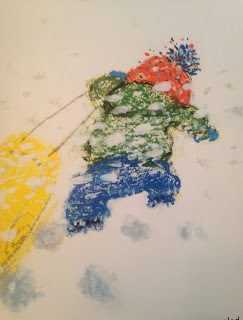

Into the Snow is a beautiful, playful book. Using colors that look like they come straight out of the Crayola box (one of the smaller sets, not the 64-crayon one!), with a texture that almost looks like rubbings (it turns out that the artist used oil pastels, gouache, acrylic colors and colored pencils), illustrator Masamitsu Saito perfectly captures a child's playfulness, fear, wonder, and exhaustion in a style all his own.  From the cover, on which our nameless child narrator mischievously pulls his hat down over his eyes, throughout the story as he works hard to pull his sled up the hill, and until he has had enough and goes back inside for the warm, cozy comfort of a cup of hot chocolate with mama, Saito renders each moment with warmth (or coldness, as the case may be!).


Author Yuki Kaneko's language is simple but vivid: "I've found an icicle.  It is shiny and clear like glass." and, at times, whimsical: "Oops, I snapped it.  I hope I didn't upset an ice fairy."

This book does the impossible: it makes playing in the snow fresh and new again.

A lovely book for toddlers and preschoolers - and their parents.

Sunday, January 10, 2016

The Results: Mockdecott 2016

The votes, all 162 of them, are in.  I have tallied and multiplied and added and my school's mock Caldecott winner was Drum Dream Girl!

The standings were as follows:

  1. Drum Dream Girl: How One Girl's Courage Changed Music by Margarita Engle, illustrated by Rafael Lopez
  2. We Forgot Brock!, written and illustrated by Carter Goodrich
  3. Finding Winnie: The True Story of the World's Most Famous Bear by Lindsay Mattick, illustrated by Sophie Blackall
  4. Tricky Vic: The Impossibly True Story of the Man Who Sold the Eiffel Tower, written and illustrated by Greg Pizzoli
  5. A Fine Dessert: Four Centuries, Four Families, One Delicious Treat by Emily Jenkins, illustrated by Sophie Blackall
  6. In a Village by the Sea by Muon Van, illustrated by Amy Chu
  7. My Pen, written and illustrated by Christopher Myers
  8. Waiting, written and illustrated by Kevin Henkes
  9. Water is Water: A Book About the Water Cycle by Miranda Paul, illustrated by Jason Chin
  10. Home, written and illustrated by Carson Ellis
  11. Lenny & Lucy by Phillip C. Stead, illustrated by Erin E. Stead
  12. The Whisper, written and illustrated by Pamela Zagarenski

Did the fact that I read Drum Dream Girl and We Forgot Brock! to many classes play a role?  I'm sure.  In retrospect, I wish I'd omitted We Forgot Brock! (which admittedly had a story that really appealed to the children) from the nominees and replaced it with Last Stop on Market Street.  I also wish I could have included Wait.

I'm looking forward to the announcements of the real awards tomorrow!

Tuesday, December 29, 2015

More 2015 Favorites

So many good picture books came out this year!  Here are a few more favorites.

Ketzel, the Cat Who Composed. This story, based on real events about a cat who "composed" a piece of music for a competition, is utterly delightful.  I love how the illustrator captures the real composer's frustration, the cat's mischievousness, and the hustle and bustle of New York City.  By the way, ketzel means cat in Yiddish, and ketzele (pronounced KETZ-el-uh) is the diminutive.  You can even buy - separately - a CD of the piano competition at which the piece was played.

Tricky Vic: The Impossibly True Story of the Man Who Sold the Eiffel Tower, written and illustrated by Greg Pizzoli.  How clever to use fingerprints for the faces of the "bad guys!"  This unique book about a con man is great for older children.

In a Village by the Sea by Muon Van, illustrated by Amy Chu.  Lovely illustrations show a Vietnamese fisherman's family waiting for him to come back from the sea.  The story-within-a-story (or painting-within-a-painting) element has readers questioning what is real.


Americanine: A Haute Dog in New York. Kebbi's energetic pencil drawings capture New York's frenetic energy better than (almost?) any I've seen.  The conceit that the narrator is a French dog who is visiting New York for the first time is unnecessary (any ignorant visitor would do; e.g., an alien, or, even better for a children's book, a young child) except to create the occasional pun ("haute dog"), the art more than makes up for it.  And there's the Orthodox Jew who appears in almost every drawing... why?  Are there any other recurring characters?  I suspect spending a bit more time with this book would pay off.

Imaginary Fred.  Have you ever attended a concert where two imaginary friends were the musicians? Have you ever introduced your imaginary friend to your friend's imaginary friend? This take on imaginary friends is unique and hilarious.  The sight of the baffled audience listening to music played by the imaginary friends (or perhaps they only hear silence?) is priceless.  There are quite a few new books about imaginary friends this year (We Forgot Brock! is another, and a big hit with my students), but this is my favorite.  

Wait. This one is perfect for the toddler-preschool crowd.  Mommy's in a hurry, but look at all that she's missing out on!  A beautiful take on how children live - and force their parents to live - in the moment.  Portis's style reminds me a bit of Lauren Castillo's here, especially as this book is set in New York City like much of Castillo's work.  I wish I'd included this one in my mock Caldecott.

Leo:A Ghost Story.  Shades of blue predominate in this story about a ghost who saves the day and finds a friend.

A Fine Dessert: Four Centuries, Four Families, One Delicious Treat by Emily Jenkins, illustrated by Sophie Blackall.  Showing how one dessert - blackberry fool - has been made in different ways throughout time not only serves as a timeline of kitchen technology (bundle of twigs - whisk - mechanical mixer - electric mixer), but also shows societal changes throughout history.

Home, written and illustrated by Carson Ellis.  A palette of brown, blue, and red showcases all kinds of homes, from the real (apartments, wigwams, boats), to the imaginary (a home on the moon with a view of Earth, the home of a Norse god).  Pair it with A House is a House For Me for a fun discussion of houses and the completely different types of art (one stark and simple; one extremely detailed) in each book.

The Little Book of Big Fears.  A clever take on alphabet books (the missing letters spell GUTSY and BRAVE) that is perfect for your little worrier.

Swan: The Life and Dance of Anna Pavlova.  This poetic biography of Anna Pavlova has the reader enter a winter wonderland.

See You Next Year.  The pleasures of visiting the same vacation spot year after year, thrown into greater relief by one change - the making of a new friend.

The Tea Party in the Woods.  In black-and-white-and-shades-of-gray with touches of red and yellow, this book tells the sotry of Kikko as she tries to bring a pie to Grandma through the woods. Sound familiar?  Not quite!  Betsy Bird wrote the perfect review.  

Wednesday, December 16, 2015

(Some of) My Favorites of 2015

Here are some of my favorite picture books of the year.  I realized that if I listed them all in one post, I wouldn't finish writing about them until January!  So here is what I hope is only the first installment.

Black Cat, White Cat. This book is just gorgeous. Borando uses the contrast and symmetry between black and white to stunning effect.  And the surprise ending (although genetically impossible), is hinted at by the one spot of orangey-red color on the cover. 
How the Sun Got to Coco's House.  Bob Graham is the master of the "small moment" story.  He takes one moment, expands on it, and makes it universal.  Or, as here, he does the opposite.  Rather than show us everything that happens in one moment, as in The Silver Button, here he takes us around the world as we follow the sun.  This is a beautiful, visually poetic take on time. A nice companion to non-fiction about time zones and the movement of the earth.

Whatever Happened to My Sister?  I think this is the only picture book which addresses the sadness - even grief - a younger child feels as her older sibling grows up and, in some ways, outgrows her.  When I asked my 7-year-old what the book was about she said, "Yeah, it's about the sister getting her period and stuff."  While the book never addresses the physical aspects of puberty, it addresses the emotional ones - for both the child going through it and her younger sibling. The resolution at the end shows that although growing up has changed the sisters' relationship, it has not severed their sororal bond.  

Bright Sky, Starry City.  A blackout allows a city girl to see the stars. Lovely.  Factual information at the end about light pollution is an added bonus.

When Dad Showed Me the Universe.  A touching, funny story about the differences in the perceptions of adults and children. I loved it, but I must admit it was lost on my 7-year-old.  


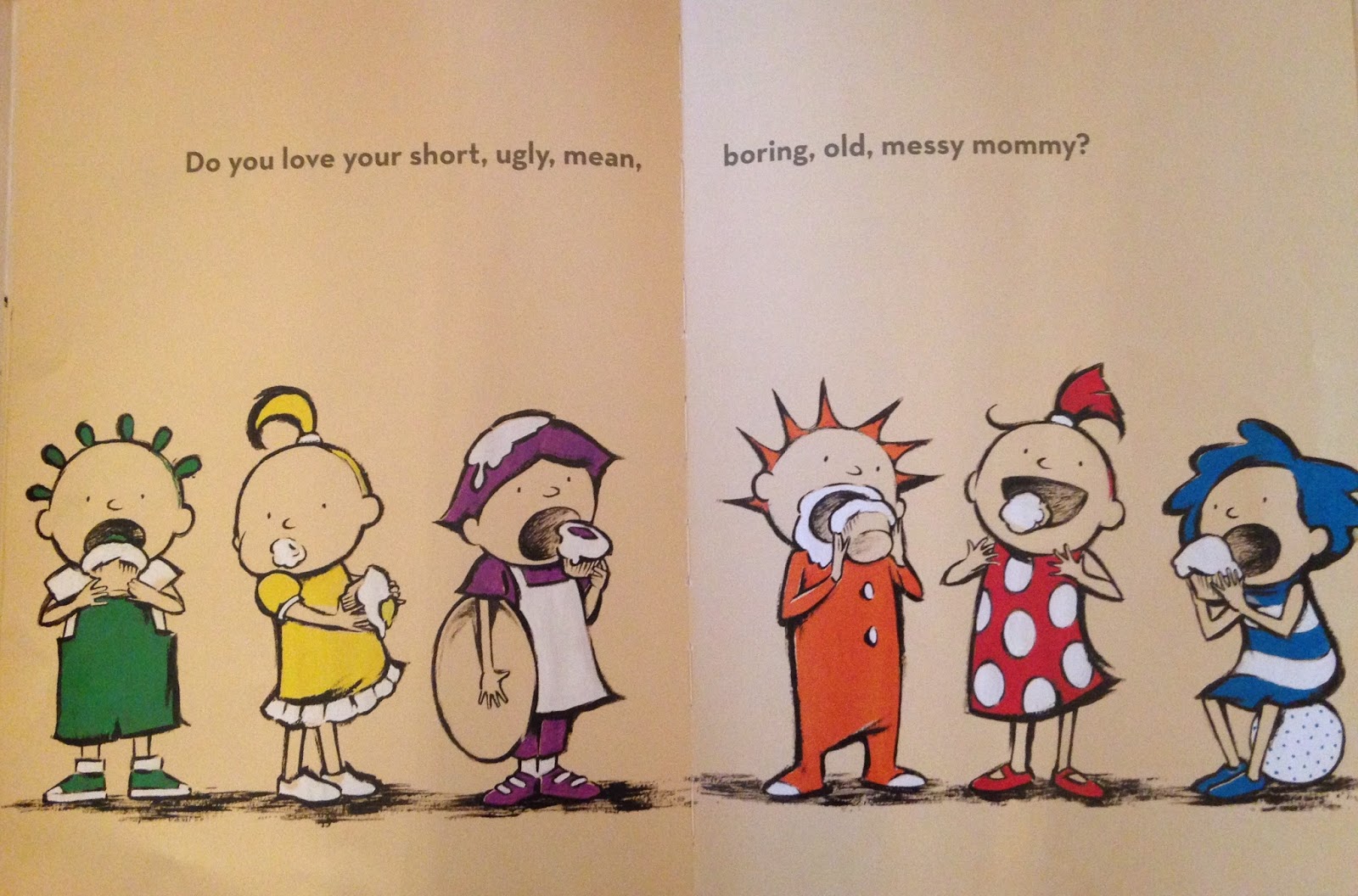
Is Mommy? This seemingly silly book, with illustrations to match by one of my favorite illustrators, Marla Frazee, is really about the enduring love children have for their mothers. Toddlers answer all the questions about their mommies in the negative - she is messy, old, ugly, mean.  But do they still love her?  Of course!  My 10-year-old loved this one and was thrilled to read it to her 2-year-old cousin.  

Mesmerized.  The true story of how Benjamin Franklin exposed Dr. Mesmer as a fraud is fascinating in itself.  This well-written, well-illustrated book goes one step further and explains the scientific method in a clear, coherent manner. Great for history buffs, budding scientists and doctors, older children, and well, pretty much everyone else, too. Now that I think of it, why hasn't this book been mentioned anywhere for an award? Perhaps the Sibert, for informational books?  

Finding Winnie: The True Story of the World's Most Famous Bear.  In addition to the beautiful illustrations, which have been justly heralded and talked about as deserving a Caldecott, I love this book for the way it talks about the power of stories.  The book is framed as the author telling the story of her great-grandfather to her son, who is named after him.  Her great-grandfather is the man who bought a bear he named Winnie, who eventually lived at the London Zoo, who in turn was the inspiration for A.A. Milne's Winnie-the-Pooh stories.  As the author says, "Sometimes you have to let one story end so the next can begin."  When her son asks if the story is all true, she answers, "Sometimes the best stories are."  With photos of her great-grandfather, Winnie, and the real Christopher Robin at the end, this book is a treasure. Although it is a bit long for younger children, the book separates the two stories, so that it could easily be read in two separate installments.

Drum Dream Girl: How One Girl's Courage Changed Music by Margarita Engle, illustrated by Rafael Lopez.  The more I read this to classes at school, the more I love it. The vibrant colors, the musical free verse, the determination of the heroine.  This may be my first choice in our mock Caldecott.

Which picture books were your favorites this year?