You know the type. You call a "friend" to commiserate over your parenting failures and she professes ignorance. She's certainly never had that problem with little Timmy. Why, little Timmy just adores his siblings. Why, little Timmy is the most adventurous eater. Why, little Timmy always does his homework the minute he comes home from school.
Well, Betty MacDonald, author of the Mrs. Piggle-Wiggle books (there are five and I must confess, so far I've only read the first), knows them well too, and that is yet another reason her books are a delight to read aloud. If you don't know Mrs. Piggle-Wiggle, you are in for a treat. A lover of children, not having any herself, (sometimes it is easier to deal with them when they are not your own!) she lives in an upside house and has cures for sassiness, sparring siblings, and all other manner of childhood afflictions. The cures usually consist of giving the child a taste of her own medicine and/or taking her condition to extremes (e.g., providing the Tiny-Bite-Taker with penny-sized portions; letting the non-bather get so dirty that you can plant her with radish seeds). Not only will you recognize your child's misbehavior in her pages, you will recognize the insufferable mothers (and they are, in the only dated thing about this book, solely mothers). Ms. MacDonald pokes fun at them, not just by exaggerating their annoying traits (or perhaps just telling the truth!) but by giving them - and their horrid children - the most ridiculous names.
When Patsy won't take a bath, her mother calls her friend Mrs. Grotto for help. Mrs. Grotto's response? "'Well, frankly, I don't know what to tell you because our little Paraphernalia simply worships her bath. Of course, Paraphernalia is quite a remarkable child anyway. Why, Thursday afternoon she said...'"
And when Hubert's mother seeks help in getting him to pick up his toys, Mrs. Bags can't help at all because she "'started Ermintrude picking up her toys when she was six months old.'"
I suppose the best revenge on such mothers is curing your own child, but we know they are never fully cured. They simply come down with next illness. As my pediatrician once told me, at a certain age, children are either sick, getting over being sick, or getting sick. What is true for illnesses of the body is true for misbehavior, too. Although we know that the current affliction is "just a phase," we know that as soon as it is over, there will be a new phase to contend with!
If only Mrs. Piggle-Wiggle had a cure for insufferable mothers.
A lot of reading, a little bit of parenting, a helping of education policy, and a taste of NYC from a library school drop-out and mom of two.
Thursday, January 30, 2014
Tuesday, January 21, 2014
Wonderful, Even Out of Order
Despite the fact that I'm incredibly messy with physical things (just ask my husband), I'm pretty organized when it comes to mental tasks. If a book is part of a series, I read it in order. And I finish the series (with rare exceptions). That's why I was horrified to discover my daughter reading Phyllis Reynolds Naylor's Alice books out of order. Out of order! Who does such a thing? And yet, when I picked one up, I understood.
Alice's voice is so real, so frank, so matter-of-fact, that you can't help but be drawn in. And, being, let us say, frugal, I put the books on hold at the library and they arrived out of order, leaving us with a random assortment as we await earlier ones in the series. But once my daughter had read one, she just couldn't wait to read the others. (The books were actually written slightly out of order, with the prequels coming later, as younger readers clamored to get in on the Alice action. Moreover, with 28 books in the series (!!!), we'll see if my daughter actually reads them all.)
I picked up the one where Alice is in seventh grade (Alice in Rapture, Sort Of). I opened it to the middle (hey, once you're reading the series out of order, why not pick up an individual book halfway through?), to this part:
Pitch perfect, right? Alice isn't horribly embarrassed by her body, as her friend Elizabeth is, but neither is she entirely comfortable with it. What girl or woman is?
A few pages later, Alice describes her friend Pamela's bikini bathing suit.
"I knew her mother had gone with her to buy it. I wondered why a mother would buy such a suit for a daughter who wasn't supposed to kiss until she was sixteen. Some parents don't seem to have a bit of sense."
Don't you just love her?!?
When her boyfriend kisses her, she tells him simply and straightforwardly, "I don't think I'm ready for this yet." And in the perfect touch, "He looked a little relieved himself."
The Alice books are some of the most-censored books out there. What a pity. Alice is a wonderful guide for young girls. She's the big sister every girl has wished for and no one has ever had. The time to read these books is when the reader is just a bit younger than Alice is in each book. I'm thrilled my 8-year-old came upon these books.
If only we had them in order.
| Some of the many Alice books, out of order. |
Alice's voice is so real, so frank, so matter-of-fact, that you can't help but be drawn in. And, being, let us say, frugal, I put the books on hold at the library and they arrived out of order, leaving us with a random assortment as we await earlier ones in the series. But once my daughter had read one, she just couldn't wait to read the others. (The books were actually written slightly out of order, with the prequels coming later, as younger readers clamored to get in on the Alice action. Moreover, with 28 books in the series (!!!), we'll see if my daughter actually reads them all.)
I picked up the one where Alice is in seventh grade (Alice in Rapture, Sort Of). I opened it to the middle (hey, once you're reading the series out of order, why not pick up an individual book halfway through?), to this part:
"It's bodies!" Elizabeth told us. "I mean, they're so embarrassing."
"Everybody's got one," I said.
"The noises they make!" she said. "I have to eat four crackers just before I go out with Tom to keep my stomach from growling."
Pitch perfect, right? Alice isn't horribly embarrassed by her body, as her friend Elizabeth is, but neither is she entirely comfortable with it. What girl or woman is?
A few pages later, Alice describes her friend Pamela's bikini bathing suit.
"I knew her mother had gone with her to buy it. I wondered why a mother would buy such a suit for a daughter who wasn't supposed to kiss until she was sixteen. Some parents don't seem to have a bit of sense."
Don't you just love her?!?
When her boyfriend kisses her, she tells him simply and straightforwardly, "I don't think I'm ready for this yet." And in the perfect touch, "He looked a little relieved himself."
The Alice books are some of the most-censored books out there. What a pity. Alice is a wonderful guide for young girls. She's the big sister every girl has wished for and no one has ever had. The time to read these books is when the reader is just a bit younger than Alice is in each book. I'm thrilled my 8-year-old came upon these books.
If only we had them in order.
Monday, January 13, 2014
Library (and Bookstore) Round-up #14
Mini-reviews of what we're reading now.
The Duchess Bakes a Cake by Virginia Kahl. Introduced to us by our awesome, well-read, 12-year-old babysitter, this rhyming story "scans," as they say. The Duchess goes a wee bit beyond her natural abilities and decides to bake a "luscious, light, delectable cake." Although her mistakes with yeast and the hijinks that ensue are the subject of many a book (see my review of Bembelman's Bakery, published more than 20 years after this one, which was first published in 1955), this story is utterly delightful, made more so by the perfect rhymes and amusing drawings.
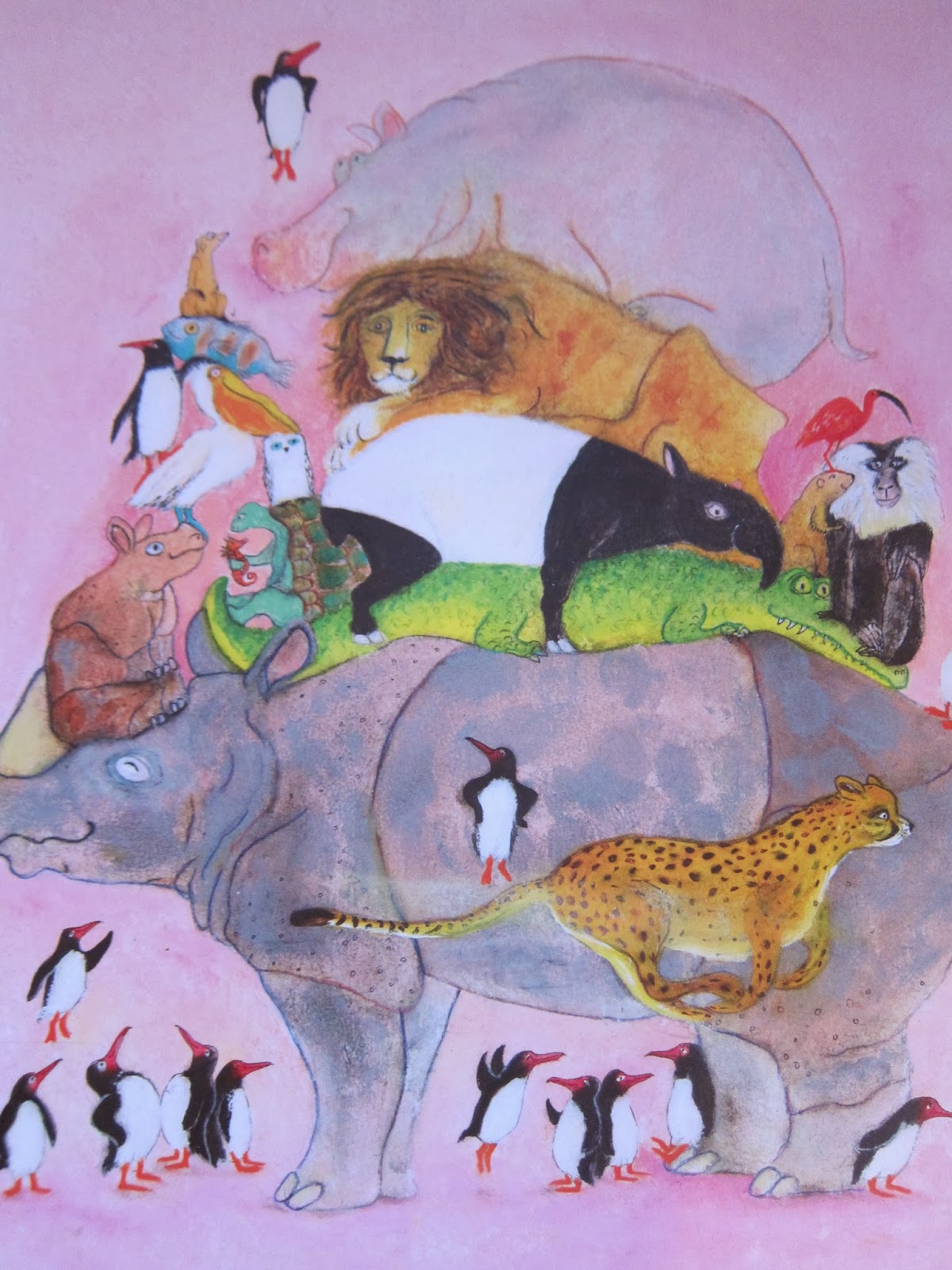
Jumping Penguins by Marije Tolman. An assortment of utterly random, bizarre and perfectly fascinating animal facts accompanied by whimsical, watercolor illustrations. You want to know how far caterpillars can throw their poop? Then this is the book for you.
Old Henry by Joan W. Blos. Henry's house doesn't look like everyone else's on his block. And apparently there is no neighborhood association to force him to mow his lawn or mend his fence. Billed as a book about different people learning to live in harmony, I saw this more as a comforting book for the messy among us and an ode to how important community is.
Arthur and the Sword by Robert Sabuda. Retold by Robert Sabuda and illustrated in his distinctive stained-glass style, this version was an excellent introduction to the folktale of King Arthur. It is, however, the story only of Arthur and the sword - it does not tell the further tales of King Arthur and his court.
Wild by Emily Hughes. After quite a bit of hype I was disappointed by this book. The story of a child who is left in the woods and raised by animals, found by people and returned to "civilization," and, unable to adapt, returned to the forest, was, in my opinion, lacking in plot. I can't see this one appealing to kids.
One Grain of Rice: A Mathematical Folktale by Demi. This is a beautifully illustrated version of a folktale which teaches the mathematical concept that doubling causes numbers to grow incredibly quickly. The illustrations and folktale setting may even entrance the math phobic!
Brush of the Gods by Lenore Look, illustrated by Meilo So. This picture book by Lenore Look, author of the chapter book series Ruby Lu (enjoyed by my older daughter last year), captivated my 6-year-old. Using the limited available knowledge about the life of the famous Chinese painter Wu Daozi, Look tells a story about the power of art, as Wu's paintings, in her telling, literally come alive.
Christina Katerina and the Box by (well-known children's book editor) Patricia Lee Gauch. Another favorite of my kindergartener about the power of imagination. A forgotten classic, its place usurped recently by other books of the same ilk such as Not a Box by Antoinette Portis and The Nowhere Box by Sam Zuppardi.
Forever by Emma Dodd. This plotless promise of unconditional love from a mama polar bear to her cub is set against an Arctic landscape which is brought to shimmering life with shiny foil illustrations. A bit gimmicky, but I fell for it anyway!
When Jessie Came Across the Sea by Amy Hest. In this beautiful story about a Jewish immigrant to America, a grandmother's bond with her granddaughter cannot be severed by time or distance. An object - here a wedding ring - represents home, family, and history. Other books with these themes include Patricia Polacco's The Keeping Quilt and The Blessing Cup and Dan Yaccarino's All the Way to America: The Story of a Big Italian Family and a Little Shovel.
My Name is Yoon by Helen Recorvits. Another touching immigrant story about the power of names and family history.
What are you reading?
| The dough rises. And rises. And rises. |
Old Henry by Joan W. Blos. Henry's house doesn't look like everyone else's on his block. And apparently there is no neighborhood association to force him to mow his lawn or mend his fence. Billed as a book about different people learning to live in harmony, I saw this more as a comforting book for the messy among us and an ode to how important community is.
One Grain of Rice: A Mathematical Folktale by Demi. This is a beautifully illustrated version of a folktale which teaches the mathematical concept that doubling causes numbers to grow incredibly quickly. The illustrations and folktale setting may even entrance the math phobic!
Christina Katerina and the Box by (well-known children's book editor) Patricia Lee Gauch. Another favorite of my kindergartener about the power of imagination. A forgotten classic, its place usurped recently by other books of the same ilk such as Not a Box by Antoinette Portis and The Nowhere Box by Sam Zuppardi.
When Jessie Came Across the Sea by Amy Hest. In this beautiful story about a Jewish immigrant to America, a grandmother's bond with her granddaughter cannot be severed by time or distance. An object - here a wedding ring - represents home, family, and history. Other books with these themes include Patricia Polacco's The Keeping Quilt and The Blessing Cup and Dan Yaccarino's All the Way to America: The Story of a Big Italian Family and a Little Shovel.
What are you reading?
Wednesday, January 8, 2014
Birthday Books and Inscriptions for a Six-Year-Old
Six years ago today, it was close to 60 degrees. I know this because it was the day I brought home my younger daughter from the hospital. Despite the weather, I insisted on dressing her in the same pink, fleecy bunting, I'd come home from the hospital in nearly 33 years before.
Regular readers know that I always write inscriptions on the books I give my daughters for their birthdays. Today my younger daughter turned 6. I only gave her two books, with two more to follow which align thematically with a gift that my parents will give her this weekend. I chose these two because they inspired repeated requests for reading, but I realized they dovetailed nicely with each other as they are both about sibling relationships. So without further ado, here are the two books I gave her and what I wrote in them.
The Seven Chinese Sisters. May you and your sister always find your own strengths and use them to help each other.
What books have you given as gifts? Do you inscribe them?
Saturday, December 21, 2013
Spotlight on... Patricia Polacco
| A small fraction of Polacco's books |
Ginger and Petunia. Petunia the pig impersonates her owner, the glamorous Ginger, while Ginger is away. Hysterical, with pitch-perfect illustrations.
Someone for Mr. Sussman. The narrator's bubbeh (grandmother) is a matchmaker who is secretly in love with her most difficult client. She tries to change herself to fit his every whim (he wants someone who bakes, no, someone who exercises, no, someone who loves blue, no, someone who dances), only to learn in the end, of course, that it is best to be herself. Yet the book is so funny that the lesson doesn't seem trite. As Bubbeh herself says, "No pot is so crooked that there isn't a lid to fit it!"
Rotten Richie and the Ultimate Dare. Patricia and her brother fight over whose avocation is more physically challenging - hockey or ballet. Their wise mother makes each of them try the other's in order to settle the dispute. As with many of her autobiographical picture books, the endpapers are decorated with real photos of Polacco and her family, which I just love.
Emma Kate. This book's surprise ending following a seemingly typical story about an imaginary friend is just delightful.
What are your favorite Patricia Polacco books?
Can you think of any other picture book author with a range even close to hers?
Thursday, December 19, 2013
Dear All Teachers
Thank you for:
- Teaching reading, writing, and 'rithmetic
- Drying tears
- Making school fun
- Tying shoes
- Cultivating friendships, not competitive
- Introducing kids to great books
- Cultivating a love of art, music, and dance
- Getting to know our children individually
- Being our partners in education
- Fostering curiosity, creativity, and a love of learning
- Using your creativity
- Employing your professional judgment and expertise
- Remembering what is developmentally appropriate
- And much more!
Wednesday, December 18, 2013
An Open Letter Re Education
I sent this today to Mayor-Elect Bill de Blasio and a slew of other government and school officials.
Dear Mayor-Elect de Blasio,
I write to you as a parent of two NYC public school children
(3rd grade and kindergarten), the daughter of two NYC public school
teachers, a proud NYC public school graduate, and a concerned citizen. My children have had, to date, wonderful
teachers. But the current atmosphere of
education “reform” is making it almost impossible for those teachers to do
their jobs. With that in mind, I ask you
to take action on the following education issues.
1
There
need to be fewer, shorter, better designed tests which count for less in
evaluating both our students and our teachers. Class time devoted to test preparation – for
any test – should be reduced and class time devoted to learning, discussion,
questioning, and the arts should be restored.
2
The DOE
should give schools a set amount of money to purchase any curriculum they choose. There should not be certain subsidized
curricula. This subsidization results in
schools like my daughters’ purchasing substandard curricula such as Pearson’s
ReadyGen ELA curriculum. In addition to
being poorly designed, with books that are not age-appropriate, lessons which
are too long (90 minutes!) and too boring (how many times can you answer the
questions: what did you read, what did you learn, what questions do you have;
they read each text three times), as
of the middle of this school year, this curriculum is not complete and the schools do not have all their materials in
their possession. It is impossible for
teachers to become familiar with the materials, make a considered judgment
about them, modify the curriculum as appropriate, and teach without the materials. But our local school purchased it because it
was subsidized and any other choice was too expensive. This is shameful.
3 Once a
school chooses curricula, those curricula should be guides, not scripts and teachers should not suffer negative
repercussions if they use their own creativity and expertise to depart from
those curricula. Rather, they should be commended for doing so. For example, at my daughters’ school, the
third grade students are required to
read a book which the third grade teachers think is inappropriate on many
levels: reading level, vocabulary, context, content and literary quality. Who
should decide what book my daughter’s class reads? The answer is obvious: her teacher. Not Pearson, not the principal, and not
me. The specific book is irrelevant;
teachers are being increasingly stripped of their autonomy and
flexibility. No wonder they are
demoralized. They are professionals and
we should respect and trust their professional opinion. Moreover, teachers at my daughters’ school
have informed me that they get “in trouble” if they do things like assign
homework they created rather than assign the curriculum-created workbook
page. Those modifications should be
applauded, not excoriated.
4
Cancel
all contracts with Pearson. It is
hard for me to believe that in light of last spring’s egregious G&T scoring
errors (I was one of the parents who brought these to the attention of the DOE. Any kind of spot-checking by someone able to
do 6th grade math should have turned up the errors. Children with 99
on two portions of an exam should not end up with an overall score of 98.) and
the recent fine by the State’s Attorney’s Office because its not-for-profit arm
participated in the for-profit ventures of its corporate parent (see The New
York Times, December 12, 2013, http://www.nytimes.com/2013/12/13/nyregion/educational-publishers-charity-accused-of-seeking-profits-will-pay-millions.html?_r=2&),
the DOE does not have legal grounds to cancel Pearson’s contracts. If it does not, those contracts should not be
renewed. Pearson makes money by selling
the poorly designed, developmentally-inappropriate curricula mentioned above, and
by selling poorly designed tests. Pearson
earns its position not by competence but via lobbying and campaign
contributions (see http://influenceexplorer.com/organization/pearson-education/2ec67ad263c448739699876db162f88f ).
We should not turn education over
to for-profit companies.
5
Reduce
class size. The current cap on class size for grades 1-5 is 32 students. 32!!
My older daughter’s class is approaching that limit, with 30 children. Any teacher and any parent can tell you that
30 students and 1 teacher is just too many.
Students cannot get individualized attention, and the teacher is overwhelmed
with grading tests and homework.
6
Universal
pre-K. I fully support your proposal
to provide truly universal pre-K.
7
Reduce or
eliminate charter schools and hold the ones that exist to the same standards as
traditional public schools. Charter
schools are destroying neighborhood schools.
The lotteries by which they enlist students are, of course
self-selecting, and when students with problems – academic, behavioral, or
otherwise – enroll, they are “counseled [that is kicked] out” sending those
kids… you guessed it, back to their neighborhood schools. Charters are “sharing” space with
neighborhood schools, kicking those schools out of their own gyms, libraries,
and auditoriums. And yet studies show
that charters, on average do no better job of educating our children. This must stop. No further charters should be granted and
those that exist should not be renewed when they come up for renewal. Instead, let’s improve all our schools.
8
Appoint a
former NYC public school teacher, and preferably a current or former NYC public
school parent, as chancellor.
9
Change
the way teachers are evaluated. Of
course teachers should be evaluated. But
not primarily based on their
students’ test scores. Furthermore, it
is ridiculous that principals are made to feel they must find something –
anything -- to criticize in a teacher’s lesson, just as teachers feel compelled
to give students 3s on their earlier report cards so that when they get 4s at
the end of the year they can “show progress.”
1
The cost
of hiring substitute teachers should not be borne by individual schools. The DOE should have a fund to pay for
substitute teachers. This should not come out of individual schools’
budgets. One of the few advantages of
having system as large as NYC’s, which otherwise, quite frankly, is unwieldy
and whose size is often a disadvantage, is economies of scale: negotiating
power for purchases, but also spreading the risk of a school having teachers
who are pregnant, who have deaths in the family, and who have appendicitis (all
of which happened at our school last year!).
The likelihood is that one school may need more subs one year; fewer the
next. Spread the risk. Since these burdens currently fall on the
school, last year my daughter, then in 2nd grade, ended up spending
several days in first grade, with her classmates spread out in other classes
throughout the school, some in classes taught in a language they do not speak,
because the school ran out of money to pay for subs back in April.
1
There
should be a sliding scale of government assistance to schools, not tiers with
hard and fast cut-offs. This is not
a “tale of two cities;” it’s a tale of three cities: the poor, the wealthy, and
the middle class. My daughters’ school
has a student body which just barely misses the cut-off for Title 1 (i.e.,
poor) schools and yet does not have a student and parent body that can raise
money like truly wealthy schools. Just
as the middle class is being squeezed, so are middle class (or lower middle class)
schools – like ours. I know this is a federal
issue, but please, do what you can to create a sliding scale of government
assistance, rather than tiers with hard and fast cut-offs.
I am looking forward to a new era in public education under
your administration. Please don’t
disappoint me – or my children.
Subscribe to:
Posts (Atom)