A lot of reading, a little bit of parenting, a helping of education policy, and a taste of NYC from a library school drop-out and mom of two.
Wednesday, February 22, 2012
It's Hard Being a Big Sister
A new book of poems understands that it's hard being a big sister. Emma Dilemma: Big Sister Poems, by Kristine O'Connell George, is the picture book equivalent of a novel-in-verse. The non-rhyming poems, read together and in order, especially the last few, tell a story. That concept really excited my older daughter, who requested that we buy the book and, surprisingly, my younger daughter loved it too (she made me read it 5 times the other day - in a row!).
I love how the poems capture the contradictions and complexity of the sibling relationship. The sisters know each other better than anyone else. The elder "translates" the younger's baby talk; the younger knows when the older one needs comforting. They push each other's buttons like no one else can. The big sister experiences feelings of annoyance, guilt, responsibility and even schadenfreude. But ultimately, these sisters love each other. These poems ring true to me, both as an older sister myself and as the mother of two girls. The realistic, warm illustrations complement the poems perfectly.
I hope the author writes another set of poems from the perspective of a little sister. Here's my attempt, written from the point of view of my younger daughter:
I want to be near you.
Every second of the day and night forever.
Because you're the funnest and the smartest and you
know
everything.
You are the best at playing family and school and
when you tell me to sit
criss-cross applesauce
and not move until after recess
I always do it.
Mommy and Daddy come in and ask why
I have been sitting still
not moving for
10 minutes and I tell them,
"The teacher said 'Don't move!'"
You are only six but
you ride your bike and read
like a ten-year-old.
I want to marry you
but
Mommy says I can't.
Sunday, February 19, 2012
Library Loot #14
For the kids:
Some of these I've already reviewed here, here, and here. Others I'll be reviewing soon.
For me:
Not pictured: The Food 52 Cookbook by Amanda Hesser and Merrill Stubbs and The Table Comes First: Family, France and the Meaning of Food by Adam Gopnik. I couldn't renew these as they were on hold for someone else but I definitely want to check them out again. I didn't time to read the latter and, although I perused the former, I didn't have time to cook anything from it. I seem to remember something about crisped polenta and boozy apple cake, though.
And in case you were wondering, no, I haven't read them all. I was overly ambitious this month. I'm afraid a few of these will be going back unread. But I'll put them on hold again!
What are you and your kids reading?
Some of these I've already reviewed here, here, and here. Others I'll be reviewing soon.
For me:
Not pictured: The Food 52 Cookbook by Amanda Hesser and Merrill Stubbs and The Table Comes First: Family, France and the Meaning of Food by Adam Gopnik. I couldn't renew these as they were on hold for someone else but I definitely want to check them out again. I didn't time to read the latter and, although I perused the former, I didn't have time to cook anything from it. I seem to remember something about crisped polenta and boozy apple cake, though.
And in case you were wondering, no, I haven't read them all. I was overly ambitious this month. I'm afraid a few of these will be going back unread. But I'll put them on hold again!
What are you and your kids reading?
Thursday, February 16, 2012
Reading Is An Adventure and the Positive Power of Peer Pressure
"Mom, this book was so good I felt like I was going on the adventure!" Well, that statement which came out of my six-year-old's mouth was a far cry from her "I'm starting to hate reading these books!" of just a week earlier. The difference? The books in question, of course - and their source.
The first sentence - the one that every parent and book-lover wants to hear - was said when my daughter finished reading, by herself, the first book in the Magic Ballerina series. The book had been not only recommended to her but actually loaned to her by a friend. Twenty-four hours after giving her the book, the little girl was so anxious to know what my daughter thought, she called and left a message: "Have you finished the book yet? Do you like it?" My daughter, who had not even started the book, promptly took it to bed with her, whereupon she read it in its entirety before going to sleep. The series, by well-known dancer Darcy Bussell, is not going to win any literary awards. But it goes a long way toward filling that huge empty spot on the bookshelf between Henry and Mudge and, true middle grade fiction like say, The Year of the Dog or Ramona. The books are short (90 pages but with some illustrations and moderately large print) and extremely fast-paced with cliffhanger endings to each chapter (think The Da Vinci Code). So literary merit aside, this book - and the fact that it was recommended by a friend - got my daughter excited about reading. In my book (pun intended), that's the most important thing a book can do.
What books got your reluctant (or not-so-reluctant) child excited about reading? How did he or she come across them?
The first sentence - the one that every parent and book-lover wants to hear - was said when my daughter finished reading, by herself, the first book in the Magic Ballerina series. The book had been not only recommended to her but actually loaned to her by a friend. Twenty-four hours after giving her the book, the little girl was so anxious to know what my daughter thought, she called and left a message: "Have you finished the book yet? Do you like it?" My daughter, who had not even started the book, promptly took it to bed with her, whereupon she read it in its entirety before going to sleep. The series, by well-known dancer Darcy Bussell, is not going to win any literary awards. But it goes a long way toward filling that huge empty spot on the bookshelf between Henry and Mudge and, true middle grade fiction like say, The Year of the Dog or Ramona. The books are short (90 pages but with some illustrations and moderately large print) and extremely fast-paced with cliffhanger endings to each chapter (think The Da Vinci Code). So literary merit aside, this book - and the fact that it was recommended by a friend - got my daughter excited about reading. In my book (pun intended), that's the most important thing a book can do.
What books got your reluctant (or not-so-reluctant) child excited about reading? How did he or she come across them?
Tuesday, February 14, 2012
Pass It On!
Thanks to my fellow kidlit bloggers, three of whom independently gave me a Liebster award!!
The award is given to blogs with fewer than 200 followers. The "rules" of the award require that the awardee then pass the award along to five more bloggers, as well as thank the blogger who gave it to you. So here goes!
First, I'd like to thank Annie and Aunt, Bill Kirk Writes and Writing on the Wall for giving me this award. And now, for my chosen recipients:
Library Mice. This British blog gives me a nice peek at books that haven't made it to the U.S. yet. I especially love her Fabulous Five feature where she asks children's book authors to choose 5 children's books that were important to them or that share a theme. I couldn't find how many followers this blog has, so if I underestimated the author's readership, I hope she forgives me!
Next up, From the Mixed-Up Files. I was shocked to discover this blog has fewer than 200 followers. It's written by a group of middle-grade authors and has really opened my eyes to the world of middle-grade fiction. These authors' passion for their audience is truly inspiring. And of course, you can't beat the name of their blog!
Young Readers has great reviews of a huge variety of books, for readers from birth to age 10.
Art on the Page, a blog about children's books by a children's book illustrator. I especially like the window into the artist's techniques, particularly printmaking, which is something I know nothing about!
And finally, 32 Pages: A Passion for Picture Books. I must admit, I again took liberties here as I could not find information about this blog's readership. A great blog focused solely on picture books.
Pass it on!
The award is given to blogs with fewer than 200 followers. The "rules" of the award require that the awardee then pass the award along to five more bloggers, as well as thank the blogger who gave it to you. So here goes!
First, I'd like to thank Annie and Aunt, Bill Kirk Writes and Writing on the Wall for giving me this award. And now, for my chosen recipients:
Library Mice. This British blog gives me a nice peek at books that haven't made it to the U.S. yet. I especially love her Fabulous Five feature where she asks children's book authors to choose 5 children's books that were important to them or that share a theme. I couldn't find how many followers this blog has, so if I underestimated the author's readership, I hope she forgives me!
Next up, From the Mixed-Up Files. I was shocked to discover this blog has fewer than 200 followers. It's written by a group of middle-grade authors and has really opened my eyes to the world of middle-grade fiction. These authors' passion for their audience is truly inspiring. And of course, you can't beat the name of their blog!
Young Readers has great reviews of a huge variety of books, for readers from birth to age 10.
Art on the Page, a blog about children's books by a children's book illustrator. I especially like the window into the artist's techniques, particularly printmaking, which is something I know nothing about!
And finally, 32 Pages: A Passion for Picture Books. I must admit, I again took liberties here as I could not find information about this blog's readership. A great blog focused solely on picture books.
Pass it on!
Monday, February 13, 2012
If You Don't Have It, Read About It! Snow Edition
Here in NYC, we're suffering (yes, suffering!) from weirdly mild weather and a scarcity of snow. So, in its absence, we've been reading about snow. A poor substitute for the real thing, but these two beautiful books go a little way in alleviating my snow cravings.
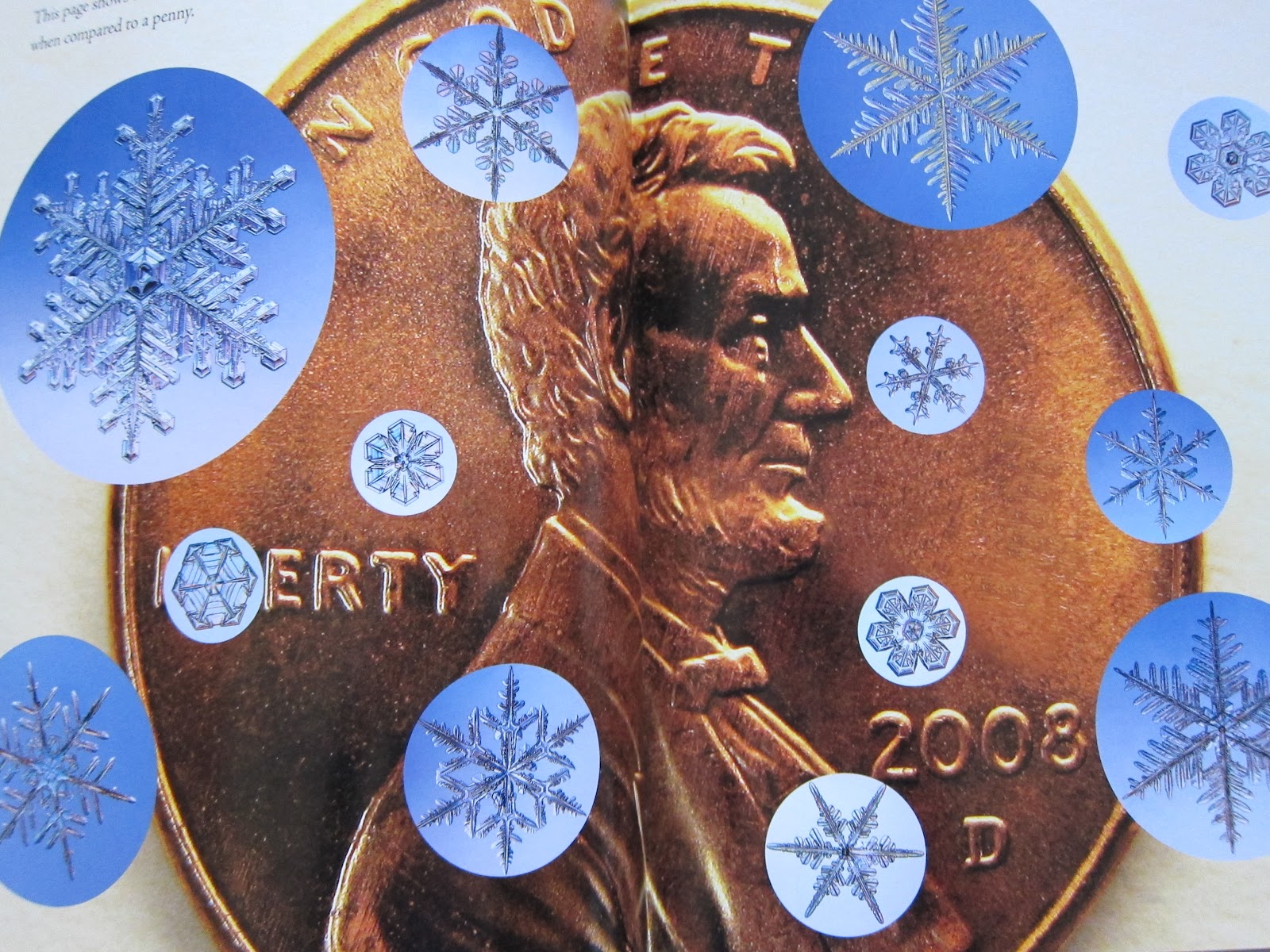
The Secret Life of a Snowflake: An Up-Close Look at the Art & Science of Snowflakes by Kenneth Libbrecht is my older daughter's favorite of the two. I think she was taken in by the unbelievable gorgeous photographs, as was I - this is one of the few books I have bought without checking it out from the library first! Dr. Libbrecht, a physics professor, photographs snowflakes with colored lights behind them, which lends them a breathtaking prismatic, rainbow effect. With several books for adults on the same topic, Dr. Libbrecht, a professor of physics at CalTech, mostly succeeds in explaining and describing snowflakes to a younger audience. I especially like the page where he shows the relative sizes of snowflakes compared to a penny. And I never knew that snowflakes come in column (pencil) shapes, or that they are often not quite symmetrical.
The Story of Snow: The Science of Winter's Wonder by Mark Cassino with Jon Nelson, PhD. is my pick. It also has beautiful, if slightly less dramatic, photos, as well as other diagrams, and the scientific explanations are a little more comprehensible to the layman (or, more importantly for our purposes, the laychild). It focuses on the same set of facts as the Libbrecht books: how snowflakes form, the different types of snowflakes, including the column-shaped ones, and the fact that snow crystals are rarely perfect (or symmetrical), among other things.
Since both books cover essentially the same ground, I would advise owning only one. Take them both out of the library and see which one you prefer.
I'm linking to Nonfiction Monday.
What is your favorite nonfiction book about snow?
The Story of Snow: The Science of Winter's Wonder by Mark Cassino with Jon Nelson, PhD. is my pick. It also has beautiful, if slightly less dramatic, photos, as well as other diagrams, and the scientific explanations are a little more comprehensible to the layman (or, more importantly for our purposes, the laychild). It focuses on the same set of facts as the Libbrecht books: how snowflakes form, the different types of snowflakes, including the column-shaped ones, and the fact that snow crystals are rarely perfect (or symmetrical), among other things.
Since both books cover essentially the same ground, I would advise owning only one. Take them both out of the library and see which one you prefer.
I'm linking to Nonfiction Monday.
What is your favorite nonfiction book about snow?
Monday, February 6, 2012
Presidential Hopefuls
I've confessed before that I don't do a lot of browsing at the library. Instead, I return my books, pick up my holds and I'm on to the next stop. But I had a few minutes the other day at the beautiful I-wish-I-could-live-there Children's Room at the 42nd Street library and serendipitously happened upon not one but two books about presidents (and/or first ladies) to complement the one I'd put on hold, just in time for Presidents' Day.
What Presidents Are Made Of by Hanoch Piven is comprised of portraits of selected presidents, along with snippets of biographical information. But these aren't your staid presidential portraits. These are collages, made with materials that Piven thought conveyed the essence of each president, like peanuts for Jimmy Carter's nose or jelly beans for Ronald Reagan's features. The biographical information isn't just the usual historical fare either but tidbits that are interesting enough to entice a child into learning more. I love the double meaning of the title! The book includes photos or paintings of all the presidents through publication date (2004) at the end. When I asked my daughter what she noticed about them she said, "They all have white faces." I pointed out that that is true no longer (a new paperback edition has come out which includes Barack Obama.), but something true then still is: they are all men.
And speaking of the lack of female presidents, Doreen Rappaport's Eleanor: Quiet No More is a wonderful introduction to a great First Lady and great humanitarian. A picture book biography which follows Eleanor from her birth to the end of her life, it includes many of her famous sayings, like "Do something every day that scares you" although it omits the famous "No one can make you feel inferior without your consent."
Finally, I had put the justly-praised Looking at Lincoln by Maira Kalman on hold and picked it just a few days ago. In her signature style, Kalman tells Lincoln's story and manages to include just the right amount of historical context combined with musings about his family life and inner that a child can relate to such as "On the day he was elected, I bet Mary made his favorite vanilla cake."
My 6-year-old, no history buff, loved all of these, and even my 4-year-old sat through them happily.
What are your favorite books about presidents or first ladies?
What Presidents Are Made Of by Hanoch Piven is comprised of portraits of selected presidents, along with snippets of biographical information. But these aren't your staid presidential portraits. These are collages, made with materials that Piven thought conveyed the essence of each president, like peanuts for Jimmy Carter's nose or jelly beans for Ronald Reagan's features. The biographical information isn't just the usual historical fare either but tidbits that are interesting enough to entice a child into learning more. I love the double meaning of the title! The book includes photos or paintings of all the presidents through publication date (2004) at the end. When I asked my daughter what she noticed about them she said, "They all have white faces." I pointed out that that is true no longer (a new paperback edition has come out which includes Barack Obama.), but something true then still is: they are all men.
And speaking of the lack of female presidents, Doreen Rappaport's Eleanor: Quiet No More is a wonderful introduction to a great First Lady and great humanitarian. A picture book biography which follows Eleanor from her birth to the end of her life, it includes many of her famous sayings, like "Do something every day that scares you" although it omits the famous "No one can make you feel inferior without your consent."
Finally, I had put the justly-praised Looking at Lincoln by Maira Kalman on hold and picked it just a few days ago. In her signature style, Kalman tells Lincoln's story and manages to include just the right amount of historical context combined with musings about his family life and inner that a child can relate to such as "On the day he was elected, I bet Mary made his favorite vanilla cake."
My 6-year-old, no history buff, loved all of these, and even my 4-year-old sat through them happily.
What are your favorite books about presidents or first ladies?
Wednesday, February 1, 2012
"I'm Starting to Hate Reading These Books!"
Yup, that's what my daughter said last night about the school books she brings home every night to read and record in her reading log. Not words any parent, especially a bookworm, wants to hear!
I don't think she hates reading in general. And I don't think she hates the books she's bringing home. It's more the fact that reading them is an obligation and that she has limited choice in what to read which makes the whole thing a chore rather than a pleasure. I did tell her she could choose something else to read and we'd record it in the reading log, but rules-following-first-child that she is, she refused.
On the upside, she actually enjoys reading many of these books once we sit down with them. They always get a smiley face rather than a sad one on the reading log! It's the idea of having to read them rather than actually reading them that she hates.
That means to me that so far this is not a problem. But I hope it doesn't become one. Any advice?
I don't think she hates reading in general. And I don't think she hates the books she's bringing home. It's more the fact that reading them is an obligation and that she has limited choice in what to read which makes the whole thing a chore rather than a pleasure. I did tell her she could choose something else to read and we'd record it in the reading log, but rules-following-first-child that she is, she refused.
On the upside, she actually enjoys reading many of these books once we sit down with them. They always get a smiley face rather than a sad one on the reading log! It's the idea of having to read them rather than actually reading them that she hates.
That means to me that so far this is not a problem. But I hope it doesn't become one. Any advice?
Subscribe to:
Posts (Atom)